Category: Revops

  • Build a Revenue Engine That Runs Without You

    Build a Revenue Engine That Runs Without You

    At Series A, the founder is almost always the best closer on the team. Not because they are uniquely talented at sales. Because they are the only person who actually understands the product, the customer, and the pitch well enough to run a complete conversation.

    That is not a compliment. That is a structural failure.

    If pipeline depends on your calendar, you do not have a revenue engine. You have a personal service business with a SaaS pricing page.

    Why Founder-Led Sales Breaks at the Worst Time

    The pattern is consistent across Seed and Series A companies. The founder closes the first 10 to 20 customers. Confidence is high. The board wants to see the number grow. You hire two AEs and an SDR. Three months later, the pipeline is thinner than before you hired them.

    Nobody did anything wrong. The problem is that the founder was running on institutional knowledge that never got documented. ICP assumptions that lived in their head. Objection handling that came from 50 conversations nobody else was on. A close that depended on the founder’s credibility, not a repeatable process.

    When you hand that off to a new rep, you are not handing off a process. You are handing off vibes. And vibes do not scale revenue.

    The question is not how to hire better salespeople. The question is how to build the system they run on. The transition from founder led to team led sales is almost always framed as a people problem. It is almost always an infrastructure problem.

    PhiOperators, not advisorsSee what your revenue system is missingIn the first conversation, we map your current GTM architecture and name the exact layer that is breaking pipeline.Book an intro

    The 5 Systems That Replace the Founder in the Pipeline

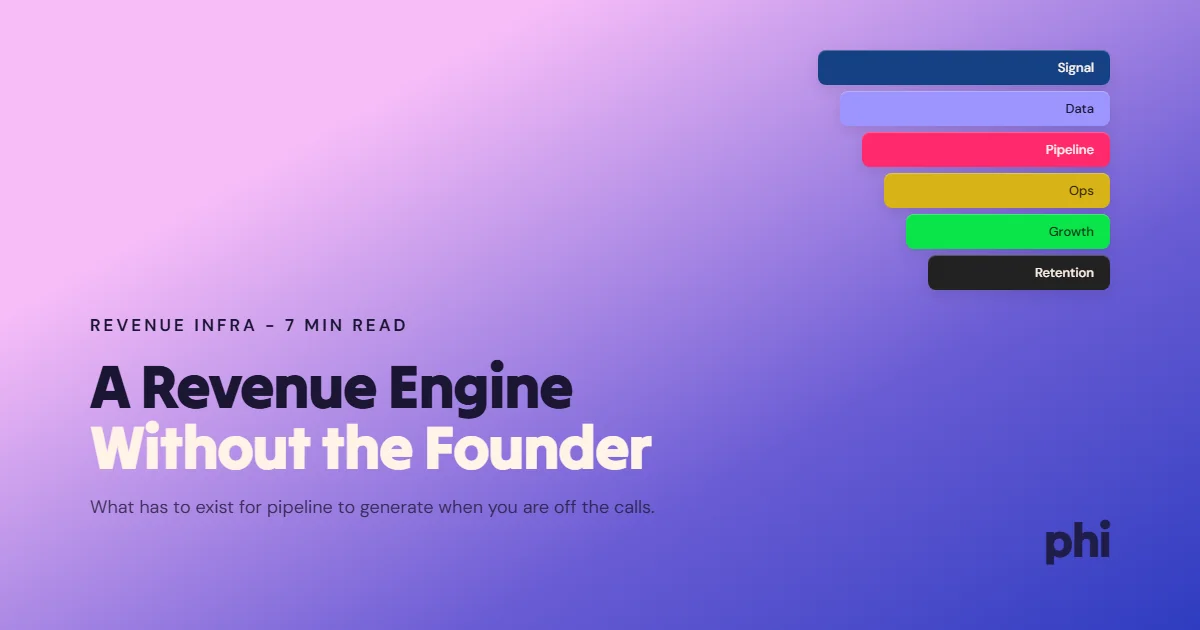
    There is no single hire that fixes founder-led sales. There is a set of systems that, when they run together, produce pipeline without your involvement. Most companies have one or two of these. Very few have all five.

    1. ICP definition with teeth. Not “companies with 50 or more employees in logistics.” A real definition: firmographic filters, technographic signals, behavioral triggers, and a clear hypothesis for why this customer buys now. The ICP lives in a document everyone can read, not in the founder’s pattern recognition. When this does not exist, every rep targets a slightly different company and generates completely different results.
    2. Outbound infrastructure, not outbound activity. Data enrichment that keeps prospect records current. Sequencing logic built around the ICP’s actual buying triggers. Multi-sender LinkedIn outreach through a tool like HeyReach so the volume is not bottlenecked by one inbox. The outbound pod is not a group of SDRs sending emails. It is a system those SDRs run on.
    3. A defined handoff protocol. The moment a lead moves from SDR to AE is where most pipeline leaks. There is no transfer of context. The AE starts from scratch. The prospect repeats themselves. The deal cools. A real handoff protocol includes a documented summary of the conversation, confirmed next steps, and a CRM record that reflects reality, not aspirations. This is an ops problem, not a people problem, and it belongs inside your sales ops layer.
    4. Pipeline visibility that does not require a meeting to understand. If you need to ask your head of sales “where are we this month,” you do not have a revenue system. You have a reporting ritual. A real RevOps layer means the CRM reflects actual deal status, attribution is connected to real channels, and the weekly number is not a negotiation. Every person on the revenue team sees the same data. More on what this actually looks like in RevOps best practices that move pipeline.
    5. A close process that does not require the founder. This is the hardest one. The close usually depends on the founder because the founder can answer any question, handle any objection, and carry the authority of the company. Replacing that requires documented objection handling, a structured discovery framework, and AEs who have been trained on real call recordings, not a one-week onboarding deck. It also requires that someone is actively reviewing calls and coaching. That coaching function is usually the first thing that disappears when the founder steps back.

    What This Actually Looks Like: Datatruck

    Datatruck came to us at zero ARR. The founder was doing everything. Good product, real market, no system.

    We built the ICP definition from scratch. We stood up the outbound infrastructure on Clay for enrichment and Instantly for sequencing. We built the CRM architecture so the pipeline was visible without anyone having to ask. We embedded a sales pod that ran the full process end to end.

    The founder stopped being the closer. The system became the closer. This is what moving from founder-led to team-led sales actually looks like in practice.

    Case StudyDatatruck: $0 to $2.5M ARR, 97% drop in CACHow replacing founder-led selling with a repeatable revenue engine led to a $12M Series A.Read the story

    The Mistake Founders Make Before They Build the System

    The default move is to hire a VP of Sales and expect them to build the system. Sometimes that works. More often, the VP inherits the same infrastructure gap the founder had, spends six months trying to figure out what is broken, and leaves before the board runs out of patience.

    Knowing how to scale a sales team is not the same as knowing how to build the system underneath it. Most VP hires are operators, not architects. They need a working system to run, not a blank canvas to design.

    The sequencing matters. Build the infrastructure first. Then hire the operators. Doing it in reverse is how you burn through $400K and end up with the founder back in the deals.

    When You Know the System Is Working

    There is a specific moment when the transition from founder-led to team-led sales has actually happened. It is not when you hit a revenue number. It is when a deal closes and you find out about it after the fact.

    You were not in the meeting. You did not send the proposal. You did not have to answer the hard question in the final call. The system ran without you and produced a closed deal.

    That is the test. Not the pipeline chart. Not the forecast call. Not how many SDRs you have. Whether pipeline generates and converts without your calendar being the critical path.

    Scaling B2B sales past founder-led selling is less about adding headcount and more about deciding, deliberately, to build something that does not need you in the room. Most founders know this. Very few actually build it before they desperately need it.

    If you are not sure which of the five systems is the weakest link in your current setup, that is usually the right place to start the conversation at Phi.
  • Five Layers Every B2B Revenue Engine Needs to Work

    Five Layers Every B2B Revenue Engine Needs to Work

    AtoB entered the fleet payments space with 77 customers and a market that had been served by the same incumbents for decades. Four years later, they held 7% of U.S. trucking market share and raised at an $800M Series B valuation. The product mattered. So did the category timing. But what actually made the revenue compound was the system underneath it.

    Most founders never build that system. They buy tools. They hire reps. They run campaigns. And when pipeline is inconsistent, they assume the problem is effort. It usually isn’t.

    A real b2b revenue engine is five stacked layers. Each layer has a failure mode that looks like a people problem but is actually a design problem. Here’s what each layer does, how it breaks, and what a working version looks like.

    Layer 1: Data

    This is the foundation. Everything above it depends on it. And most companies have no idea how bad their data actually is.

    The failure mode: your CRM is full of records nobody trusts. Titles are wrong. Companies have churned or been acquired. The ICP you defined 18 months ago hasn’t been validated against the deals you actually closed. Your outbound team is prospecting into a list that was stale before they touched it.

    A working data layer has three things. A defined, validated ICP built from closed-won data, not assumptions. A continuous enrichment process (tools like Apollo run inside our outbound pods to keep signals fresh). And a feedback loop that updates the ICP definition when the market moves.

    Bad data at this layer doesn’t just waste outbound effort. It corrupts your attribution, breaks your routing logic, and makes your reporting meaningless. Fix this first, or you’re building on sand.

    Layer 2: Channels

    Once you know who you’re going after, you need to reach them. The failure mode here isn’t using the wrong channel. It’s running channels that don’t talk to each other.

    Most B2B teams run email sequences, LinkedIn outreach, paid ads, and content in parallel. Each channel has its own owner, its own metrics, and its own definition of a lead. Marketing counts a form fill. Sales counts a meeting booked. Nobody agrees on what “pipeline” means.

    A working channel layer treats outbound and inbound as one system. Outbound surfaces the accounts. Content warms them. Paid retargets the ones who showed intent. Sequences pick up the thread. When a prospect sees your LinkedIn post, gets an email, and then sees a retargeted ad, that’s not coincidence. That’s architecture.

    The specifics depend on your stage. Early companies usually get more from outbound than inbound. Our outbound GTM pods are designed to run this as one integrated motion, not three separate workstreams owned by three different vendors.

    Layer 3: Routing

    This is the layer nobody talks about until it’s broken. And by then, revenue has already leaked.

    Routing is the set of rules that determines what happens to a lead the moment it enters your system. Who owns it? What’s the SLA to first contact? Does it go to a rep based on territory, vertical, company size? What happens if nobody picks it up in 48 hours?

    The failure mode: inbound leads sit in a queue. Hot outbound replies get routed to the wrong rep. AEs get handed accounts with no context on what the prospect already engaged with. The first conversation starts cold even though the prospect has already been through five touchpoints.

    A working routing layer is documented, automated, and owned. Not by a rep. By the system. The rules live in the CRM. The handoff triggers automatically. And there’s a fallback when the primary owner is out. A proper revenue engine b2b layer layers all five of these on top of each other. Building a revenue engine is not a marketing project. It is an infrastructure project.

    This is where sales ops earns its cost. Not in building reports, but in building the logic that makes sure every qualified signal gets the right human response in the right window.

    PhiOperators, not advisorsSee which layer is breaking your pipelineWe’ll walk through your current system and show you exactly where revenue is leaking before you book another rep.Book an intro

    Layer 4: CRM Architecture

    Your CRM is not a database. It’s the operating system for your revenue team. Most companies treat it like a database. That’s the problem.

    The failure mode: deals are created inconsistently. Stages don’t map to actual buyer behavior. There’s no standard for what moves a deal from one stage to the next, so two reps at the same company have completely different stage definitions in their heads. Close dates are guesses. Forecast accuracy is a joke.

    A working CRM architecture starts with stage definitions that reflect reality. Each stage has an entry criterion (what has to be true for a deal to be here) and an exit criterion (what has to happen to move it forward). Fields are standardized. Workflows are automated. The CRM reflects what’s actually happening in the market, not what reps remembered to log.

    This is what RevOps is actually for. Not dashboards. The architecture underneath the dashboards. If you want to know more about how this function works and why most teams underinvest in it, this post breaks it down.

    AtoB’s revenue system was built on CRM architecture that connected outbound signals to deal stage progression to CS handoffs. When you’re scaling from 77 customers to 7% market share, you cannot rely on reps remembering to update records. The system has to enforce consistency.

    Case StudyAtoB: 77 customers to 7% U.S. trucking market shareThis is what happens when all five layers work together inside a single vertical.Read the story

    Layer 5: Reporting Loops

    The fifth layer is where most companies declare victory too early. They build a dashboard. They look at it in the weekly sales meeting. And then nothing changes based on what they see.

    That’s not a reporting loop. That’s a reporting display.

    The failure mode: metrics are tracked but not acted on. You know your open rate dropped. You don’t know why, and nobody owns figuring it out. You know conversion from meeting to proposal is low, but there’s no structured process for diagnosing what changed. Data accumulates without informing decisions.

    A working reporting loop closes the gap between signal and action. When outbound reply rates drop below threshold, the sequence gets reviewed within the week. When a deal stage conversion drops, the rep and their manager review call recordings together. When CAC rises month over month, the ICP definition gets interrogated.

    The companies that have tools but no real system almost always break here. The tools generate data. Nobody has designed the process for turning that data into better decisions. So the system never learns, and results plateau.

    The Sequence Matters

    These five layers aren’t a checklist you can work through in any order. They’re a stack. Each layer depends on the one below it.

    LayerWhat breaks without itWho owns the fix
    1. DataOutbound hits the wrong accounts. Enrichment fails. ICP drifts.RevOps + outbound pod
    2. ChannelsVolume without attribution. Marketing and sales blame each other.GTM architecture
    3. RoutingLeads go cold. Reps work the same account twice. Revenue leaks silently.Sales ops
    4. CRM ArchitectureForecasts are fiction. Deal stage means nothing. Handoffs break.RevOps
    5. Reporting LoopsSystem never learns. Results plateau. Fixes target symptoms, not causes.RevOps + leadership

    Building a revenue machine means building all five. Skip a layer and the ones above it underperform. It’s not a people problem. It’s a sequence problem.

    Most teams have at least three of these layers in some form. The question is whether they’re connected. If your answer is “sort of,” that’s the gap where revenue is disappearing right now.

  • AI Agents in RevOps: What They Actually Fix Today

    AI Agents in RevOps: What They Actually Fix Today

    Half the RevOps vendors in your inbox right now are calling their product an “AI agent.” Most of them mean they added a GPT wrapper to a Zapier flow. The other half built something that genuinely removes human bottlenecks. Telling them apart is the actual problem.

    This is a post about that distinction. Not an AI hype piece. Not a dismissal either. A practical split between what AI agents in RevOps can actually do today versus what still breaks the moment a human steps away.

    The Four Things Agents Actually Handle

    Revenue operations automation has a real use case in four narrow areas. These aren’t edge cases. They’re high-volume, low-judgment tasks that eat 30-40% of a RevOps operator’s week when done manually.

    Data enrichment. Pulling firmographic and contact data, filling gaps in your CRM, scoring records against your ICP definition. Clay does this well when your inputs are clean. The agent runs enrichment on net-new records the moment they hit your system. No human touches the row until it’s complete.

    Lead routing. Territory-based, segment-based, or round-robin assignment. If the logic is deterministic, an agent runs it faster and more consistently than a human checking a spreadsheet. The error rate on manual routing in companies with 3+ territories is significant. Agents get this right because there’s no ambiguity in the rule set.

    Activity logging. Calls, emails, meetings. Syncing them from your sequencing tools into your CRM without a rep remembering to do it. This sounds trivial. It isn’t. Bad activity data is why most RevOps reporting is wrong. Agents log automatically. The pipeline visibility that comes from clean activity data changes how your whole team reads the funnel.

    Follow-up drafting. Pulling context from the CRM, the last call transcript, and the deal stage, then generating a draft follow-up email for the AE to review and send. Not auto-sending. Drafting. The human still approves. But the cognitive load drops by 80% and follow-ups actually happen on time.

    Where the Vaporware Lives

    The vendors stop giving specifics here. Watch for it.

    Deal strategy requires context that agents don’t have. Who’s the real champion in the account? Is the procurement delay a budget issue or a political one? Is the competitor named in the deal actually a threat or just a negotiating tactic? These are judgment calls. An agent can surface the data. It cannot tell you what it means.

    Exception handling is worse. The moment something falls outside the defined logic, an agent either applies the wrong rule or does nothing. A lead that matches two territories. A deal that should skip a stage. A renewal where the billing contact left the company last month. Every one of these requires a human who understands the system well enough to override it correctly. Agents flag exceptions poorly and resolve them worse.

    Forecast calls are the clearest example of where revenue operations still needs humans. Agents can surface the numbers. They cannot read the room. They don’t know which rep sandbagging their pipeline. They don’t know that the account an AE just called “likely to close” has been “likely to close” for three consecutive quarters.

    PhiOperators, not advisorsWe’ll map where agents fit your stackFirst conversation surfaces exactly which RevOps tasks in your system are ready for automation and which ones will break if you pull the human out.Book an intro

    A Decision Matrix for n8n + Clay Stacks

    If you’re evaluating ai revops tooling right now, this is the frame that actually helps. Run every candidate task through two questions: How deterministic is the logic? What breaks if the agent gets it wrong?

    TaskLogic deterministic?Cost of agent errorAutomate?
    Data enrichmentYesLow (fixable)Yes
    Lead routingYes (if rules are defined)Medium (misrouted deals)Yes, with audit trail
    Activity loggingYesLowYes
    Follow-up draftingMostlyLow (human reviews)Yes, human-in-loop
    Deal stage progressionPartiallyHigh (bad pipeline data)No, flag only
    Exception handlingNoHighNo
    Forecast callsNoVery highNo
    Deal strategyNoVery highNo

    The pattern is consistent. Agents earn their place when logic is deterministic and errors are cheap to catch and reverse. They earn nothing in situations where ambiguity is the whole point.

    What n8n + Clay Actually Looks Like in Practice

    When we build outbound pods for clients, the agent layer handles enrichment and sequencing triggers. Clay pulls firmographic and intent data. n8n routes the enriched records into the right sequence in Instantly based on segment. The humans on the pod handle ICP refinement, message strategy, and any account that behaves unexpectedly.

    That split is not arbitrary. It reflects where human time is actually worth spending in a revenue operations automation stack. Enrichment is rote. ICP refinement is not. Routing is rote. Noticing that a full segment stopped replying and diagnosing why is not. RevOps automation is not the same as agent autonomy. Most of what we deploy is deterministic, and the agent surface sits on top.

    The companies that implement this badly are the ones that automate the judgment calls first because those feel like the most painful bottlenecks. They are painful. But they’re painful because they’re hard, not because they’re manual. Making them automated doesn’t make them easier. It makes the errors invisible.

    Case StudyAtoB: 77 customers to 7% U.S. trucking market shareThe RevOps system we built for AtoB connected outbound infrastructure, CRM architecture, and activity logging into one operating layer, so the team had clean data at every stage of the funnel.Read the story

    The Real Question to Ask Before You Buy

    Most founders evaluating ai agents and revops tooling ask “can this tool do X?” That’s the wrong question. The right question is “what does my team do when this tool does X wrong?”

    If your answer is “we’ll catch it in the weekly pipeline review,” you’ve just described a system with a week-long lag on every agent error. That’s not ai revops. That’s automation with a delayed human override, which is often worse than no automation at all because errors compound before anyone sees them.

    If your answer is “the agent flags it for human review before acting,” you’ve built something that actually works. The human stays in the loop on ambiguity. The agent handles volume. That’s the right architecture.

    The vendors selling you “fully autonomous RevOps” are the ones to be skeptical of. Not because agents aren’t powerful. Because “fully autonomous” in a revenue system means “nobody’s accountable when it breaks.” And in revenue, things break constantly. That’s why the job exists.

    Build the agent layer for what it’s good at. Keep humans where judgment lives. If you’re not sure where that line sits in your specific stack, that’s the conversation worth having before you sign the contract.

  • Where Your Pipeline Actually Leaks (It’s Not Your Sales Team)

    Where Your Pipeline Actually Leaks (It’s Not Your Sales Team)

    Most founders, when pipeline stalls, look at their reps. Are they sending enough emails? Are the call numbers up? Is the close rate acceptable? Then they hire a sales coach or fire the SDR lead and reset the clock.

    The pipeline problem is almost never the people. It’s the system they’re plugged into.

    A real revenue audit doesn’t start with rep activity. It starts with the infrastructure underneath the reps: data quality, CRM architecture, handoff protocols, attribution logic, and the visibility layer that tells you what’s actually working. When those break, every rep in the org is flying blind and you’re diagnosing the wrong patient.

    Here are the six places pipeline leaks before it ever reaches a conversation. Walk through these in order before you touch headcount.

    1. Lead Data Quality: The Leak Nobody Measures

    Your sequences aren’t underperforming because the copy is bad. In most cases, they’re underperforming because 30 to 40 percent of the contact data feeding them is stale, incomplete, or miscategorized.

    Check your bounce rate on outbound email. Anything above 5 percent is a signal your data layer has a problem. Check how many records in your CRM are missing firmographic fields, like employee count, revenue range, or tech stack. If your outbound pod is running sequences without enriched ICP data, they’re generating noise, not pipeline.

    The diagnostic question: can your team pull a clean list of 500 ICP accounts with verified contacts, job titles, and technographic fit in under an hour? If the answer is no, your revops strategy has a data problem, not a messaging problem.

    Apollo in the Phi stackOur outbound pods use Apollo to pull verified contacts and layer in firmographic data before any sequence touches a prospect.See how we use it

    2. CRM Architecture: Are You Tracking Deals or Creating the Illusion of Tracking?

    Open your CRM right now and answer three questions. What percentage of open opportunities have a defined next step with a date attached? What percentage of closed-lost deals have a documented reason? And how many deals in your pipeline haven’t been touched in more than 14 days?

    If you can’t answer all three in under two minutes, your CRM is a contact database, not a revenue operating system.

    Bad CRM architecture creates three specific failure modes: reps work the deals they’re comfortable with instead of the ones that need action, managers run forecasts based on gut feel instead of stage data, and nobody can trace why a deal went cold because the history isn’t there. The RevOps pod exists specifically to fix this, building stage definitions, field requirements, and automation workflows that enforce the discipline the CRM was supposed to create.

    3. MQL-to-SQL Handoff: The Dead Zone Where Leads Go to Die

    Marketing sends a list. Sales ignores half of it. Marketing blames sales for not following up. Sales blames marketing for sending garbage leads. This conversation happens every week at companies of every size and it never gets resolved because nobody has defined what a qualified handoff actually looks like.

    The specific things to check here:

    1. Is there a documented SLA for how fast sales must contact a marketing-sourced lead? (The industry benchmark is under five minutes for inbound. Most teams are at 24-plus hours.)
    2. Do MQLs have a minimum data threshold before they route to sales? (Job title, company size, and intent signal at minimum.)
    3. Is there a feedback loop from sales back to marketing on lead quality? Or does that feedback happen in quarterly reviews and get ignored?
    4. What happens to an MQL that sales doesn’t contact within the SLA window? Does it route to a nurture sequence or fall into a void?

    If you don’t have written answers to all four, you have a handoff problem. Your marketing operations and your sales ops need to be one connected system, not two teams with adjacent spreadsheets.

    4. Attribution: You’re Measuring the Last Click, Not the System

    Most B2B companies attribute closed deals to the last marketing touchpoint or the SDR who sent the final email. This tells you almost nothing useful.

    A deal that closed from an outbound sequence touched the prospect through LinkedIn content first, a cold email second, a case study third, and a referral fourth. If your revops roadmap only credits the email that got the reply, you’ll defund LinkedIn, deprioritize content, and cut the referral program. Then you’ll wonder why outbound starts underperforming six months later.

    The fix isn’t a fancier attribution tool. It’s first-touch, multi-touch, and pipeline-influenced attribution running simultaneously, with someone accountable for interpreting the data and translating it into channel decisions. That’s a RevOps function, and most early-stage companies don’t have it.

    PhiOperators, not advisorsRun the revenue audit with operators who fix it afterIn the first conversation, we map your specific leak points and tell you which ones are costing you the most pipeline right now.Book an intro

    5. Handoff from Sales to Customer Success: Where Expansion Revenue Disappears

    The handoff from a closed deal to your CS team is one of the most ignored leak points in B2B revenue. The AE closes, throws the account into an onboarding queue, and moves on. CS inherits a customer they know nothing about, with no context on what was promised during the sale, no visibility into the technical environment, and no playbook for the first 30 days.

    The result: slower time-to-value, lower CSAT scores, and reduced expansion potential. The customer that was supposed to grow into a $200K account renews flat because nobody was tracking health signals in the first 90 days.

    This is precisely what the CS pod fixed at AtoB. Retention systems, onboarding workflows, and health scoring built across thousands of fleets. The outcome was a 40% CSAT improvement.

    Case StudyAtoB: 40% CSAT improvement across thousands of fleetsPhi built AtoB’s retention engine from scratch, connecting onboarding workflows to health scoring so no account went dark in the critical first 90 days.Read the story

    6. Reporting and Visibility: The Audit Nobody Wants to Run

    The final leak point is the one that makes all the others invisible: you don’t have a reporting layer that shows you where pipeline is dying in real time.

    Pull your pipeline velocity report. If you don’t have one, that’s the answer. Pull your stage conversion rates for the last 90 days. If they aren’t tracked by rep, by segment, and by source, you can’t diagnose anything. Pull your average time-in-stage. If deals are sitting in “Proposal Sent” for 30-plus days with no activity logged, something upstream is broken and nobody knows it yet.

    A working revops strategy gives leadership one dashboard that answers four questions: how much pipeline do we have, where is it stalling, what’s the source quality, and what does the next 90 days look like? If your current setup can’t answer those four questions in a single view, you’re making revenue decisions without data. You’re not operating a system. You’re running on feel.

    The companies we work with don’t hire us to diagnose their revenue system and hand them a deck. They bring in the RevOps pod to build the reporting infrastructure, fix the CRM architecture, close the handoff gaps, and run the operation going forward. That’s different from revops consulting or revenue operations consulting services that map the problem and leave. We’re in the system with you.

    If you’re reading this checklist and recognizing your own pipeline, the useful next question isn’t “which of these do we have?” It’s “which one is costing us the most right now?” That’s where the audit starts.

  • Automated Lead Generation vs. Human Touch: The 2026 Decision Framework

    Automated Lead Generation vs. Human Touch: The 2026 Decision Framework

    Most B2B teams are caught between two bad extremes. One camp automates everything and wonders why reply rates collapsed. The other refuses to automate anything and burns SDR hours on work a script could handle in seconds.

    The truth sits in the middle. Automated lead generation works brilliantly for volume, enrichment, and routing. It fails the moment a human buyer needs to feel understood. This guide draws the line for you: what to hand to machines, what to keep human, and how to stitch both into a pipeline that actually converts in 2026.

    The Core Principle: Automate Inputs, Humanize Decisions

    Think of your funnel as a factory floor. Machines handle the repetitive, rules-based work. Humans handle the judgment calls.

    Automate anything that is:

    • High-volume and repetitive
    • Rules-based with clear inputs and outputs
    • Time-sensitive (needs to happen in seconds)
    • Not dependent on emotional intelligence

    Keep human anything that is:

    • Judgment-heavy or context-dependent
    • Relationship-defining (first real conversation, objection handling)
    • Creative (messaging strategy, positioning shifts)
    • Trust-building with senior buyers

    This is the same logic that shapes a healthy revenue operating system from seed to Series B machines run the rails, humans run the relationships.

    What to Automate in Lead Generation

    Here is where lead gen automation pays back within weeks, not quarters.

    1. Prospect Sourcing and Enrichment

    Pulling contacts from databases, scraping LinkedIn, appending firmographic data, and verifying emails, all of this is mechanical work. AI lead generation tools can build a 500-account list with verified decision-maker contacts in the time it takes an SDR to finish coffee.

    2. Data Hygiene and Routing

    Lead scoring, list deduplication, territory routing, CRM updates. Zero creative input required. Automation here prevents the data decay that silently kills pipelines. For a deeper view, see our RevOps best practices that move the pipeline.

    3. Sequencing and Cadence Execution

    Sending the email. Following up on day 3, 7, and 14. Logging the activity. Pausing the sequence when someone replies. These are tasks your SDRs should never touch manually.

    4. Intent and Behavioral Signal Capture

    Website visits, content downloads, pricing page views, G2 comparisons. Track these automatically and feed them to reps as trigger events.

    5. Meeting Scheduling and Reminders

    Calendar links, automated confirmations, reminder SMS. Friction here costs you show-rates. B2B appointment setting services lean heavily on this layer.

    What to Keep Human in Lead Generation

    Here is where automated lead gen tools break down and destroy your brand quietly.

    1. Opening Message Strategy

    The first sentence of a cold outreach is not a templating exercise. It is a positioning decision. A human needs to craft the angle, the hook, and the proof point. AI can generate 50 variants, but a human picks the one that actually lands.

    2. Objection Handling and Mid-Funnel Conversations

    The moment a prospect pushes back, writes a two-line reply with a real concern, or asks a sharp question, you need a human. No AI today handles nuance well enough to protect a deal in motion. This is covered in our guide on outbound prospecting techniques for B2B meetings.

    3. ICP Refinement and Positioning Shifts

    Noticing that your best customers share a trait nobody has spotted yet. Deciding to retire a segment. Rewriting your value prop after losing three deals in a row. Judgment work, entirely.

    4. Senior-Buyer Conversations

    If you are selling into a B2B buying committee, the CFO does not want an AI-written email. They want a human who understands their board dynamics.

    5. Strategic Account Research

    For top-tier accounts, deep research beats volume every time. A human reading a 10-K, scanning earnings calls, and pulling the right angle will out-convert a 10,000-contact blast.

    The Automate vs. Keep Human Matrix

    TaskAutomateKeep HumanWhy
    Contact sourcingYesNoHigh volume, rules-based
    Email verificationYesNoMechanical
    Initial outreach copy strategyNoYesPositioning decision
    Sequence executionYesNoRepetitive
    Reply handling (first touch)NoYesNuance required
    Meeting bookingYesNoFriction reduction
    Discovery callsNoYesRelationship-defining
    Lead scoringYesNoRules-based
    Account research (top 50)NoYesStrategic judgment
    CRM data updatesYesNoRepetitive

    How AI Changes the Equation in 2026

    AI lead generation has blurred the line, but not erased it. What changed:

    • AI now drafts personalization at scale. But a human still needs to approve the angle and quality-check the output before it hits an inbox.
    • AI can qualify inbound leads. But humans still own the transition from qualified to booked.
    • AI handles Tier 3 accounts well. Tier 1 and 2 still need humans in the loop.

    The rule: let AI do the first draft, the first pass, the first filter. Humans own the last mile. For a deeper look, see our AI deep research playbook for GTM executives.

    The Risks of Over-Automating

    Teams that automate past the line usually see three things break:

    Reply rates crash. Prospects sniff out generic outreach in two seconds and block the domain.

    Brand damage compounds. Every bad email trains your market to ignore you. Domain warming and reputation recovery take months.

    Pipeline quality degrades. Volume goes up, qualified meetings go down. You end up paying SDRs to sit on bad calls.

    This is why choosing a lead generation agency without getting burned matters so much; many agencies hide behind automation to inflate metrics.

    The Hybrid Model That Actually Works

    The best-performing teams run a three-layer stack:

    1. Automation layer: sourcing, enrichment, routing, sequencing, tracking
    2. AI-assist layer: first-draft copy, account research summaries, reply triage
    3. Human layer: strategy, objection handling, senior conversations, closing

    Each layer feeds the next. Automation generates the list. AI prepares the context. Humans execute the moments that matter. See our breakdown of how B2B sales outsourcing works for how this splits across teams.

    How Phi Helps

    Phi deploys GTM pods (SDRs, AEs, GTM Engineers, RevOps operators) that plug directly into your revenue architecture. We are not an agency selling hours and we are not a staffing firm placing bodies. Stripe did not sell you a payment button it gave you payment infrastructure. Phi gives you revenue infrastructure.

    Our pods run the hybrid model by default: automation handles the rails, AI handles the prep, our humans handle the conversations that decide deals. Clients like TruckX scaled from $2M to $16M ARR in 18 months on exactly this split. Book a meeting if you want to see how it would wire into your pipeline.

  • What Is RevOps and Why Every B2B Company Needs It Now

    What Is RevOps and Why Every B2B Company Needs It Now

    It's Tuesday afternoon. Sales says there's $400K in pipeline. Marketing says it's $600K. The CRM says $290K.

    The CRO is on Slack asking which number to bring to the board. Nobody has a confident answer.

    This is the moment most founders first feel the absence of RevOps. Not when they read a definition. When three people report three different versions of the same quarter and the founder is the only one who can stitch the truth together.

    The wrong question

    Most founders Google "what is revops" and get definitions written by the same software companies trying to sell them another platform. The definitions land in two flavors. Too abstract: "the alignment of sales, marketing, and customer success." Too tactical: "the function that manages your revenue tech stack."

    Neither tells you what RevOps actually does on a Tuesday afternoon when your three teams report three different numbers.

    The better question is what breaks in a company without RevOps, and what the function exists to fix.

    Three symptoms you already feel

    The first symptom is that every team reports different revenue numbers. Sales pulls from their pipeline view. Marketing pulls from their attribution tool. CS pulls from the renewal forecast. Each team has its own definition of "qualified," "active," and "at risk." Nobody owns the source of truth, so there isn't one.

    The second symptom is that handoffs leak. Marketing-qualified leads die between marketing and sales because nobody agrees what MQL means. Closed-won deals get fumbled between sales and CS because the handoff lives in someone's head. Revenue falls through the cracks between teams because nobody owns the cracks.

    The third symptom is that the founder is still the most informed person about pipeline. Not because they're the best operator. Because they're the only one who can manually synthesize data from four systems into one mental model. The CRM should do this. It doesn't, because nobody has been accountable for making it.

    These are not sales problems. They're not marketing problems. They're not CS problems.

    They are RevOps problems. And they exist whether or not anyone in your company has the title.

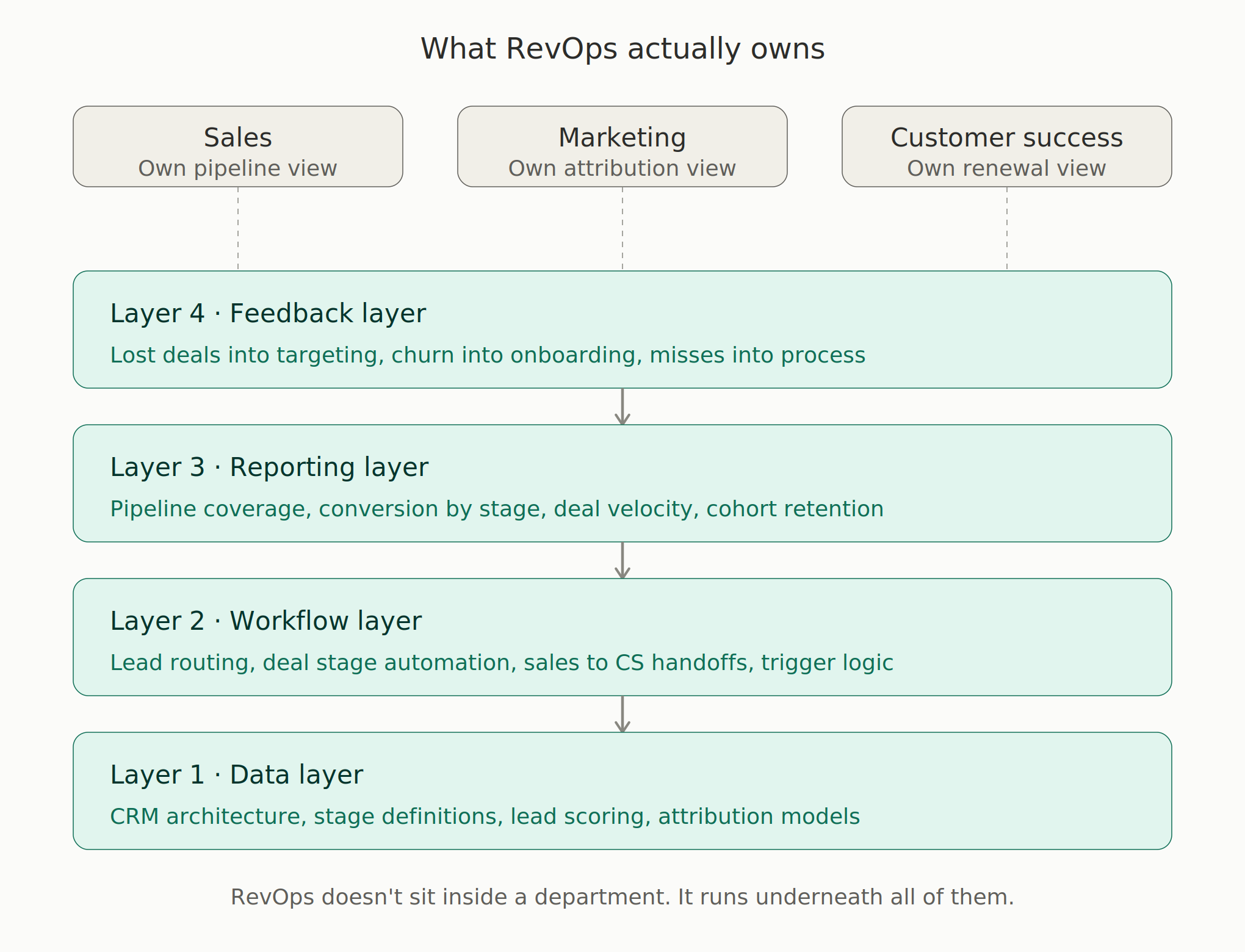
    What RevOps actually owns

    Define RevOps not by what it is, but by what it owns.

    RevOps owns the data layer: CRM architecture, pipeline stage definitions, lead scoring logic, attribution models, data hygiene. The single source of truth that every other team operates from.

    RevOps owns the workflow layer: how leads route, how deals progress through stages, what triggers automation, what requires human judgment, how the handoff from sales to CS actually works in practice instead of in a Notion doc nobody reads.

    RevOps owns the reporting layer. Not just dashboards. The architecture of how the company sees itself. Pipeline coverage. Conversion rates by stage. Deal velocity. Cohort retention. The numbers that drive decisions, built on definitions everyone agrees on.

    RevOps owns the feedback layer: the loops that turn lost deals into changes in targeting, churned customers into changes in onboarding, missed targets into changes in process. This is the layer that makes revenue compound instead of plateau.

    Each layer depends on the one underneath it. Reporting is meaningless without clean data. Workflows break without reliable reporting. Feedback loops never close without all three operating together. This is why RevOps cannot be a side project for a Salesforce admin. It's an operating layer.

    original 1
    original 1

    When you need it (and what bad RevOps looks like)

    Founders ask when they should hire RevOps. The honest answer is that you needed it the moment you had more than one channel feeding pipeline and more than one person closing deals.

    Most companies ignore it until $3M to $5M ARR. By that point, their CRM data has been corrupted for two quarters and it takes another six months to clean. The cost of waiting compounds quietly.

    But hiring the wrong RevOps person is worse than not hiring one. Bad RevOps looks like a Salesforce admin who builds reports nobody uses, takes tickets from sales reps, and slowly becomes the person you ask to "pull a list." Good RevOps looks like an operator who can tell you why your sales cycle just got 14 days longer and which two stages of your sequence to rebuild to fix it.

    Bad RevOps reacts to requests. Good RevOps owns the system and proactively rebuilds the pieces that are degrading.

    The hiring trap

    Most companies try to solve this with one person. A "RevOps Manager" who is supposed to be a Salesforce admin, an analyst, an automation engineer, and a strategist at once.

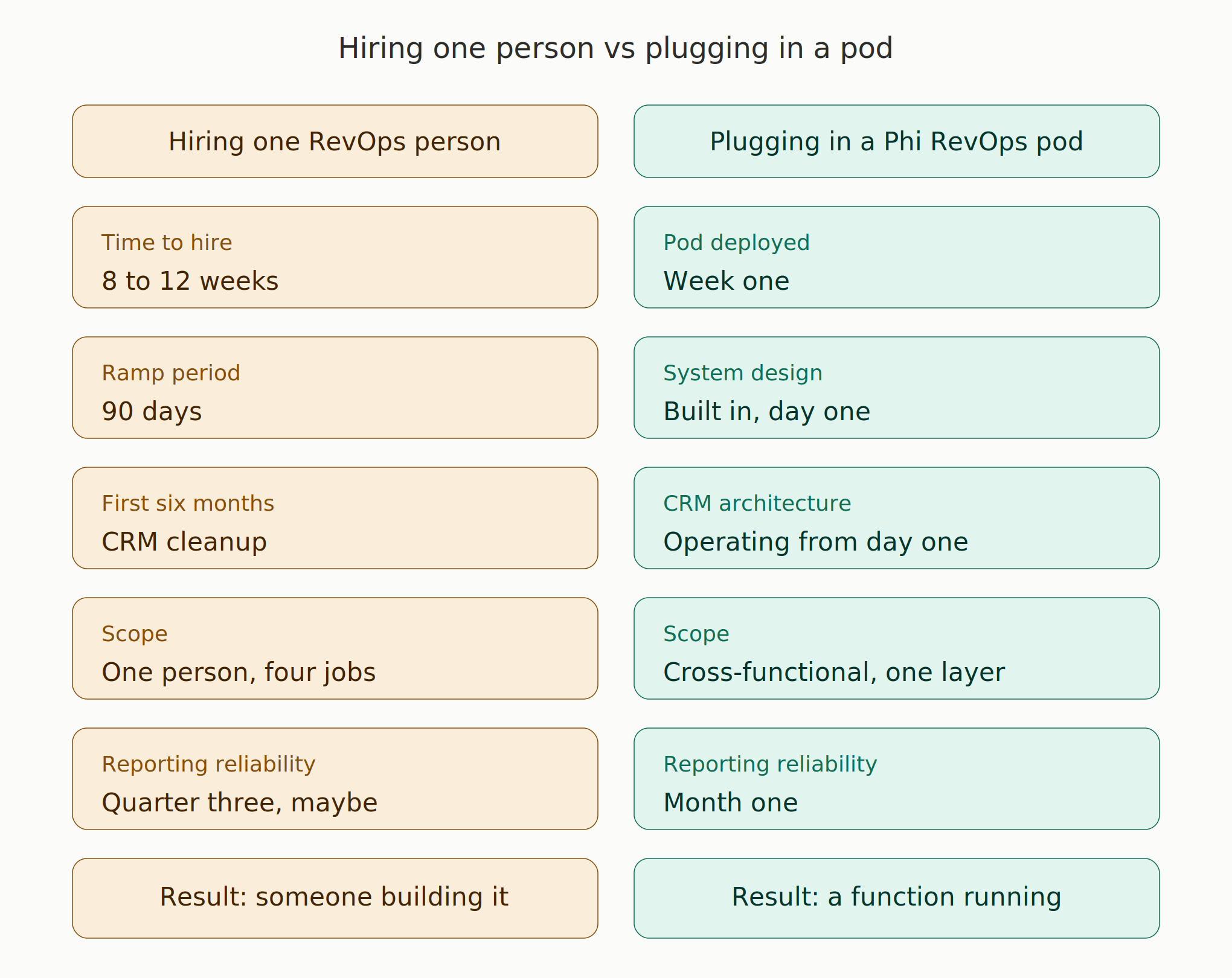
    The hire takes 8 to 12 weeks to find. They take 90 days to ramp. They spend the next six months untangling the existing CRM mess before they can do anything strategic. By month nine, the CRO is asking why pipeline reporting still isn't fixed and the RevOps lead is buried in cleanup work that should have been done by an architect, not a single hire.

    This is what happens when you treat a system problem like a hiring problem.

    Phi deploys RevOps pods that arrive with the architecture built in. The pod includes operators who own CRM design, attribution tracking, automation workflows, and pipeline reporting as one connected layer. They plug into your existing stack (HubSpot, Salesforce, whatever you're running) and produce clean data and reliable reporting in weeks, not quarters.

    No ramp period. No "let me audit your CRM for three months first." The system starts working immediately because the pod arrives as a system, not as a single hire trying to build one alone.

    Hiring one RevOps person is hiring someone to build infrastructure from scratch. Plugging in a Phi pod is plugging into infrastructure that already knows how to operate.

    original 2
    original 2

    The truth founders eventually face

    RevOps stops being optional the moment a company stops being founder-led on revenue.

    While the founder is the bottleneck, they hold the system together with memory and Slack threads. The minute they hand off, the absence of architecture becomes visible. Numbers stop reconciling. Handoffs stop happening. The CRO inherits a pipeline they can't trust and a team that can't agree on what's real.

    Most founders treat this as a hiring problem. It's not. It's a system problem dressed up as a hiring problem. And no single hire fixes a system that was never built.

    If your CRM is starting to feel like a liability instead of an asset, that's the signal. The function exists to be built before you need it, not after the data is already corrupted.

  • What B2B Lead Generation Services Actually Deliver

    What B2B Lead Generation Services Actually Deliver

    Most founders buying lead generation services for the first time get surprised twice. First by how different providers are from each other. Then by how long it takes to see results they can act on.

    This post breaks down what b2b lead gen services actually include, how to compare lead gen companies, and what realistic delivery looks like before you sign anything.

    What "Lead Generation" Actually Means

    The term lead generation services covers a wide range of models. What one provider calls lead gen, another calls demand gen or pipeline development. Before comparing vendors, map exactly what is in scope.

    Most lead generation company offerings fall into one of these buckets:

    Model

    What It Delivers

    What It Doesn't

    List building

    Verified contact data

    Outreach or pipeline

    Appointment setting

    Calendar slots

    Qualified intent

    SDR outsourcing

    Booked meetings

    Closed revenue

    Full outbound pod

    Contextualized pipeline

    Marketing or content

    Inbound + outbound hybrid

    Multi-channel coverage

    RevOps infrastructure

    If a provider is only building lists or handing off raw contact data, that is not b2b lead gen services in any meaningful sense. You still need someone to design and run the outreach. The distinction between appointment setting and full outbound execution matters more than most buyers realize. The B2B appointment setting services breakdown covers where that line sits.

    What a Strong Provider Actually Includes

    At minimum, a credible lead generation company should deliver:

    • ICP definition and list building tied to firmographic and technographic signals, not just job titles

    • Multi-channel outreach across email and LinkedIn with sequenced follow-up

    • Messaging strategy built around the specific pain your ICP is actively dealing with

    • CRM hygiene so that booked meetings arrive with context, not just a name

    • Reporting at both the activity level (sends, opens, replies) and the outcome level (meetings booked, pipeline generated)

    What most b2b lead gen services skip is the connection to your broader revenue system. Meetings that land in your CRM with no context, no qualifying notes, and no handoff protocol are noise. Not pipeline. The high-performing SDR system guide covers what that operational layer looks like when it is built correctly.

    How to Evaluate Lead Gen Companies

    When comparing lead gen companies, four things matter more than everything else.

    ICP specificity. Can they segment beyond job title and company size? The best b2b lead gen services work off intent signals, recent funding rounds, hiring patterns, and technographic data. Generic lists produce generic reply rates.

    Messaging ownership. Do they write the sequences, or do you? If you are writing the copy, you are doing the hard part. A credible lead generation company should bring a messaging framework and test variations from week one. The 9-step cold outreach framework shows the sequencing logic behind outbound that actually converts.

    Reporting transparency. You need weekly visibility into sends, open rates, reply rates, and meetings booked. If a provider is reluctant to share granular data, that is the signal.

    Pipeline vs. activity SLAs. Some lead generation services promise activity (X sends per month). Better ones commit to outcomes (X qualified meetings per month). Know which kind you are buying before you sign.

    Realistic Timelines and Results

    The single biggest source of disappointment with b2b lead gen services is timeline mismatch.

    Week

    What's Happening

    1-2

    ICP definition, list build, domain warm-up

    3-4

    First sequences live, early reply data coming in

    5-6

    Messaging iteration based on what is and isn't working

    7-8

    First qualified pipeline from outbound

    If a lead generation company promises booked meetings in week one, they are either skipping domain warm-up (which kills deliverability) or working off pre-built lists with no targeting logic. Neither produces durable pipeline.

    The SDR metrics sales leaders track post goes into the numbers you should hold any lead generation services provider accountable to across the full ramp period.

    What Does It Cost?

    Lead generation services pricing varies significantly by model and scope:

    • Managed outbound pods: $8,000 to $20,000/month depending on headcount and tooling

    • Appointment setting only: $3,000 to $8,000/month

    • List building only: $1,000 to $3,000/month

    The lowest-cost option is almost never right for a company trying to build repeatable pipeline. The embedded SDR team vs. in-house hiring comparison covers where the real cost difference sits when you account for ramp time, tooling, and management overhead. For additional context on what a bad hire in the same function actually costs, the bad sales hire cost breakdown runs the math in detail.

    The Difference Between Lead Gen and Pipeline

    Most lead gen companies stop at the meeting. They count it as a win whether or not the prospect was qualified. A better model connects outbound prospecting directly to sales execution, so the person booking the meeting and the person running it are working from the same context.

    The gap between those two things is often where pipeline stalls. If your funnel is generating meetings but not closing them, the stalled pipeline GTM audit is the right diagnostic to run.

    Outbound in isolation also doesn't produce compounding results. The outbound GTM in 2026 post covers how the model is shifting toward systems that combine workflow automation, data enrichment, and tighter sales handoffs. The workflow automation for SDR scaling post goes deeper on the operational side.

    How Phi Approaches This

    Phi's outbound GTM pod plugs directly into your existing stack and operates as an embedded team. That covers SDRs, sequencing infrastructure, data enrichment, and automation running on Clay, HeyReach, Instantly, and n8n.

    The accountability model is different from most lead generation services. Phi's pods are measured on qualified pipeline, not activity metrics. That model produced 93 meetings and 44 closed deals in four months running Payoneer's outbound operation.

    For a broader comparison of how this differs from traditional outsourcing, how B2B sales outsourcing works covers the structural differences.

  • RevOps Best Practices That Actually Move Pipeline Forward

    RevOps Best Practices That Actually Move Pipeline Forward

    Your RevOps function exists. You hired for it. You have the dashboards. And your pipeline still isn't moving.

    The dashboard problem

    We see this pattern constantly. A company builds out RevOps. They hire a RevOps manager, maybe a small team. They set up dashboards in HubSpot or Salesforce. They build reports that show pipeline by stage, conversion rates, average deal cycle. The leadership team reviews these dashboards every Monday.

    And nothing changes.

    The pipeline doesn't grow. The conversion rates don't improve. The sales cycle doesn't shorten. The dashboards just confirm, week after week, that things are roughly the same.

    The problem isn't the data. The problem is that most RevOps functions are built to observe the pipeline, not move it. They report on what happened. They don't change what happens next.

    That's the difference between RevOps as a reporting function and RevOps as an operating system. One gives you visibility. The other gives you velocity.

    Why most RevOps teams get stuck in "reporting mode"

    It usually starts well. The first RevOps hire cleans up the CRM. Builds the dashboards. Standardizes the pipeline stages. Everyone feels good because there's finally visibility into what's happening.

    Then it stalls. The RevOps team becomes the "dashboard team." Sales asks for a new report. Marketing asks for a new attribution view. The CEO wants a board deck with pipeline metrics. RevOps spends 80% of its time pulling data and building slides. Maybe 20% on actually fixing the systems that produce that data.

    This is the trap. RevOps gets hired to build infrastructure but ends up maintaining dashboards. And nobody notices because the dashboards look professional and the Monday meetings feel productive.

    Meanwhile, the actual problems sit untouched. Leads are leaking between marketing and sales because the handoff isn't automated. Reps are spending two hours a day on data entry that should take zero. Outbound campaigns run in Instantly but the results don't flow back into the CRM, so attribution is a guess. Customer success has no idea which accounts are at risk because the signals live in three different tools that don't talk to each other.

    Those are pipeline problems. And dashboards don't fix pipeline problems. Systems do.

    What RevOps looks like when it actually moves pipeline

    The RevOps teams that move pipeline share a few things in common. None of them are about which tool you use or how your dashboards look.

    The system connects, not just reports

    The first thing that separates real RevOps from reporting-mode RevOps: every tool in the stack talks to every other tool. Not through manual exports. Not through someone copy-pasting data between tabs. Through actual infrastructure.

    Lead enrichment in Clay feeds directly into outbound sequences in Instantly and HeyReach. When a prospect replies, that signal routes back into the CRM automatically. When a deal moves stages, the relevant teams get notified without someone sending a Slack message. When a customer churns, the data flows back to inform which ICP segments are actually working.

    This sounds basic. Almost nobody does it. Most companies have five or six tools that each work fine in isolation and don't connect to anything else. RevOps should be the connective tissue. Not the reporting layer on top.

    At Phi, we build these connections through n8n workflows. When a lead hits a certain activity threshold across channels, the system routes them to the right rep with full context. When a campaign underperforms, the system flags it before someone notices in a weekly review. That's RevOps as infrastructure.

    Attribution is closed-loop, not last-touch

    Most attribution models are broken. They give credit to the last thing that happened before a deal closed. The rep gets credit. Or the demo gets credit. Or the Google ad gets credit.

    Nobody knows what actually generated the pipeline.

    Closed-loop attribution tracks the full path. Which enrichment source identified the lead. Which outbound sequence made first contact. Which content the prospect engaged with before booking a call. Which rep handled the conversation. Which CS touchpoint led to expansion.

    This isn't about building a perfect model. Perfect attribution doesn't exist. It's about building enough signal that you can make real decisions. Like: should you double down on that LinkedIn sequence targeting TMS companies, or is it the email sequence targeting factoring firms that's actually producing deals?

    Without this, you're investing in channels based on vibes. With it, you're investing based on data. That's RevOps moving pipeline.

    Lead routing happens in seconds, not days

    Here's a number that will bother you: the average response time to inbound leads at most B2B companies is over 24 hours. Some studies put it closer to 42 hours.

    Your prospect filled out a form. They were interested. They were thinking about their problem right then. And your team got back to them two days later, after they'd already talked to a competitor.

    RevOps that moves pipeline treats lead routing as critical infrastructure. When a lead comes in, the system scores it (is this actually ICP?), enriches it (what do we know about this company?), routes it (which rep handles this segment?), and notifies the rep, all within minutes. Not because someone manually checks the inbox. Because the system is built to do it automatically.

    Same thing on the outbound side. When a prospect engages with a sequence (opens three emails, clicks a link, views the LinkedIn profile), the system should surface that signal to the rep immediately. Not in next Monday's pipeline review. Now.

    Feedback loops exist between every function

    The biggest pipeline killer in most B2B companies is the gap between teams. Marketing generates leads that sales says are garbage. Sales closes deals that CS struggles to retain. CS identifies expansion opportunities that nobody follows up on.

    RevOps closes these gaps by building feedback loops into the system.

    Sales marks a lead as "bad fit"? That data flows back to marketing so the targeting improves. CS flags an account as "at risk"? That triggers a retention workflow and informs the outbound team which segments have churn problems. A deal closes faster than average? The system captures what was different about that deal so the pattern can repeat.

    These aren't meetings. They're automated feedback loops built into the infrastructure. The data moves without anyone scheduling a sync.

    The CRM is a system, not a spreadsheet

    This one sounds obvious. It isn't.

    Most CRMs are glorified spreadsheets with a nicer interface. The data is stale because reps don't update it. The stages are meaningless because they were set up once and never validated against actual deal progression. The forecasting is fiction because it's based on rep self-reporting rather than system signals.

    RevOps that works treats the CRM as the operating system for revenue. That means: automated data capture so reps don't manually log activities. Validated pipeline stages that reflect how deals actually move, not how someone imagined they would. Contact and account enrichment that runs continuously, not once at lead creation. Hygiene workflows that catch duplicates, stale deals, and missing fields before they corrupt the data.

    When the CRM is clean and connected, everything else works better. Forecasting gets accurate. Attribution gets reliable. Reps trust the system instead of building their own shadow spreadsheets.

    What this looks like when it all connects

    We ran this system for Payoneer. Their outbound operation needed infrastructure, not just people. We embedded the full RevOps and outbound layer. Lead enrichment feeding sequencing. Routing automation. Attribution tracking across every touchpoint. CRM workflows that kept the data clean without manual input.

    93 meetings booked. 44 closed deals. Four months.

    The meetings didn't come from working harder. They came from a system where every component connected to every other component. The enrichment informed the targeting. The targeting informed the sequences. The sequences fed data back into the CRM. The CRM surfaced signals for the reps. The reps closed.

    That's RevOps moving pipeline. Not reporting on it.

    The real question

    Pull up your RevOps dashboards right now. Look at the metrics. Pipeline by stage. Conversion rates. Average deal cycle.

    Now ask: which of those dashboards actually changed how your team operates this quarter? Which one triggered a decision that moved pipeline?

    If the answer is "none of them," your RevOps function is reporting. It's not operating.

    And reporting never moved pipeline forward.

    If you want to see what RevOps looks like when it's built to operate, not just observe, talk to someone who's built it before.

  • Revenue Infrastructure Explained for B2B Founders Who Are Tired of Buying Software

    Revenue Infrastructure Explained for B2B Founders Who Are Tired of Buying Software

    You spent $6K last month on software your team barely uses. Your pipeline still runs through your personal LinkedIn. And the last vendor who promised "full visibility" gave you a dashboard nobody opens.

    You don't have a software problem. You have an infrastructure problem.

    The Software Graveyard

    Open your browser. Count the tabs. HubSpot. Apollo. Gong. Clay. Outreach. Slack. Notion. Looker. Maybe a couple more you forgot you're still paying for.

    That's eight to twelve subscriptions. Somewhere between $4K and $8K a month. And the pipeline number? Still depends on whether the founder had a good week on LinkedIn.

    The tools aren't broken. HubSpot does what HubSpot does. Apollo pulls contacts. Gong records calls. The problem is that nobody designed what happens between them. Each tool runs its own logic, stores its own version of the truth, and reports on its own slice of reality. Your CRM says one thing. Your outbound tool says another. The spreadsheet your VP of Sales keeps on the side says something else entirely.

    No one is lying. But no one is right either, because there's no system connecting the data, the people, and the decisions.

    The tools are islands. And the founder is the only bridge.

    Infrastructure Is Not a Product

    Every SaaS company with a Series B now calls itself "infrastructure." Your CRM claims to be your "revenue platform." Your outbound tool says it's "the backbone of modern GTM." Your enrichment vendor says they're "the data layer."

    None of them are infrastructure. They're features.

    Real revenue infrastructure is the operating logic that connects your ICP definition to your outbound sequences to your CRM hygiene to your pipeline reporting to your feedback loops. It's the system that turns raw activity into compounding pipeline. Not one tool. Not a stack of tools. The connective tissue between them, designed and operated by people who understand the whole picture.

    Think about what Stripe did for payments. Before Stripe, you didn't buy "a payment tool." You plugged into payment infrastructure. Payments just worked. Processing, compliance, reconciliation, fraud detection. One layer. All connected.

    Revenue should work the same way. But almost nobody has built it that way.

    The Five Layers

    Real b2b revenue system architecture isn't a checklist. It's five interconnected layers, and each one depends on the others. Pull one out and the whole thing collapses.

    The foundation is data integrity. Not "clean data" in the way your CRM vendor means it when they sell you deduplication. This is CRM architecture that reflects how your buyers actually move through a decision. Enrichment logic that feeds your outbound targeting. ICP precision that goes beyond firmographics into actual buying signals. If this layer is wrong, everything above it runs on bad assumptions.

    On top of that sits the outbound engine. Not sequences running in a vacuum. Sequencing architecture across email, LinkedIn, and phone that adapts based on signal data. Multi-channel logic that knows when to accelerate and when to pause. Most companies have sequences. Very few have an engine. The difference is whether someone designed the system or just turned on the tool.

    The third layer is the one everybody skips: the operator layer. Humans who design, run, and refine the system. Not people clicking buttons inside software. System operators who understand why the data layer matters, how the outbound engine should behave, and what the feedback loops are telling them. Without this layer, the tools just sit there. Expensive and inert.

    Above that is GTM architecture. This is the connective tissue between marketing signals, sales motion, and CS handoffs. When a prospect engages with content, does that data reach the SDR before the next touchpoint? When a deal closes, does the CS team know the exact pain points that were sold against? Most companies have walls between these functions. This layer removes them.

    At the top: feedback loops. This is what makes the entire system compound. Lost deal data feeding back into outbound targeting. Conversion rates by segment refining ICP definitions. Call objections updating messaging. Without feedback loops, you have a static system that decays over time. With them, you have a gtm infrastructure that gets smarter every week.

    Each layer feeds the others. Take out the operator layer and nobody maintains the data. Take out the feedback loops and your targeting goes stale. Take out the data layer and your outbound engine runs blind.

    No single tool covers more than one of these layers. Most don't even cover one completely.

    Why Software Companies Can't Sell You This

    Software companies build products for scale. They need 10,000 customers using the same product the same way. That's how the math works.

    Revenue infrastructure is the opposite. It's specific to your ICP, your sales motion, your data quality, your team's capacity, your buyer's decision process. No product can be both general enough to sell at scale and specific enough to be your infrastructure.

    That's not a criticism of the tools. It's a recognition that tools are components, not systems. Someone still has to be the architect. And that architect can't be a product.

    Every founder who's bought a tool expecting it to impose a system has learned this the hard way. Apollo doesn't tell you your ICP is wrong. HubSpot doesn't flag that your pipeline stages don't match how your buyers move. Gong doesn't build the feedback loop from lost deals back into your outbound targeting.

    The tools sit in their lanes. The system either exists or it doesn't.

    What Plugging Into Infrastructure Looks Like

    Most companies try to build revenue operations for startups by buying ten tools and hoping someone on the team figures out how to connect them. Three months later, the tools are half-configured, the data is already decaying, and the founder is still the best closer because nobody else has context on the full picture.

    Phi skips that phase entirely.

    Phi doesn't sell software. Phi deploys a GTM pod directly into your revenue architecture. The pod contains SDRs and AEs who are system operators (they know how to design and run the revenue engine b2b companies need, not just execute tasks), GTM Engineers who build the automation and data enrichment layer, and RevOps operators who maintain CRM hygiene and pipeline architecture.

    The pod arrives with the system design built in. Your data layer, outbound engine, operator layer, GTM architecture, and feedback loops. All connected. All running. Not after a 90-day integration period. From week one.

    The Stripe parallel holds. Stripe didn't sell you a payment button and expect you to build the processing logic around it. It gave you payment infrastructure. Plug in and payments work.

    Phi doesn't sell you outbound sequences and expect you to build the revenue system around them. It gives you revenue infrastructure. Plug in and pipeline works.

    We took TruckX from $2M to $16M ARR in 18 months. Datatruck from $0 to $2.5M ARR, then they raised a $12M Series A off the pipeline we built. Payoneer's outbound operation produced 93 meetings booked and 44 closed deals in 4 months. Those aren't tool metrics. Those are system metrics.

    The Real Question

    You've been solving the wrong problem. The problem was never which tool to buy. The problem was that nobody designed the system the tools were supposed to serve.

    Software gives you features. Infrastructure gives you pipeline.

    If you're ready to stop buying and start building, we should talk.

  • Revenue Infrastructure Explained for B2B Founders Who Are Tired of Buying Software

    Revenue Infrastructure Explained for B2B Founders Who Are Tired of Buying Software

    Most B2B founders do not have a revenue system. They have a stack.

    A CRM that holds stale data. Outbound tools that fire emails nobody reads. An SDR who got onboarded in six weeks and left in six months. A RevOps contractor who built dashboards in isolation. Marketing running on a different attribution model than sales.

    The result is a revenue team that looks functional on paper and performs poorly in practice.

    That is not a software problem. It is an infrastructure problem.


    What Revenue Infrastructure Actually Is

    Revenue infrastructure is the operating layer that sits between your product and your revenue.

    It is not a tool. It is not a team. It is the system that connects your ICP definition, your outbound motion, your pipeline tracking, your customer onboarding, and your retention mechanics into a single architecture that runs together.

    Think of it the way you think about payment infrastructure. Before Stripe, payments required weeks of bank integrations, fraud systems, and compliance work. Stripe collapsed all of that into one layer that just works. Revenue infrastructure does the same thing for GTM. Instead of buying and stitching together twelve tools, you plug into a system that is already designed, already running, and already producing pipeline.

    The key word is operating. Not advising. Not strategizing. Operating.


    Software vs. Infrastructure: What is the Difference?

    This is where most founders get the framing wrong.

    Category

    Software

    Revenue Infrastructure

    What it is

    A tool

    An operating layer

    Who runs it

    Your team

    A dedicated system or pod

    What it produces

    Data and reports

    Pipeline and revenue

    What happens when you add headcount

    Costs go up

    Capacity scales

    What happens when it breaks

    You file a support ticket

    Someone who owns outcomes fixes it

    Software requires a team to operate it. Infrastructure is the team and the system, running together.

    A CRM alone will not book meetings. Clay will not build your outbound motion. HeyReach will not write sequences that convert. These tools are inputs. Infrastructure is what turns them into output.


    Why Founders Keep Buying Tools Instead of Building Systems

    Three reasons.

    It feels faster. Signing up for a SaaS product takes ten minutes. Designing a revenue system takes weeks. Founders under pressure default to the option that shows movement, even if that movement is sideways.

    It is easier to justify. A $500/month tool line item is a simple budget conversation. An embedded team running your full GTM motion is a different category of decision, even when the economics are stronger.

    The alternatives were wrong before. Most founders who pushed back on agencies got burned. They paid for strategy decks and got no pipeline. That experience trains founders to keep buying tools they control, even when the tools are not solving the problem.

    The GTM execution challenges most B2B startups face are not tool problems. They are systems problems. And systems require design, not subscriptions.


    What Revenue Infrastructure Looks Like in Practice

    At Phi, we run it through GTM pods. A pod is a cross-functional team that embeds directly into your stack and runs a specific part of your revenue system.

    Outbound Pod: SDRs, sequencing infrastructure, data enrichment, and campaign operations. Runs on Clay for lead intelligence, HeyReach for LinkedIn outbound, Instantly for email, and n8n for automation. The pod does not replace your CRM. It plugs in and produces pipeline from it. This is how Phi ran Payoneer's outbound motion: 93 meetings booked, 44 closed deals in four months.

    RevOps Pod: CRM architecture, attribution tracking, pipeline reporting, and workflow automation. Connects the data layer so sales, marketing, and CS all see the same numbers. The hidden role of RevOps is steering the GTM motion, not just cleaning up after it.

    Customer Success Pod: CS operators embedded inside client orgs. Onboarding workflows, retention systems, expansion playbooks. This is how AtoB built retention across thousands of fleet accounts, achieving a 40% CSAT improvement.

    Content and GTM Marketing Pod: SEO, LinkedIn thought leadership, and paid campaigns built on pattern-interrupt creative. Builds inbound volume alongside the outbound motion so both channels compound over time.

    Each pod runs as infrastructure, not as an external vendor. The difference matters because ownership of outcomes sits inside the system, not outside it.


    Who Revenue Infrastructure Is Built For

    Not every company needs this. Here is who does.

    You are the right fit if:

    • You are post-seed to Series B and revenue growth is the primary constraint

    • You have tried agencies or freelancers and got strategy without execution

    • Your current GTM team is running on tools nobody fully owns

    • You need pipeline this quarter, not a 90-day onboarding before anyone does anything

    You are not the right fit if:

    • You are pre-product and still validating your ICP

    • You need one specialist (a single SDR, a single RevOps hire)

    • You want advisory work, not operators running inside your system

    The GTM fit matrix is worth reviewing if you are unsure which motion matches your stage. Infrastructure works when there is something to operate. If the GTM motion has not been validated yet, the first job is validation, not execution.


    The Cost Comparison Most Founders Do Not Run

    Founders who default to hiring in-house rarely do the full math.

    Cost Item

    In-House Build

    Revenue Infrastructure (Phi Pod)

    SDR fully loaded

    $80,000/yr

    Included in pod

    RevOps hire

    $90,000/yr

    Included in pod

    GTM Engineer

    $110,000/yr

    Included in pod

    Tools and licenses

    $24,000/yr

    Included in pod

    Ramp time to pipeline

    90-120 days

    30 days

    Risk if hire leaves

    Full restart

    None

    One bad sales hire costs over $180,000 when you factor in ramp, lost pipeline, and replacement. Infrastructure does not carry that risk because accountability sits at the system level, not the individual level.


    What Changes When You Get the Infrastructure Right

    TruckX went from $2M to $16M ARR in 14 months. DataTruck went from $0 to $2.5M ARR in under two years with a 97% reduction in CAC. AtoB grew from 72 customers to 7% U.S. market share. These are not outcomes from better software. They are outcomes from a revenue operations system designed and operated as a single architecture.

    The GTM maturity curve is straightforward: companies that treat revenue as infrastructure scale. Companies that treat it as a department full of tools do not.

    If your current GTM motion is producing inconsistent results despite consistent investment, the answer is probably not another tool. It is a system designed to produce pipeline, operated by people who are accountable for that outcome.

    That is what revenue infrastructure is. And it is what Phi builds.


    See how Phi builds and runs revenue infrastructure for B2B companies. Book a call.