Category: Revops

  • Buying More Sales Tools Will Not Fix Your Pipeline

    Buying More Sales Tools Will Not Fix Your Pipeline

    Somewhere between month six and month eighteen, most founders realize they’ve spent $40k to $120k on sales tools and pipeline hasn’t moved. Not meaningfully. Maybe a few blips. But nothing that looks like a working system.

    The instinct is to buy something else. A better sequencer. A new data provider. An AI layer on top of the CRM that was already not working. The stack grows. The pipeline doesn’t.

    This is not a tools problem. It never was.

    What a Typical Stack Actually Looks Like

    Before diagnosing the failure, it helps to see how common this pattern is. Here’s roughly what a Series A or growth-stage B2B company has accumulated by the time they call us:

    LayerCommon ToolsMonthly Cost (est.)
    Prospecting and dataApollo, ZoomInfo, or both$500-$2,000
    Email sequencingOutreach, Salesloft, or Instantly$800-$3,000
    LinkedIn outboundOne of four tools, often abandoned$300-$800
    CRMHubSpot or Salesforce, partially configured$500-$3,500
    EnrichmentClearbit, Clay, or both$400-$1,500
    ReportingA dashboard nobody opens$200-$600

    That’s $2,700 to $11,400 per month. Annualized, you’re looking at $32k to $136k. And most of those tools have overlapping functions, contradictory data, and no one person who owns the full picture.

    The tech stack for modern outbound sales teams was supposed to solve the volume problem. More accounts, more contacts, more touchpoints. What it created instead was a coordination problem nobody budgeted for.

    Three Reasons Tool-Stacking Fails

    The failure isn’t random. It follows a pattern. Almost every founder who ends up with a flat pipeline and a full stack ran into one or more of these three problems.

    No system owner. Tools don’t run themselves. Someone has to define the ICP, load the lists, write and iterate the sequences, monitor reply rates, update the CRM, and close the feedback loop back to the top. When that person doesn’t exist, or when it’s “the SDR manager plus whoever has bandwidth,” nothing works end to end. Your RevOps layer becomes a graveyard of half-configured automation that nobody trusts.

    No data hygiene. Every tool in a typical B2B tech stack writes data somewhere. The problem is that they write different data in different formats and nobody reconciles it. Your CRM says a prospect is “in sequence.” Your sequencer says they replied two weeks ago. Your enrichment tool has them at a company they left in 2023. You are running outbound against a fiction.

    No feedback loop. The revops tech stack is supposed to answer one question: what is actually working? But when tools don’t talk to each other, when attribution is broken, when reps are logging activities inconsistently, you can’t answer that question. You can’t tell if your sequence is underperforming because the copy is wrong, the ICP is wrong, the data is stale, or the timing is off. So you guess. You change the subject line. Pipeline stays flat.

    PhiOperators, not advisorsTell us what your stack costs, we’ll show gapsIn one conversation, we’ll map exactly where your current setup is leaking pipeline and what a working system looks like instead.Book an intro

    The Sales Enablement Tech Stack Myth

    The sales enablement tech stack category was built on a reasonable premise: give reps better information, better content, and better tools at the moment of contact, and they’ll close more. The problem is that enablement became a product category before most companies had the operational foundation to use it.

    You cannot enable a team that doesn’t have a working ICP definition. You cannot sequence your way out of bad data. You cannot report on a pipeline that isn’t connected to a CRM anyone actually updates.

    Most founders added enablement tools on top of an already broken foundation. The tools got smarter. The system got messier. And the person who was supposed to own all of it, the ops person, the RevOps hire, the SDR manager, was already underwater managing the tools they already had.

    This is not a people failure. It is an architecture failure. The tech stack for modern outbound sales teams is only as good as the operating layer underneath it. Without that layer, you are paying for a car you don’t know how to drive.

    What the Alternative Actually Looks Like

    The companies generating real pipeline in this environment are not running more tools. They are running fewer tools inside a tighter system, operated by a team that owns outcomes, not activities.

    Here is what that looks like in practice. When Phi ran the outbound operation for Payoneer, the pod ran on four tools: Apollo for prospecting and data, HeyReach for LinkedIn outbound across multiple sender accounts, Instantly for email sequences at scale, and n8n for workflow automation. Not twelve tools. Four. Each one with a defined owner and a defined function.

    Case StudyAtoB: 77 customers to 7% U.S. trucking market shareAtoB’s outbound engine scaled an entire vertical with the same pod model: fewer tools, one accountable operating layer, measurable outcomes.Read the story

    The pod did not replace Payoneer’s existing CRM or change their internal processes. It plugged into what they had and ran outbound as one operating layer. 93 meetings booked. 44 closed deals. Four months.

    That result did not come from a better sequencer. It came from an accountable team that owned the full system from ICP definition to closed deal, and had the infrastructure to close the feedback loop every week.

    This is what an outbound pod actually looks like when it works. Not a vendor running campaigns. An embedded operating layer that runs your pipeline system and is accountable for what comes out of it.

    Before You Buy Another Tool

    Run this audit first. For every tool in your current stack, answer three questions:

    1. Who owns this tool’s output, by name, not by team?
    2. Is the data in this tool accurate enough to act on today?
    3. Does this tool’s data feed back into a single place where we can see what’s working?

    If you can’t answer all three for more than half your tools, you do not have a pipeline problem. You have a system problem. Buying more tools will not fix it. It will make it more expensive.

    The b2b marketing tech stack, the revops tech stack, the sales enablement tech stack, all of them are infrastructure. Infrastructure only produces output when someone is operating it. Right now, most companies have infrastructure and no operator. RevOps best practices matter far less than having one person or one pod who owns the full system and is measured on what it produces.

    The companies that are pulling ahead right now are not the ones with the most tools. They are the ones who finally stopped buying and started building. If your pipeline has been flat for two quarters, the next subscription is not the answer.
  • RevOps vs Sales Ops: What the Wrong Choice Costs You

    RevOps vs Sales Ops: What the Wrong Choice Costs You

    A founder told me last quarter that he’d just hired his first “RevOps person.” I asked what she was working on. He said: cleaning up the CRM, fixing the sales forecast, helping reps with Salesforce. That’s a Sales Ops hire. Good one, probably. But not RevOps. And that distinction was about to cost him twelve months of data he’d never get back.

    The revops vs sales ops confusion is everywhere right now. Not because founders are careless, but because most job descriptions, agency pitches, and LinkedIn thought leadership use both terms to mean the same thing. They don’t mean the same thing. And the gap between them is where revenue disappears.

    What Sales Ops Actually Covers

    Sales Operations is scoped to the sales team. Full stop. A Sales Ops function owns the tools your reps use, the processes they follow, and the reporting that tells you what the pipeline looks like this quarter.

    In practice, that means: CRM hygiene, sales forecasting, territory design, quota setting, rep onboarding and ramp, commission tracking, and the workflows inside your sales tech stack. If something breaks in HubSpot or Salesforce and an Account Executive can’t log a deal, Sales Ops fixes it.

    That’s genuinely valuable work. Companies that run without it waste enormous amounts of rep time on manual data entry, bad forecasts, and commission disputes. If your sales team is growing past five reps and you don’t have someone owning this, stop reading and go hire one.

    But Sales Ops has a hard ceiling. It can tell you how the sales team is performing. It cannot tell you why a lead generated by marketing converted at half the rate of a referral. It cannot tell you which customer segments are expanding or churning. It has no visibility into the handoff between sales and CS. It owns one room in a house with many rooms.

    What RevOps Actually Covers

    Revenue Operations connects sales, marketing, and customer success into a single system. The goal is one version of truth across every team that touches revenue, from the first ad impression to the renewal conversation three years later.

    Revenue operations vs sales operations comes down to scope. RevOps owns the data architecture that lets you answer questions like: which marketing channels produce customers who actually retain? Which sales motions correlate with expansion? Where does the handoff from sales to CS break down? What’s the Annual Recurring Revenue contribution from expansion vs new logo?

    The infrastructure that makes this work includes: unified CRM architecture, cross-functional attribution, lifecycle stage definitions shared across all three teams, lead routing logic that connects marketing data to sales context, and CS health scoring that feeds back into pipeline reporting. None of that lives inside Sales Ops. All of it lives inside RevOps.

    If you want to understand this in more depth, the post on what RevOps is and why B2B companies need it walks through the full architecture.

    Side by Side

    FunctionSales OpsRevOps
    ScopeSales team onlySales + Marketing + CS
    CRM ownershipSales fields and pipeline stagesFull lifecycle data model
    ReportingSales forecast, rep activityAttribution, expansion, retention
    AttributionNot in scopeFirst touch to renewal
    CS visibilityNoneHealth scores, churn signals
    Marketing alignmentLead handoff at bestShared pipeline definition and data
    Right forSub-$2M ARR or sales-only GTMMulti-team revenue motion at any scale

    What the Wrong Frame Actually Costs

    Here’s what happens when a company that needs RevOps hires a Sales Ops person instead. The hire does good work. The forecast gets cleaner. Reps are happier. The CRM improves. Six months in, the CEO asks: “Why are our best logos churning at 18 months?” Nobody can answer. The data doesn’t exist. Marketing doesn’t know which segments sales closed. CS doesn’t know what was promised during the sales process. The CRM has deal data, but nothing connects it to onboarding or renewal. When founders ask us about RevOps vs sales operations, the honest answer depends on what they are trying to connect.

    That’s not a people problem. That’s an infrastructure problem created by the wrong scope decision twelve months earlier.

    The cost compounds in expansion revenue. Most B2B companies past $3M ARR have meaningful Average Revenue Per Account upside sitting in their existing customer base. Getting to it requires knowing which accounts are healthy, which are at risk, and which have buying signals for expansion. That intelligence lives at the intersection of CS data, product usage data, and sales history. Sales Ops doesn’t have a mandate to build that. RevOps does.

    PhiOperators, not advisorsNot sure which ops layer you’re missing?We’ll map your current revenue data model and tell you exactly where the gaps are costing you.Book an intro

    The Decision Rule

    Build Sales Ops first if your revenue problem is entirely inside the sales team. Reps are slow to ramp. The forecast is unreliable. Quota attainment is inconsistent. Territory conflicts are eating manager time. If fixing those problems would materially change your revenue trajectory, that’s where to start.

    Build RevOps if your revenue problem spans more than one team. Marketing is generating leads that sales ignores. CS is seeing churn that nobody warned them about. You can’t tell which channels produce your best customers. Expansion is happening accidentally, not systematically. Any of those symptoms means you need the connected system, not just a cleaner CRM.

    The inflection point for most companies is somewhere between $1.5M and $3M ARR. Below that, Sales Ops discipline is usually enough. Above it, the absence of connected revenue data starts costing real money every quarter. Not hypothetically. In deals you didn’t know were at risk and expansions you didn’t know were possible.

    What Building It Actually Looks Like

    The companies that get this right don’t hire a job title. They build a system. That means a CRM data model where marketing touches, sales activity, and CS health scores all live in connected objects. It means attribution reporting that traces pipeline back to channel. It means shared definitions: what counts as a qualified lead, what counts as a successful onboarding, what triggers an expansion conversation.

    When we built the revenue system for AtoB, the work wasn’t just outbound. It was connecting outbound pipeline data to retention data so the team could see which customer segments were worth acquiring and which were expensive to keep. That system helped take them from 77 customers to 7% of the U.S. trucking market.

    Case StudyAtoB: 77 customers to 7% U.S. trucking market shareConnected revenue infrastructure, not just outbound, drove the growth that supported an $800M Series B valuation.Read the story

    The RevOps system we build for clients starts with the data model, not the dashboard. Most companies want the dashboard first. That’s backwards. You cannot report accurately on data that was never captured correctly. Fix the architecture, then the reporting tells you something true.

    Sales Ops vs RevOps is not a debate about which function is more important. It’s a question of what your revenue system actually needs to answer. If you don’t know the answer, that’s usually the first sign you need RevOps.

  • RevOps for Startups: What to Build in Your First 90 Days

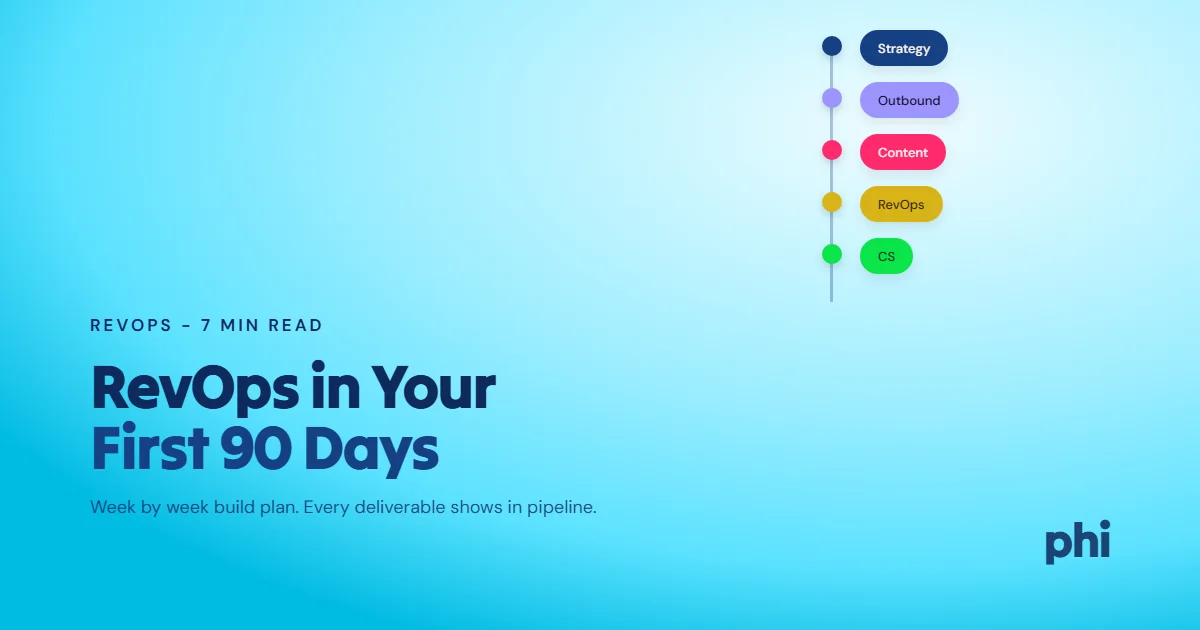
    RevOps for Startups: What to Build in Your First 90 Days

    Most early stage tech startups hit $1M ARR with a CRM that looks like a crime scene. Deals in the wrong stage. No close dates. Three different definitions of “qualified” depending on which rep you ask. Marketing has no idea which campaigns actually produced revenue. The CEO is still building pipeline reports by hand in a spreadsheet every Sunday night.

    That’s not a people problem. It’s an infrastructure problem. And it’s exactly what a RevOps engagement is supposed to fix.

    Here’s what revops for startups actually looks like, week by week, tied to specific deliverables that show up in the pipeline report. Not theory. Not a roadmap slide. The actual work.

    Weeks 1-2: The Audit You Don’t Want to Do

    The first two weeks of any early stage revops engagement are uncomfortable. You’re not building anything yet. You’re finding out how bad the existing system actually is.

    The deliverable is a CRM audit. Every deal stage, every field, every automation (or lack of one) gets documented. What you’re looking for: where deals stall, what data is missing, and whether your pipeline report is measuring what you think it’s measuring.

    In almost every startup we’ve worked with, the audit surfaces the same three problems. Deal stages are based on rep behavior, not buyer behavior. Lead source attribution is either missing or wrong. And there’s no consistent definition of what “qualified” means, so your ARR forecast is built on guesswork.

    You can’t fix the system until you know what’s actually broken. The audit is the foundation everything else gets built on.

    Weeks 3-6: Definitions, Deal Stages, and Attribution

    This is the longest phase, and the most important. You’re setting the rules the entire revenue team will operate by.

    The work breaks into three tracks running in parallel.

    1. Deal stage redefinition. Each stage gets a buyer-behavior exit criteria. A deal doesn’t move to “Proposal” because the rep sent one. It moves when the prospect acknowledged receiving it and confirmed a next step. Small distinction. Massive impact on forecast accuracy.
    2. Lead scoring and routing. What makes a lead qualified? You’re building the scoring model now, not later. This is where ICP tightens from “companies with 50+ employees” to something you can actually enrich against in a tool like Apollo.
    3. Attribution modeling. First touch, last touch, or multi-touch? The answer depends on your sales cycle length. For most tech startups with a 30-60 day cycle, a simple first-touch-plus-last-touch model is enough to start. You’re not building a perfect attribution system. You’re building one that’s better than nothing, which is where most startups are right now.

    By the end of week six, your pipeline report should look different. Deal stages reflect reality. Lead routing is automated. And for the first time, you can trace a closed deal back to its source. Startup RevOps is not about picking the perfect stack. It is about picking the minimum stack that can run for the next 12 months without a rebuild.

    If your sales team is running outbound alongside this work, make sure the sequencing infrastructure is connected to the CRM from day one. The outbound pod and the RevOps layer have to talk to each other, or you’re building two separate systems that don’t compound.

    PhiOperators, not advisorsWe’ll show you exactly what to build firstIn the first conversation, we map your current RevOps gaps and tell you which ones are costing you pipeline right now.Book an intro

    Weeks 7-10: Automation That Actually Saves Time

    By week seven, you have clean deal stages and a working attribution model. Now you automate the work that was happening manually, or not at all.

    The highest-value automations at this stage are not complicated. They’re the ones that eliminate the five-minute tasks reps do thirty times a week.

    AutomationWhat it replacesPipeline impact
    Auto-create contact on form fillManual data entry by SDR or AEFaster lead response, no dropped leads
    Deal stage change triggers task creationRep manually setting follow-up remindersConsistent follow-up, fewer deals going cold
    Sequence enrollment from CRM propertyRep manually adding contacts to sequencesHigher outbound volume without more headcount
    Win/loss notification to SlackWeekly deal review in a meetingReal-time feedback loop for the whole team
    Renewal date triggers CS outreachCS manager manually tracking spreadsheetExpansion and retention caught before churn

    None of these automations require a custom build. They’re native workflows in most CRMs. The reason most startups don’t have them is not complexity. It’s that nobody ever sat down and designed the system.

    For more on what automation looks like inside a RevOps pod, including how workflow automation connects to your CRM layer, the patterns we see across early stage tech companies are worth reading.

    Weeks 11-13: Closed-Loop Reporting

    The final phase is the one most startups skip because they think they’re not ready for it. They are.

    Closed-loop reporting connects marketing spend to closed revenue. Not leads. Not MQLs. Closed revenue. You’re building two reports: a pipeline report that shows where deals come from and where they stall, and a revenue attribution report that shows which channels produced actual ACV.

    When both reports are running, you can answer the question every founder is actually asking: “Which thing we’re spending money on is producing customers?”

    This is also when the RevOps layer connects to the CS function. Onboarding workflows, health scoring, expansion triggers. The revenue system doesn’t stop at closed-won. For a look at what that connection looks like in practice, the AtoB CX engagement shows how a retention system gets built on top of a sales infrastructure.

    What 90 Days Looks Like With Proof

    Datatruck came to Phi with no revenue system. Founder-led sales, no CRM discipline, no attribution. In 90 days, the RevOps infrastructure was running. Pipeline was visible. Marketing spend was connected to revenue. The outbound and RevOps layers were operating as one system.

    Case StudyDatatruck: $0 to $2.5M ARR, 97% drop in CACPhi built Datatruck’s RevOps and GTM system from scratch in 90 days, taking them from founder-led sales to a repeatable revenue engine that raised a $12M Series A.Read the story

    The result was $2.5M ARR, a $12M Series A, and a 97% drop in CAC. Not because of better salespeople. Because the system was finally designed to produce pipeline instead of just track it.

    Revops for tech startups is not a long-term strategy project. It’s a 90-day build. The question is whether you start now or wait until the mess is expensive enough to force the issue.

    If you want to see what the first 90 days would look like for your specific stack and stage, there’s more on how we approach RevOps best practices that move pipeline, or you can talk to someone who’s built this system before.

  • RevOps Software B2B Startups Actually Need

    RevOps Software B2B Startups Actually Need

    Most B2B startups have too many tools and too little system. The average seed-to-Series-A company is running eight to twelve pieces of revops software. Ask the founder what each one does and you’ll get a confident answer for three of them.

    This isn’t a budget problem. It’s an architecture problem. Tools don’t build pipeline. The system connecting them does.

    What follows isn’t a ranked list of every revenue operations software option on the market. It’s the five categories every B2B startup needs, the one or two tools Phi actually runs per category, and the reason each one earns its place in a real operating system.

    Category 1: CRM (The System of Record)

    Everything else in your revops tech stack feeds into or out of the CRM. If the CRM is wrong, everything downstream is wrong.

    Phi runs HubSpot for most early-stage clients. Not because it’s the most powerful CRM available, but because it’s the one founders can actually understand without a dedicated admin. The pipeline views are clean. The deal properties are flexible enough to match real sales motions. And the native integrations with sequencing tools mean you’re not stitching things together with duct tape from day one.

    The mistake most startups make isn’t choosing the wrong CRM. It’s treating the CRM as a place to log activity instead of a system that drives behavior. Stages matter. Properties matter. The moment a rep can skip a stage or close a deal without filling in ICP fields, the data is worthless. Build the architecture first. The adoption follows.

    If you want to see how CRM architecture actually affects Annual Recurring Revenue (ARR) growth, look at what happens when it’s done right from the start rather than retrofitted six months in. Retrofitting costs three times as long.

    Category 2: Data Enrichment (The Intelligence Layer)

    Bad data is the most expensive thing in your stack. Your reps are spending 30-40% of their time finding information that should already be in the system. Worse, they’re sequencing the wrong people entirely because the ICP definition isn’t enforced at the data layer.

    Phi runs Clay here, and it’s not close. Clay pulls from over 75 data sources simultaneously, runs enrichment waterfalls so you’re not paying for a single provider that misses half your targets, and lets you build custom enrichment logic without writing Python. You can define ICP signals, job change triggers, technology stack indicators, and funding events, all feeding directly into the CRM.

    Apollo in the Phi stackWe use Apollo for initial prospect sourcing before Clay runs enrichment and ICP scoring on every record.See how we use it

    Apollo does a different job. We use it for initial prospecting and contact discovery before Clay takes over for enrichment and scoring. Think of Apollo as the source and Clay as the brain that processes the source. Running them in sequence rather than in parallel is what makes the data layer actually work.

    The output isn’t just cleaner data. It’s faster ramp for every rep that joins later, because they’re not starting from scratch on account research. The system gives them context before the first call.

    Category 3: Sequencing (The Outbound Engine)

    Sequencing tools are only as good as the data feeding them. This is why category two has to come before category three. Most startups get this backwards. They buy a sequencing platform, load it with a CSV from LinkedIn, and wonder why reply rates are under 1%. The RevOps tools list above is deliberately short. Our pods run on these because each one has a job no other tool does as well.

    Phi runs Instantly for email sequencing at scale. The deliverability infrastructure is built for volume without the domain reputation problems that kill most outbound programs. You can rotate sender accounts, warm domains in parallel, and run true multivariate tests on sequence logic rather than just subject lines.

    The honest reason we don’t rely on HubSpot sequences for outbound is throughput. HubSpot sequences work well for low-volume, high-touch motions. For true outbound at scale, you need a dedicated sequencing tool with deliverability as a first-class feature, not an afterthought. Instantly gives us that. Paired with Clay’s enrichment, it’s the foundation of our outbound GTM pod.

    Case StudyDatatruck went from $0 to $2.5M ARR with 97% CAC dropThe sequencing and enrichment system we built was the foundation of the revenue engine that took them to a $12M Series A.Read the story

    Category 4: Automation (The Connective Tissue)

    This is the category most startups skip entirely, and it’s the reason the other three don’t compound.

    Every tool in your stack is generating signals. A prospect opens an email three times. A deal sits in a stage for 21 days. A customer hits a product usage threshold. Without automation, those signals die in the tool that generated them. With automation, they trigger workflows: a task for a rep, a Slack alert for the AE, a deal update in the CRM, a handoff to customer success.

    Phi runs n8n for workflow automation. It’s open source, which means you’re not paying per-task fees that scale painfully as volume grows. It connects to every tool in the stack through webhooks and native integrations. And because it’s self-hosted, client data stays in client infrastructure rather than passing through a third-party automation vendor. That matters more than most founders realize when they’re later talking to enterprise procurement teams.

    The workflows we build in n8n aren’t flashy. They’re the unglamorous connective tissue that makes the whole system feel alive: lead routing logic, deal stage triggers, enrichment webhooks, CS handoff conditions. Our AI automation work runs through n8n as the orchestration layer for most of it.

    PhiOperators, not advisorsWe’ll map your stack and show you what’s missingIn the first conversation, we identify the specific gaps in your revops architecture and what it’s costing you in pipeline.Book an intro

    Category 5: Reporting (The Feedback Loop)

    Most startups have dashboards. Almost none have a feedback loop.

    A dashboard tells you what happened. A feedback loop tells your reps, your marketing team, and your CS team what to do differently next week. The difference between the two is attribution. If you can’t tie a closed deal back to a specific sequence, a specific ICP segment, and a specific channel, you’re not learning anything from your data. You’re just watching numbers.

    This is where RevOps architecture earns its budget. HubSpot’s reporting is good enough for most Series A companies if the CRM architecture is clean. The problem is the “if.” Custom report builders only work when the properties feeding them are consistent. That means deal stages enforced, ICP fields required, source attribution captured at contact creation, not retroactively filled in by a rep who doesn’t remember where the lead came from.

    The companies getting real value from their reporting aren’t the ones with the fanciest BI tools. They’re the ones who built clean data discipline into the CRM from the start. Read more on this in our post on revops best practices that move pipeline.

    The Stack Is Not the Strategy

    Here’s the thing about revops software that nobody tells you: the tools are the easy part. You can stand up HubSpot, Clay, Instantly, n8n, and Apollo in a week. What takes longer is the system design. Which signals trigger which workflows. How ICP is defined and enforced at the data layer. How marketing hands off to sales and sales hands off to CS without the context dying in the transition.

    That’s not a software problem. That’s an architecture problem. And architecture is a human job.

    The startups that pull away from their peers aren’t running different tools. They’re running the same tools inside a system someone actually designed. If your revops tech stack feels like a collection of subscriptions rather than a working revenue engine, the answer isn’t another tool.

  • RevOps Implementation Roadmap: Seed to Series B

    RevOps Implementation Roadmap: Seed to Series B

    Most founders don’t think about RevOps until something breaks. A board meeting where the pipeline number doesn’t match what sales told them. A commission dispute nobody can settle because the CRM data is six weeks stale. A Series A diligence call where the investor asks for cohort retention data and the answer is “we’d have to pull that manually.”

    By then, the fix costs three times what it would have at the start.

    This is a stage-by-stage revops roadmap built for founders who want to get ahead of it. Not a consultant’s framework. A founder’s build order, with the specific thing to construct at each stage and the specific failure mode that ends you if you skip it.

    Seed Stage: The Foundation Nobody Wants to Build

    At Seed, RevOps isn’t a team. It’s a discipline. You’re probably doing sales yourself, or you have one AE you trust. The instinct is to stay lean and not “over-engineer” the system before you have product-market fit. That instinct is mostly right. But it has one fatal blind spot.

    The build target at Seed is a clean, logged sales process inside a CRM that everyone actually uses. That’s it. Not dashboards. Not attribution modeling. Not a dedicated ops hire.

    What you need:

    1. A CRM with stages that match how deals actually move, not a default HubSpot template you’ve never touched
    2. A logging discipline: every call, every email thread, every “we’ll revisit in Q2” conversation entered as an activity, not left in someone’s head
    3. A definition of what counts as a qualified opportunity, written down, shared with anyone touching a deal
    4. A closed-lost reason taxonomy with four to six buckets, because “not a fit” tells you nothing useful about why you lost

    This takes one focused week to set up. It pays back in every investor conversation, every new hire ramp, and every pipeline review you run for the next two years.

    The Seed-stage failure mode is founder-memory as the system of record. You know which deals are real. You know which accounts have been touched. That knowledge lives in your head, not in the CRM. Then you hire a second salesperson and hand them a graveyard with no context, and you wonder why their ramp takes seven months.

    Datatruck came to us with exactly this problem. Founder-led sales, some pipeline, zero infrastructure. We built the system from scratch. The result was $0 to $2.5M ARR and a $12M Series A, with CAC dropping 97% once the system started generating qualified pipeline instead of the founder generating it manually.

    Case StudyDatatruck: $0 to $2.5M ARR, 97% drop in CACThe playbook for replacing founder-memory with a revenue system that runs without the founder in every deal.Read the story

    Series A: The Attribution Problem You Don’t Know You Have

    You’ve closed your A. You have a sales team now, probably two to four reps, maybe a marketing hire. Leads are coming from multiple places. Some from outbound, some from content, some from referrals, some from paid. And you have no reliable way to know which channel is actually producing revenue.

    This is where revenue operations implementation gets its first real test. The build target at Series A is attribution and pipeline visibility. Not sophisticated multi-touch attribution modeling. Just honest, consistent answers to three questions: where did this lead come from, what did it cost to acquire, and did it close?

    What you need to build:

    1. Lead source tracking that survives handoffs between marketing and sales, including UTM discipline and CRM field enforcement
    2. A first ops hire, ideally someone who has run a CRM migration and knows what a broken attribution model looks like before it breaks
    3. A weekly pipeline review process with a consistent format that forces honest stage progression, not deals that sit in “proposal sent” for 90 days
    4. A definition of ARR and ACV that every person on the revenue team agrees on, because you’d be surprised how often they don’t

    The Series A failure mode is invisible pipeline rot. Deals that looked real in the CRM but weren’t real in the world. Stage definitions that meant different things to different reps. A forecast number that came from sales intuition rather than historical conversion rates. Then the board asks for a Q3 call and your pipeline coverage is 1.4x, not 3x, and you find out two weeks before the quarter ends.

    Your RevOps pod at this stage should be one sharp operator plus clean tooling, not a department. The point is to build the data layer so you can see what’s actually happening, because you cannot manage what you cannot measure.

    PhiOperators, not advisorsFind out if your pipeline data is actually realWe’ll walk through your current CRM architecture and tell you exactly where the attribution is breaking before it shows up in your forecast.Book an intro

    Series B: When RevOps Becomes a Competitive Advantage

    By Series B, you have enough revenue motion that the question stops being “is this working” and starts being “why is this working, and can we repeat it.”

    You probably have SDRs, AEs, a marketing team, maybe a CS function. Each group is producing data. None of it connects. Sales doesn’t know which marketing campaigns are producing their best accounts. CS doesn’t know which segments are churning. Finance is building a revenue model off a spreadsheet that someone in sales ops updates manually every month.

    The build target at Series B is a full RevOps operating layer: CRM architecture that connects every function, forecasting models built on real conversion data, feedback loops between sales and marketing, and a CS system that flags churn risk before the customer cancels.

    This is a pod, not a person. One RevOps hire cannot build and run this. You need someone who owns strategy, someone who runs the tools, and someone who keeps the data clean. That is either three hires or one embedded pod that operates as one system.

    AtoB is the clearest example of what happens when you get this right. They scaled from 77 customers to 7% of the U.S. trucking market and a $800M Series B valuation. That kind of growth doesn’t happen without a revenue system that can see what’s working across every segment, every channel, and every quarter.

    The Series B failure mode is a forecasting model that looks sophisticated but is built on bad inputs. You have a beautiful waterfall chart in your board deck. But the stage conversion rates in that model came from 18 months ago, before you changed your ICP, before you hired three new reps with different closing styles, before you added a new product line. The model is a fiction. And you won’t find out until you’re 40% off on a quarter that matters.

    The Stage-by-Stage Build Table

    StageBuild TargetFailure ModeTeam Shape
    SeedClean CRM + logged sales processFounder-memory as system of recordFounder or first AE
    Series AAttribution + pipeline visibilityInvisible pipeline rot, broken forecastingOne ops hire + tooling
    Series BFull RevOps operating layerForecasting model built on bad inputsRevOps pod (3+ operators)

    What This Actually Means for Your Next 90 Days

    Every stage of this revops guide points to the same underlying truth: the system has to be built before you need it. Not after the bad quarter. Not after the board meeting. Not after the investor asks for the cohort data you don’t have.

    If you’re at Seed and you’re still running the sales process from memory, spend one week building the foundation. If you’re post-A and your attribution model is a guess, that’s your ops hire’s first project. If you’re post-B and your forecast is still coming from sales intuition rather than a real operating model, that’s what a full sales ops and RevOps pod is built to fix.

    The companies that build this infrastructure early don’t just have cleaner data. They make better decisions, faster, with less internal argument about what the numbers actually say. That compounds. Every quarter, on every metric that matters.

    If you want to see what this looks like in practice, the RevOps best practices that actually move pipeline post is a good next read. Or if you’re trying to explain to a skeptical exec why this matters at all, start with what RevOps is and why B2B needs it.

    The question isn’t whether you need a revenue operations system. It’s whether you build one before the next diligence call, or after.

  • The RevOps Framework Every B2B Startup Actually Needs

    The RevOps Framework Every B2B Startup Actually Needs

    Most B2B startups that tell me they have RevOps have a CRM someone set up two years ago, a spreadsheet the head of sales maintains manually, and a marketing team that measures leads while sales measures opportunities. Same funnel. Three different versions of reality.

    That is not a revenue operations framework. That is three functions doing their own accounting.

    The companies that fix this do not buy more tools. They build a system with clear ownership across every intersection of layer and function. Here is what that actually looks like.

    The 9-Cell Matrix

    A working revops framework has two axes. The first is layers: data, process, and insight. The second is functions: sales, marketing, and customer success. Every cell in the matrix has something that gets built and someone who owns it.

    Most startups have cells 1 and 4 partially filled. Sales has some data in the CRM. There is some kind of lead handoff process. Everything else is improvised.

    SalesMarketingCustomer Success
    DataCRM hygiene, deal stage definitions, contact enrichmentLead source attribution, MQL definitions, campaign taggingHealth scores, product usage data, renewal dates
    ProcessSequence workflows, pipeline stage gates, handoff from SDR to AELead routing, nurture triggers, MQL-to-SQL handoff rulesOnboarding workflows, QBR cadences, expansion triggers
    InsightWin/loss by segment, rep ramp benchmarks, forecast accuracyCAC by channel, pipeline contribution, content-to-close attributionChurn prediction, NPS trends, expansion ARR by cohort

    Nine cells. Each one has a clear owner, a defined artifact, and a feedback loop back into the system. None of them are optional once you are past $1M ARR.

    Layer One: Data

    The data layer is where most startups fail before they even know they have a problem. Sales is logging deals inconsistently. Marketing is using UTM parameters nobody agreed on. CS is tracking health in a spreadsheet that gets updated when someone remembers.

    The result: when the CEO asks “what is driving our best deals this quarter,” nobody can answer without a two-hour manual pull.

    What gets built here is unglamorous. Deal stage definitions everyone actually uses. Contact enrichment that runs automatically so reps are not researching manually. Lead source attribution that marketing and sales both agree on. Health score inputs that CS ops owns and updates on a defined schedule.

    The data layer is not a dashboard project. It is a definitions project. Until your three functions agree on what a qualified lead is, what a healthy account looks like, and when a deal moves from stage two to stage three, any reporting you build on top of it is fiction.

    Our RevOps pod spends the first two weeks of any engagement doing nothing but data architecture. Not automation. Not reporting. Definitions and hygiene.

    Layer Two: Process

    Process is where revenue disappears. Not in the pitch. Not in the proposal. In the handoff.

    SDR books a meeting and drops a note in Slack. The AE reads it four hours later and shows up to a call with no context. Marketing sends an MQL to sales with no routing logic, so it sits in a queue for three days. CS gets a new customer handed off with a one-line email and no onboarding playbook.

    These are not people problems. They are process problems. And they compound.

    What gets built in the process layer: documented handoff rules with SLAs, lead routing logic that fires automatically when a lead hits a defined threshold, pipeline stage gates that require specific fields before a deal can advance, and onboarding workflows that CS runs from day one without needing to ask sales what the customer was promised.

    The SDR-to-AE handoff is the one most startups try to fix first. It is not the most important. The MQL-to-SQL handoff between marketing and sales is where most pipeline leaks before anyone touches it. If marketing’s definition of a qualified lead and sales’s definition do not match, every MQL report is a lie.

    This is the part of the revenue operations framework that requires actual cross-functional agreement. You cannot automate your way around a political problem.

    PhiOperators, not advisorsMap your 9 cells with someone who’s done itWe’ll walk through your current RevOps setup and show you exactly which cells are broken and what gets built to fix them.Book an intro

    Layer Three: Insight

    Insight is the layer most startups skip to first and build wrong. They build a dashboard. The dashboard shows last month’s closed revenue. Someone looks at it once a week. Nothing changes.

    That is not insight. That is a rearview mirror.

    A real revops maturity model treats the insight layer as a feedback system, not a reporting system. Win/loss analysis that tells you which ICP segments are closing at 40% versus 12%. Rep ramp benchmarks that tell you when a new hire is off track before they miss quota. Churn prediction that gives CS 60 days of warning, not a retrospective.

    The insight layer for marketing means knowing which channels produce pipeline that actually closes, not just pipeline that gets created. CAC by channel with close rate factored in. Content attribution that connects a blog post to a closed deal three months later.

    For CS, it means cohort analysis on expansion ACV, not just total NPS. Which onboarding pathways produce accounts that expand versus accounts that churn at renewal? That is the question. Most CS teams cannot answer it because they have not built the data layer underneath the insight layer.

    The insight layer only works when the data layer is clean and the process layer creates consistent inputs. You cannot analyze what you did not capture consistently.

    What Ownership Actually Means

    The matrix is useful. Ownership is what makes it real.

    Every cell needs one person whose name is attached to it. Not a team. Not “sales and marketing together.” One person who is accountable when the cell breaks and responsible for iterating it when the system grows.

    The data cells tend to live with RevOps. The process cells are co-owned: RevOps designs them, the function head enforces them. The insight cells belong to whoever needs to make decisions from them, but the RevOps operator builds and maintains the underlying logic.

    This is where a named revops playbook actually comes from. Not a template downloaded from the internet. A documented set of owners, artifacts, and feedback loops specific to your stack, your stage, and your ICP.

    See how this works in practice in our breakdown of RevOps practices that move pipeline, or read the fundamentals in what RevOps actually is and why B2B companies need it.

    Most Startups Have Two Cells. Phi Fills Nine.

    When we audit a new client’s RevOps setup, the pattern is almost always the same. The sales data cell has something in it, even if it is messy. There is a rough process for moving deals through the pipeline. Everything else is a gap.

    No attribution in the marketing data cell. No lead routing in the marketing process cell. No health scoring in the CS data cell. No onboarding workflow in the CS process cell. No win/loss analysis anywhere.

    AtoB came in with pipeline but no system underneath it. We built the full matrix: clean data architecture, handoff processes with SLAs, and insight loops that tied sales activity to revenue by segment. They went from 77 customers to 7% of the U.S. trucking market.

    Case StudyAtoB: 77 customers to 7% U.S. trucking market shareWe built the RevOps architecture that let AtoB scale pipeline without rebuilding their team from scratch.Read the story

    Two cells is enough to survive early-stage. It is not enough to scale. The companies that grow past $5M ARR without rebuilding their GTM motion from scratch are the ones that built all nine.

    Which cells are yours actually filling right now? If you cannot answer that for all three functions, that is the first thing to fix.

  • Your Pipeline Dashboard Is Lying to You

    Your Pipeline Dashboard Is Lying to You

    A founder we spoke with last quarter was convinced his team had a closing problem. Pipeline looked healthy. Cover ratio was 3.2x. His head of sales was confident.

    They missed the quarter by 31%.

    The deals in the pipeline weren’t real. Half had no activity logged in 60 days. Several were sitting in “Proposal Sent” because no one had updated the stage in two months. The data feeding the revops dashboard was stale, manually entered, and in three cases, referred to companies that had already churned.

    This is not a dashboard problem. It’s an infrastructure problem. And you cannot fix it by buying a better BI tool.

    Why Pipeline Data Goes Bad

    Most revenue operations data pipelines work like this: a rep does something, then (maybe) logs it, then a manager (maybe) reviews it, then someone exports it into a spreadsheet to clean it before the Monday forecast call. By the time the number reaches the CEO, it’s four days old and has been touched by six humans.

    Every handoff is a degradation point.

    Manual entry is the original sin. Reps log what they remember, not what happened. “Discovery call” covers everything from a 45-minute qualification conversation to a three-minute voicemail. Stage definitions drift because nobody audits them. Enrichment data goes stale the moment it’s pulled. A contact title that was “VP of Sales” in January is often wrong by March.

    The result is a revops reporting environment where the numbers aren’t lying on purpose. They’re just wrong. And wrong data drives wrong decisions: wrong forecasts, wrong rep coaching, wrong resource allocation.

    PhiOperators, not advisorsWe’ll show you where your pipeline data breaksFirst conversation maps your data gaps and tells you exactly which automation layer fixes them first.Book an intro

    The Automation Layer That Actually Fixes This

    Revops data automation isn’t about dashboards. It’s about what happens before data reaches a dashboard. The automation layer has four components. Each one addresses a specific failure mode.

    1. Enrichment at ingestion

    Every new record, whether it comes from a form fill, an SDR sequence reply, or a LinkedIn connection, hits Clay before it touches the CRM. Clay pulls firmographic data, technographic signals, contact verification, and job change alerts. By the time the record lands in your system, it already has industry, employee count, tech stack, and a verified email. Your reps aren’t entering this. They don’t have to.

    The payoff isn’t just cleaner data. It’s that your outbound pod is working from accurate signals instead of stale exports. Sequence personalization is based on real company attributes, not what an SDR guessed from a LinkedIn profile six weeks ago.

    2. Activity capture via webhooks

    If a rep sends an email from Gmail and your CRM doesn’t auto-log it, that activity disappears. Multiply that across a team of eight and you’ve lost 30-40% of deal movement every week.

    The fix is webhook-based activity capture connected through n8n. Every email send, reply, meeting booking, and call outcome fires a webhook that writes to the CRM without human input. N8n handles the routing: which deal, which stage, which contact. The rep never touches the CRM for activity logging. The data is complete because the system captures it, not the person.

    3. Stage-transition triggers

    Stage gates in most CRMs are ceremonial. A deal moves to “Negotiation” because someone clicked a dropdown, not because a specific event happened. Stage-transition automations change that.

    In n8n, you build trigger logic tied to real events. A deal moves to “Qualified” only when a discovery call is logged AND a company size field is populated AND an AE is assigned. A deal advances to “Proposal” only when a deck link is sent AND a follow-up meeting is booked. If those conditions aren’t met, the deal stays in its current stage and an alert fires to the rep and their manager.

    This turns your pipeline stages into actual data. Not optimistic labels.

    4. Anomaly alerts

    The last layer is pattern detection. N8n runs scheduled checks against your CRM data and fires Slack alerts when something breaks a defined threshold.

    AnomalyTrigger ConditionAlert Target
    Stale dealNo activity logged in 14 days, deal openRep + manager
    Stage regression riskDeal in “Proposal” for 21+ days with no meeting bookedManager + RevOps
    Gap-to-quota alertWeighted pipeline drops below 2.5x quota with 3 weeks left in quarterHead of Revenue + CEO
    Enrichment failureNew record missing 3+ required fields after 24 hoursRevOps operator
    Close date driftExpected close date changed twice in 30 daysManager

    These aren’t vanity alerts. Each one maps to a decision someone needs to make before the quarter goes sideways.

    What This Looks Like in Practice

    The stack we run this on is Clay for enrichment, n8n for workflow automation and webhook orchestration, and the client’s existing CRM as the system of record. We don’t rip out what’s already there. We build the automation layer on top of it.

    The RevOps pod sets up the enrichment workflows in Clay, maps the webhook triggers in n8n, defines the stage-gate logic with the client’s sales leadership, and configures the anomaly thresholds based on historical deal velocity. A typical implementation takes three to four weeks from kickoff to live alerts.

    After that, the system runs. Reps log less. Managers see more. Forecasts stop being fiction.

    Case StudyAtoB: 77 customers to 7% U.S. trucking market shareWe built the revenue operations data layer that let AtoB scale outbound without losing pipeline visibility as deal volume grew.Read the story

    The Dashboard Is the Last Thing You Fix

    Most teams build the revops dashboard first and wonder why it shows garbage. The dashboard is not the problem. It’s a display layer. Displays show what they’re fed.

    Fix the feed. Build the automation layer that enriches records at ingestion, captures activity without human input, enforces stage gates through real event logic, and surfaces anomalies before they become forecast surprises. That’s what makes a revops dashboard worth looking at.

    Apollo in the Phi stackOur RevOps pod uses Apollo for contact verification and prospecting data before records flow into enrichment and CRM workflows.See how we use it

    Most pipeline problems aren’t selling problems. They’re data problems you’ve been calling selling problems for two quarters. How much of your current pipeline would survive a real audit?

  • RevOps Consulting That Ships Infrastructure in 30 Days

    RevOps Consulting That Ships Infrastructure in 30 Days

    Most pre-Series-A founders who come to us have the same setup: a CRM someone configured in an afternoon, a spreadsheet that one salesperson owns, and no idea which channel is actually generating pipeline. They’ve often already paid for RevOps consulting once before. What they got was a slide deck titled “Revenue Operations Roadmap” and a Notion doc nobody opened after week three.

    That’s not a vendor problem. It’s a model problem. Most revenue operations consulting engagements are designed around advice, not execution. The consultant leaves. Nothing runs.

    Here’s what a 30-day engagement should actually produce.

    What You’re Actually Buying (and What You Aren’t)

    When a pre-Series-A company hires a revops consultancy, the goal isn’t a framework. The goal is a working system that your team can operate without the consultant on a Slack call every morning.

    That means five specific artifacts. Not recommendations about them. The actual built things.

    1. CRM stage architecture. Named stages that map to real buyer behavior, not the default HubSpot template. Entry and exit criteria written in plain language. Every open deal re-staged against the new model before the engagement closes.
    2. Attribution model. First-touch, last-touch, or multi-touch, depending on your sales cycle length. The model is wired into your CRM, not living in a spreadsheet. When a deal closes, you know which channel sourced it.
    3. Sequence infrastructure. At least two active outbound sequences connected to your CRM. Replies, bounces, and meeting books all flow back into contact records automatically. Your outbound pod or your first SDR plugs into this on day one.
    4. Lead routing logic. Rules for how inbound leads get assigned. No more “whoever saw the notification first” routing. Criteria-based, logged, auditable.
    5. Weekly revenue report. A single dashboard your CEO and head of sales can read in under four minutes. Pipeline by stage, new meetings booked, deals moved, deals stalled. Numbers, not narrative.

    If a revops consulting services engagement doesn’t ship all five of these, it isn’t RevOps. It’s research.

    The 30-Day Cadence, Week by Week

    The reason most engagements fail isn’t bad strategy. It’s sequencing. Consultants spend too long on discovery and run out of time to build.

    Here’s the cadence that actually works.

    DaysWorkOutput
    1-10CRM audit, ICP validation, stage mapping, attribution scopingArchitecture doc, signed off by founder before day 11
    11-20CRM build, stage migration, sequence infra wired up, routing rules liveWorking CRM, first sequences sending, lead routing active
    21-25Attribution model connected, reporting dashboard built, data QADashboard your team can read without explanation
    26-30Handoff, documentation, 30-day usage walkthrough with your ops leadSOPs, video walkthroughs, your team owns the system

    Days 1-10 are the only phase where the word “strategy” belongs. After day 10, everything is build or QA. If your revenue operations consulting partner is still running workshops in week three, something is wrong.

    Why the 90-Day Strategy Deck Doesn’t Work for Pre-Series-A

    Larger RevOps firms default to 90-day engagements because that’s how they staff for utilization. A senior consultant does discovery. A junior analyst does the build. A project manager coordinates. By month three, you have a thorough document and a Loom video. Your CRM looks the same as it did on day one.

    Pre-Series-A companies can’t absorb that model. You have 12 to 18 months of runway. Every week without a working pipeline system is a week of compounding cost. Hiring an AE into a broken CRM is expensive. Hiring two into a broken CRM is a crisis.

    The founders who get this right treat RevOps the same way they treat product: ship something that works, get feedback, iterate. They don’t wait for the perfect system. They build the right system for where they are today and wire in feedback loops so it gets better as the team grows.

    PhiOperators, not advisorsWe build your revenue system in 30 daysFirst call is a working session: we map your current CRM state and tell you exactly what gets built in the first 30 days.Book an intro

    The Infrastructure That Connects Everything

    RevOps isn’t a standalone function. It’s the connective tissue between your outbound motion, your ARR reporting, and your sales team’s daily workflow.

    When the CRM stage architecture is right, your outbound sequences tie directly to pipeline stages. A prospect who books a meeting through your outbound pod lands in the CRM at the right stage, gets the right follow-up sequence, and shows up in the right pipeline report. Nothing manual. Nothing falling through a gap between tools.

    When attribution is wired in, you stop guessing which campaigns are working. You can tell your board exactly what channel sourced your last ten closed deals. That matters for Series A conversations more than founders expect.

    When lead routing logic exists, your inbound leads don’t get cold. Speed-to-contact is one of the highest-use variables in early-stage sales. An inbound lead that waits 90 minutes for a response is often already talking to a competitor.

    The companies that scale past $2M ARR without a RevOps hire burning them aren’t lucky. They built the infrastructure before they needed it. Datatruck did exactly this: by the time they were generating meaningful inbound, the system was already tracking it. They went from $0 to $2.5M ARR and raised a $12M Series A, with CAC dropping 97% along the way.

    Case StudyDatatruck: $0 to $2.5M ARR, 97% drop in CACHow building revenue infrastructure before scaling headcount kept acquisition costs from spiraling as pipeline grew.Read the story

    The One Test That Tells You If It Worked

    After 30 days, there’s one question worth asking. Can your head of sales pull a pipeline report, by stage and by source, without asking anyone for help?

    If the answer is yes, the engagement worked. The system is real. It’s theirs.

    If the answer is no, you don’t have RevOps infrastructure. You have a consultant’s CRM that nobody on your team fully understands. That system will decay inside 60 days, and you’ll be back to the spreadsheet.

    Good revenue operations consulting doesn’t make itself indispensable. It builds something your team can own, operate, and improve without the consultant in the room. Anything that doesn’t meet that standard is a service, not infrastructure.

    The difference between a founder who closes their Series A with clean pipeline data and one who walks into that meeting with a spreadsheet usually comes down to whether they treated RevOps as a one-time project or as the operating layer their revenue team runs on. Build the layer. Everything else gets easier.

  • RevOps as a Service for Startups That Can’t Hire a Full Team

    RevOps as a Service for Startups That Can’t Hire a Full Team

    Most Seed and Series A founders make the same hire too early. They watch their pipeline get messy, their CRM fill with garbage data, and their board ask questions they can’t answer. So they hire a RevOps lead. Six months later, they’ve spent $180K and the CRM is still a mess.

    The problem wasn’t the person. It was the assumption that a single hire could build and run a revenue operations function simultaneously, while also onboarding into a company with no documentation, no clean data, and no clear ICP.

    There’s a better model. And the math is hard to argue with.

    What a Full RevOps Hire Actually Costs You

    A mid-level RevOps manager in a U.S. market runs $130K-$160K base. Add benefits, payroll taxes, equity, and the three to four months it takes for them to actually understand your business, and you’re looking at $180K-$200K of real cost before they’ve shipped a single dashboard.

    At Seed or Series A, that’s not a people problem. It’s a capital allocation problem. You’re spending enterprise-level infrastructure budget on a company that isn’t enterprise-scale yet.

    The alternative is revenue operations as a service: fractional operators who already know the stack, an embedded pod that plugs into your CRM on day one, and shared infrastructure that doesn’t need to be rebuilt from scratch because it’s already been built for 40 other companies.

    PhiOperators, not advisorsFind out what your RevOps gap is actually costingWe’ll walk through your current stack and tell you exactly where the attribution breaks and the pipeline data goes dark.Book an intro

    What RevOps as a Service Actually Covers

    This is where most founders get confused. They think outsourced revops means someone logs into HubSpot once a week and cleans up deal stages. That’s not what a real RevOps pod does.

    A Phi RevOps pod covers three layers:

    1. CRM architecture. Deal stages mapped to your actual sales motion, not the HubSpot default. Custom fields that reflect how your team qualifies. Automation that moves records without human input.
    2. Attribution and pipeline reporting. Which channels are producing pipeline, which are producing noise, and how to tell the difference. Your board shouldn’t be guessing. Neither should you.
    3. Feedback loops between sales, marketing, and CS. The moment those three functions are looking at different numbers, your revenue system breaks. The pod connects the data layer so everyone sees the same picture.
    4. Workflow automation. Lead routing, rep notifications, deal alerts, renewal triggers. The manual work that eats 30-40% of your sales team’s time gets systematized.

    This is what the Phi RevOps pod is actually built to run. Not advise on. Run.

    How the Fractional RevOps Model Works in Practice

    Fractional revops isn’t a consultant who sends you a Notion doc with recommendations. It’s an operator embedded in your org who owns specific outcomes: pipeline visibility, ARR forecasting accuracy, CRM data integrity.

    The engagement looks like this in practice:

    WeekWhat the pod does
    1-2CRM audit. Map what exists, identify the gaps, document the current sales motion.
    3-4Architecture build. Deal stages, custom fields, routing logic, and baseline dashboards.
    5-8Attribution layer. Connect marketing, outbound, and inbound data into one pipeline view.
    9-12Automation and handoff. Systematize the manual workflows. Train the team. Hand off clean documentation.

    By week 12, you have a functioning revenue operations layer. A full-time hire at week 12 is still in their ramp period, asking where the sales deck lives.

    Why Outsourced RevOps Fails (And How to Avoid It)

    Outsourced revops gets a bad reputation because most implementations are poorly structured. An agency sends a part-time contractor. The contractor has no context on the business. Nobody owns the outcome. Three months later, there are new dashboards nobody uses and the CRM is still a mess.

    The fix is accountability. The pod needs to own a specific metric, not just a list of tasks. At Phi, the RevOps pod is accountable for pipeline visibility and forecast accuracy. Those are numbers we can point to. If the board can’t get a clean pipeline report by month two, we haven’t done our job.

    That’s the difference between a vendor and an operator. Vendors deliver work. Operators own outcomes.

    If you want to understand how we think about the operator model versus the agency model, that contrast is laid out here.

    What a Real Pod Engagement Looks Like

    AtoB came to Phi needing revenue infrastructure that could scale with their growth in the trucking market. They weren’t looking for a slide deck with recommendations. They needed operators who could build the system and run it.

    The RevOps layer we built connected outbound, sales, and customer success into one operating picture. AtoB’s team went from 77 customers to 7% of the U.S. trucking market. They raised at an $800M Series B valuation.

    Case StudyAtoB: 77 customers to 7% U.S. trucking market sharePhi built and ran the revenue infrastructure that connected AtoB’s sales and ops into one system as they scaled.Read the story

    The point isn’t the trucking vertical. The point is that the infrastructure had to exist before the scale was possible. Revenue operations as a service is what made the system run without adding three full-time ops hires.

    The Real Question Is Timing, Not Budget

    Every founder eventually hires a full-time RevOps lead. That hire makes sense at $8M-$10M ARR when the complexity of your revenue system justifies a dedicated owner. Before that, the math doesn’t work.

    At Seed and Series A, you don’t need a full RevOps org. You need a functioning system. Those are different problems with different price tags.

    The revops as a service model exists specifically for the gap between “we need this” and “we can afford the full hire.” Fractional operators, embedded pods, and shared infrastructure give you the capability without the burn.

    If you want to go deeper on why RevOps matters at this stage before you make any decisions, this post covers the fundamentals.

    The founders who wait until they can afford the full hire usually spend six months flying blind first. That’s the real cost nobody puts in the spreadsheet.

  • Six Questions to Ask Before Hiring a RevOps Agency

    Six Questions to Ask Before Hiring a RevOps Agency

    Somewhere around month three, you realize the RevOps firm you hired hasn’t touched your pipeline once. They’ve cleaned your Salesforce. They’ve built twelve dashboards. They’ve written a 40-page process doc nobody reads. But the number of qualified deals moving through your funnel is exactly what it was when you signed the contract.

    This is the default outcome when you hire a revops agency that operates like a Salesforce consultancy. And most of them do.

    The framing below is a buyer’s diagnostic. Six questions you ask before you sign anything. Each one is designed to surface whether you’re hiring operators or advisors.

    Why Most RevOps Firms Leave You With a Cleaner CRM and the Same Broken Pipeline

    The market for revenue operations help is genuinely confusing. You have pure-play CRM implementers, RevOps practitioners who focus on pipeline visibility, fractional CROs who advise but don’t execute, and GTM agencies that bolt RevOps onto the side of an outbound engagement. Most of them call themselves a revenue operations agency.

    The distinction that matters isn’t in the name. It’s in what they’re accountable for after the system goes live.

    A CRM rebuild is not a revenue system. It’s table stakes. If your RevOps infrastructure isn’t connected to your outbound motion, your CS team’s retention data, and your pipeline attribution, it’s just a prettier spreadsheet.

    The companies with tools but no revenue system almost always have one thing in common: they paid someone to build a component, not a system. The CRM got rebuilt. The outbound sequences got written. The onboarding playbook got documented. Nothing talks to anything else.

    The Six Questions

    Use these before you sign. They’re not gotcha questions. Any good revops firm will answer them without hesitation. The ones who can’t are telling you something.

    1. Do you operate after you build, or do you hand off and leave? This is the most important question. Most RevOps consultants are project-based. They scope the work, deliver the build, and move on. Ask specifically: who is responsible for running the system in month four? If the answer is “your internal team with our documentation,” you’re buying a build, not infrastructure.
    2. Do you own pipeline outcomes, or just reporting outputs? Anyone can build a dashboard that shows pipeline stage velocity. The question is whether they’re accountable when the numbers go sideways. Ask: what happens if pipeline drops 20% in month two post-launch? Do they adjust the system, or do they send you a report explaining why it dropped?
    3. Does your pod touch outbound and CS, or only the CRM? Revenue operations without a connection to outbound execution is just database management. The same is true on the other side: if your CS team’s retention signals aren’t flowing back into the CRM, your attribution is fiction. Ask which specific systems the team will integrate and operate, not just configure.
    4. Do you integrate across the stack, or does your work silo into one tool? A real RevOps engagement touches your CRM, your sequencing infrastructure, your enrichment layer, your CS platform, and your reporting. If the scope of work only names one tool, you’re getting a consultant, not a system builder. Ask them to describe the last full-stack build they shipped, and name the tools involved.
    5. Do you report on pipeline movement, or just on activity metrics? Activity reports (emails sent, calls logged, tasks completed) are easy to generate and tell you almost nothing useful. Ask what the default reporting cadence looks like and whether it includes deal velocity, stage conversion rates, and ARR attribution by channel. If they start with “here’s how we set up your dashboards,” that’s the wrong answer.
    6. What does the engagement look like six months after launch? This is the simplest tell. A project-based RevOps agency has a defined end date. An infrastructure partner doesn’t. Ask what the team is doing in month six. Are they still running the system? Are they iterating on it based on pipeline data? Or have they wrapped up and invoiced out?

    PhiOperators, not advisorsFind out if your RevOps system is actually runningWe’ll map exactly where pipeline is stalling and what the system needs to fix it.Book an intro

    What a Real RevOps Build Looks Like in Practice

    When Phi built AtoB’s revenue system, the work wasn’t limited to CRM architecture. The RevOps layer connected to their outbound motion, their CS onboarding workflows, and their attribution tracking. Every signal fed back into the same operating layer. Sales knew which channels were producing qualified pipeline. CS knew which customer segments were churning. The system iterated because the team running it stayed embedded.

    Case StudyAtoB: 77 customers to 7% U.S. trucking market shareA full-stack revenue system, not a CRM rebuild, drove AtoB to an $800M Series B valuation.Read the story

    That’s the difference between a RevOps firm that builds and one that operates. The build is maybe 20% of the value. The other 80% is what happens when the system needs to respond to real pipeline data over the following months.

    The Table: What You’re Actually Buying

    What they promiseWhat it usually meansWhat you actually need
    CRM implementationSalesforce rebuild, hand-off, goodbyeCRM architecture connected to live pipeline data
    Revenue reportingActivity dashboards nobody acts onStage conversion and ACV attribution by channel
    Process documentationA 40-page playbook your team ignoresWorkflows embedded in the tools your team already uses
    RevOps strategyA deck with recommendations and no executionAn operator who runs the system after the strategy is set
    Automation setupOne-time workflow build with no iterationA running automation layer that adjusts when the process changes

    One Red Flag Worth Calling Out Directly

    If a revops consultants team’s first deliverable is a discovery report, that’s a signal. Discovery is fine. A 20-page summary of what they found is not a deliverable. It’s a way of appearing to move without actually moving.

    The right engagement starts with a system design, names the specific tools being connected, and puts an operator on the work within the first two weeks. Not a strategist. An operator.

    You can read more about how we think about this at why Phi is different from a typical revenue operations agency. The short version: we build the system and we run it. Those are not the same thing, and most firms only do one.

    The RevOps category is full of smart people who are very good at designing systems and very bad at running them. Before you sign, find out which one you’re hiring.