Category: GTM

  • AI Isn’t a GTM Add-On Anymore – It’s Your Execution Engine

    AI Isn’t a GTM Add-On Anymore – It’s Your Execution Engine

    Most B2B startups today can list the AI tools in their stack faster than they can explain how those tools move the pipeline.

    They’ll say things like:

    “We use ChatGPT for content.”“
    We automated outbound with Clay.”
    “We added AI call summaries to our CRM.”

    Sounds modern. But here’s the uncomfortable truth: 

    Adding AI ≠ building an AI-powered GTM motion.

    In 2023–2024, AI was a tactical add-on, mostly a marketing sidekick.

    In 2025, it's something else entirely:

    AI is now a GTM operating model – not just a set of tools.

    A model that drives how you target, sequence, qualify, close and retain customers.
    But if your AI lives inside disconnected tools, you’re not scaling GTM, you’re scaling chaos.

    The First Wave: AI for Speed, Not Strategy

    Let’s rewind to the early AI hype cycle:

    • Content teams used AI to generate SEO blogs

    • SDRs used it for intro-line personalization

    • Marketers relied on ChatGPT to spin up landing pages fast

    This brought surface-level efficiency, but it masked deeper issues.

    Because underneath all that AI activity, the GTM engine – your ICP, segmentation, attribution, buyer modeling and win-loss feedback remained untouched.

    As we outlined inMistakes in B2B Go-To-Market Strategy, speed without orchestration is a vanity upgrade. Not a system.

    The Shift: AI as Infrastructure for Modern GTM

    The most forward-leaning teams we work with – from FinTech to FreightTech, aren’t just using AI. They’re operating on it.

    AI isn’t a dashboard feature. It’s the underlying OS powering sales, marketing, CS, RevOps and product decisions.

    At Phi, we call this the AI-Powered GTM Engine – an evolution from static funnels to intelligent feedback systems.

     Explore: The GTM Multiplier: How Cross-Functional Alignment Accelerates Execution

    What That Actually Looks Like (Not Just Talk) 

    1. Smart ICP + TAM Discovery

    Don’t build your ICP from a whiteboard session.

    But, analyse:

    • Hiring data + messaging shifts

    • Tech stack indicators

    • Buyer intent from public sources

    • LinkedIn activity + competitor engagement

    With Clay and enrichment systems, train AI to find real buyer signals, not just idealized personas.

    And if you're still guessing your TAM?

    Read: What Is Total Addressable Market (TAM)?

    2. Signal-Based Segmentation

    Forget “industry + headcount.” Instead, segment on urgency, activation likelihood and product relevance – and your models should learn from every campaign.

    For deeper insight: Explore: Customer Segmentation in a Successful GTM

    3. Playbooks That Learn

    Every outbound that runs should inform the next.A/B testing tones, CTAs, offer sequencing shouldn’t come with gut feel, but with AI pattern recognition.

    Over time, your GTM motion becomes smarter, faster and more relevant.

    This ties into our thinking on Winning GTM Strategies Through Data Analytics – where strategy isn’t static. It’s adaptive.

    4. RevOps That Orchestrates, Not Reacts

    Most teams treat RevOps like a reporting layer. Instead, treat it like an operating layer.

    GTM velocity demands AI-powered RevOps that connect systems, not just monitor them.

    How to use AI across the funnel:

    • Lead scoring adapts to funnel velocity

    • Routing logic updates based on close rate by segment

    • Sales enablement is powered by win/loss call summaries

    • Attribution is stitched across channels + tools

    Explore more in RevOps Automation for Startups

    5. Human-AI Handoffs Built In 

    Don’t chase “full automation.” Build collaborative workflows:

    • SDRs using AI-curated insights to personalize better

    • AEs getting coaching from AI call summaries

    • CS teams using usage analytics to reduce churn

    It’s all about orchestration, not replacement.

    Learn more: AI SDRs Explained: Redefining Sales Development

    Why Most Startups Get This Wrong

    In most teams we audit:

    • Marketing owns ChatGPT

    • Sales uses Gong AI

    • The founder plays with prompts on weekends

    • RevOps is buried in dashboards

    No one connects the dots. So the “AI stack” grows, but nothing improves.

    The result?

    Faster noise. Not smarter GTM.

    We diagnose these siloes in our Go-To-Market Audit: 10 Areas to Diagnose Your Startup GTM

    What Founders Should Ask Themselves:

    • Is AI surfacing revenue insights or just writing faster copy?

    • Are we using AI to prioritize GTM investment?

    • Is our GTM strategy improving, or just our task speed?

    If the answer is “no”,  then you don’t have an AI-powered GTM system. You have AI noise.

    The AI-Powered GTM Model: What’s Required

    1. Shared GTM playbooks across teams

    2. RevOps as the AI orchestrator, not a passive reporter

    3. ICP + segmentation defined by signals, not hunches

    4.  Feedback loops that train your systems

    5.  QA layers for AI outputs

    6. Cross-functional ownership (not just “Marketing’s toys”)

    Need a blueprint?

    Start here: How Cross-Functional Teams and AI Make GTM Strategy Effective

    Real Results From Real Teams 

    With a FinTech startup we advised:

    • AI-enabled segmentation improved conversion rates by 35%

    • Sales cycle reduced by ~30%

    • CAC dropped by ~25%

    With a FreightTech company:

    Our signal-based outbound playbooks unlocked $400K in new pipeline in 6 weeks

    Retention improved after AI insights were routed to CS weekly.

    Both built using systems we outlined in our AI Agent Models for GTM

    AI Is Not the Answer – It’s the Framework

    Startups winning in 2025 aren't using more AI, they're using it differently.

    They've stopped treating AI like a sidekick and started using it as their GTM Operating system.

    You don't need a 10-person RevOps team. You need a partner who builds systems, not dashboards.

    Want to see how we’d structure your AI-powered GTM motion?
    Let’s talk!

  • From TOFU to BOFU: Subtle Truths That Shape Your Pipeline

    From TOFU to BOFU: Subtle Truths That Shape Your Pipeline

    Every founder loves the sales funnel. It feels structured, predictable, and measurable.
    At the top of funnel (TOFU), leads flow in. The middle (MOFU) nurtures them.

    The bottom (BOFU) closes deals. Simple in theory, yet messy in practice.

    In reality, pipeline stages rarely look like neat diagrams in pitch decks. Buyers loop back and forth, reps bend process, and founders often confuse pipeline growth with pipeline health.

    Just like in go-to-market strategy execution, the funnel is less a straight line and more a living system.

    Stage 1: Top of Funnel (TOFU) – Awareness Isn’t the Same as Interest

    For early-stage startups, TOFU often looks like progress. Outbound campaigns, ads, and sign-ups flood dashboards with numbers. But not all awareness is equal.

    A bloated TOFU creates false comfort if:

    • Most leads don’t fit your ICP

    • Outbound lists target titles, not problems

    • Campaigns capture attention, but not intent

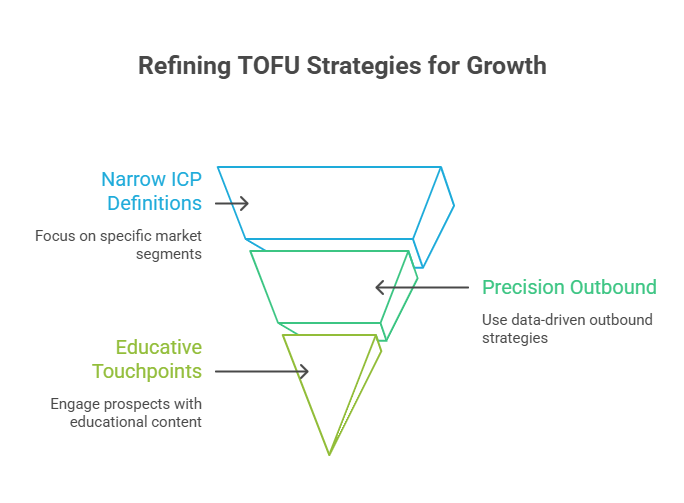
    Subtle Truth: TOFU is less about filling the funnel and more about filtering it.

    Effective TOFU means:

    For founders, the right question is: Would I pay to pursue every lead at TOFU? If not, the funnel is already leaking.

    Stage 2: Middle of Funnel (MOFU) – Nurture Isn’t Neutral

    MOFU is where opportunities either gain velocity or stall quietly. Too often, it becomes a waiting room until someone is “ready.”

    In practice, this stage hides the biggest blind spots:

    • Generic nurture sequences with little personalization

    • Marketing content focused on features rather than pain

    • Misaligned handoffs where ownership between sales and marketing blurs

    Subtle Truth: MOFU either accelerates deals or stalls them.

    Momentum in MOFU requires:

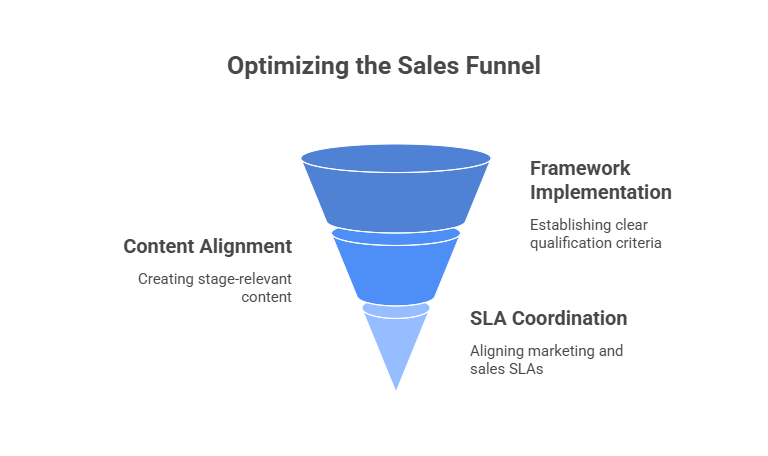
    • Clear qualification frameworks, like the structured checkpoints in a GTM audit.

    • Stage-relevant content – ROI models, objection handling, and proof points – similar to those used in CAC optimization strategies.

    • Aligned SLAs across marketing and sales, a coordination gap often solved by revenue operations.

      For investors, MOFU metrics often look promising, but without conversion velocity, the funnel risks becoming a holding pen instead of a growth engine.

      Optimizing The Sales Funnel
      Optimizing The Sales Funnel

    Stage 3: Bottom of Funnel (BOFU) – Confidence Isn’t the Same as Control

    BOFU feels closest to revenue. Forecasts, proposals, and deal probabilities dominate dashboards. Yet many “committed” deals aren’t truly committed.

    Pitfalls include:

    • Shallow discovery that leaves pain and budget unvalidated

    • Late-stage deals without decision-makers involved

    • Discount-heavy negotiations when differentiation is unclear

    • Forecasts inflated by “happy ears” instead of historical conversion data

    Subtle Truth: BOFU is less about confidence and more about control over the buying process.

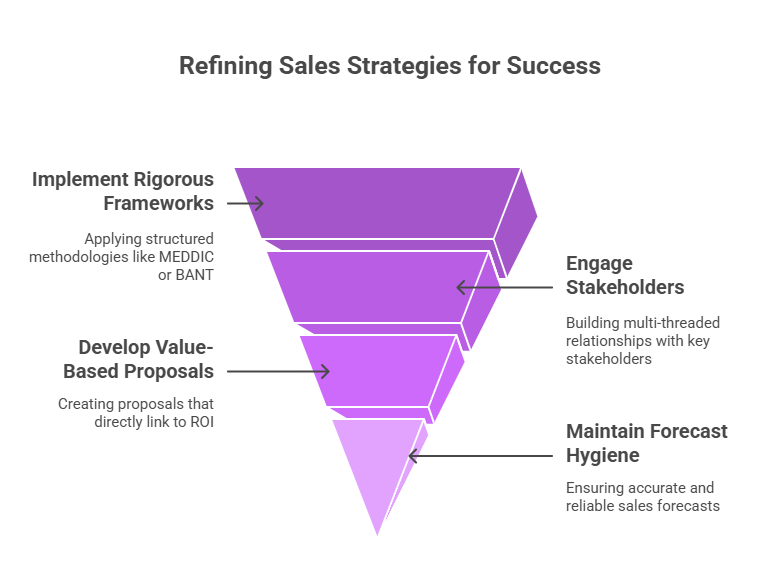
    A disciplined BOFU emphasizes:

    In one freight tech project, we reduced forecast inflation by nearly 30%, shifting from optimism to defensible numbers.

    Stage 4: Post-Sale – The Overlooked Growth Stage

    Most funnels stop at “Closed Won.” But real growth begins post-sale. Without structured processes, churn rises, expansion slows, and advocacy never materializes.

    Key truths here:

    Subtle Truth: The cheapest pipeline you’ll ever build is inside your existing customer base.

    In a fintech engagement, expansions drove ~60% of ARR growth-proof that post-sale execution can rival new logo acquisition.

    The Funnel as a System, Not Stages

    The most important nuance: the funnel isn’t linear. Buyers skip, pause, and revisit stages unpredictably. The real funnel is a living system that demands operational backbone.

    That means:

    Subtle Truth: Funnels work when treated as operating models, not static diagrams.

    Beyond the Funnel: Turning Subtle Truths Into Growth

    From TOFU to BOFU and well beyond, your funnel is more than a diagram. It’s a reflection of how precisely your team understands, engages, and converts real buyers.

    The subtle truths aren’t there to criticize-they’re there to help founders see where the funnel quietly shapes outcomes. Because in today’s market, growth isn’t about filling the funnel wider. It’s about making each stage sharper, stronger, and more aligned with reality.

    That’s exactly where Phi Consulting comes in. We don’t just audit your funnel-we help you rebuild it as a growth engine.

    From refining ICPs and tightening outbound precision, to aligning Sales-Marketing-CS with RevOps as the backbone, to ensuring your funnel delivers measurable revenue at every stage Phi turns subtle truths into operational discipline.

    Our approach is simple: no funnel theatre, no vanity metrics. Just GTM strategies that cut through noise, deliver pipeline health, and scale revenue predictably.

    Ready to turn your funnel into a true operating model? Book a demo with Phi today.

  • How Smart Founders Codify Their Sales GTM Motion Before Scaling

    How Smart Founders Codify Their Sales GTM Motion Before Scaling

    Turning Instinct into Infrastructure Before You Hire

    “Our founder closed the first 10 logos. Now we’re trying to scale.” 

    That sentence should trigger a GTM audit, not a job post.

    The Lie Founders Are Sold: “Get Out of Sales”

    If you've raised a Seed or Series A round in the last 18 months, chances are an investor told you:

    “Hire a Head of Sales so you can step out and scale.”

    But in 2025, smart founders know: Founder-led sales isn’t a phase. It’s a signal.

    Those early wins are packed with high-quality GTM signal – the kind that informs:

    – Who your real buyers are (not just users)- What messaging unlocks urgency- Where trust is built and lost in the sales cycle- Which triggers, phrases, or use cases convert- And how the first 30 seconds of your pitch shape the rest

    If you're scaling without extracting those insights, you're flying blind.

    This is why many post-seed teams run into trouble with bloated CAC, longer sales cycles and inconsistent messaging – a problem we often diagnose during ourGTM execution audits.

    Founder-Led Sales: The Ultimate GTM Data Stream

    Founders who close the first 15–20 deals themselves aren’t just generating cash flow – they’re compressing go-to-market learning cycles.

    At Phi, we’ve worked with multiple startups across FinTech, Cloud and FreightTech where the founder’s early notes became the foundation for:

    • Lower CAC by ~25–40%

    • Higher ramp speed for new reps

    • Shorter sales cycles (30–50% faster)

    • Messaging consistency across all channels

    That clarity came from deconstructing early wins and turning them into playable GTM blocks.

    Startups that skip this step often end up with “gut-based” hiring, sales guessing and PMF milestones missed by quarters, not weeks.

    If this sounds familiar, you're not alone – we've outlined this trap in our post onGTM execution challenges most B2B startups face.

    From Selling to Synthesizing

    Let’s get tactical.

    Ask yourself:

    • Do you truly know why your first 10–20 customers bought?

    • Was it the urgency, your network, a unique product hook or simply your energy?

    • Could anyone on your current team replicate those results?

    Most founders operate on instinct. But growth demands systems and signal extraction.

    You don’t need another script. You need a loop that turns instinct into insight.

    Step-by-Step: Codifying Founder Sales Motion

    1. Deconstruct Every Deal

    Start with a Founder Sales Memo – a document where you break down each of your first 10-20 wins:

    • What triggered the conversation?

      Was it inbound traffic, warm intros, outbound targeting or channel partnerships?

    • Who was the economic buyer? 

      Don’t confuse users with actual decision-makers.

    • What language created curiosity? 

      The exact phrases, hooks, or metaphors from the first call that made the buyer lean in.

    • Where did urgency come from? 

      Was it a quarterly deadline? A compliance shift? Team bandwidth issues?

    • What objections came up, and how did you resolve them? 

      Real objections, real answers – not theoretical slides.

    This step alone can uncover GTM patterns faster than any sales tool.

    It's the same approach we apply during founder-led stages ofgo-to-market strategy execution.

    2. Codify the Language That Landed

    You probably said something in a pitch that no one else on your team would naturally say – and it worked.

    Now it’s your job to extract those moments.

    • How did you describe the product differently on demo calls?

    • What metaphors or storytelling loops did buyers resonate with?

    • What was your "aha" moment in the pitch – and how did you get there?

    • What didn’t you say that created trust?

    Use call transcripts (Gong, Fathom, etc.) to tag, cluster and compile what we call your “Win Words Doc.”

    This is a proven method we implemented inDataTruck’s GTM transformation – where early language loops fueled a consistent outbound engine.

    3.  Build Your GTM Blocks

    Structure your early wins into modular GTM assets:

    • ICP Sketches:

      Go deeper than industry. What tech stack do they use? What pain points spike urgency? What job titles actually engage?

    • Trigger Libraries:

      Capture contextual cues like funding, tool fatigue or regulatory shifts that signal perfect timing.

    • Objection Handlers:

      Document real, tested phrases that worked on the spot – not just theoretical FAQs.

    • Value Pillars:

      What were the two or three business outcomes that actually closed the deal?

    These blocks become your go-to-market operating system – not a static playbook.

    This approach is aligned with theaccount-based go-to-market strategy we build for early-stage and growth-stage clients.

    4. Don’t Hire Sales to Guess – Hire to Run the Play

    Hiring a VP of Sales before you've mapped the field is a costly mistake.

    Your goal isn’t to delegate sales – it’s to extract and document the GTM system so others can execute it.

    We helped a FreightTech founder who sold the first $500K on his own. Instead of hiring a VP, he brought in a 3-person GTM pod – and they simply ran what already worked.

    Result: $3M ARR in 11 months.

    As we outline inwhy your GTM execution partner matters, your next hire shouldn’t be a guesser. It should be a refiner.

    5. Test With a Pod Before Scaling

    Instead of jumping to a full sales team, test your system with a focused lean pod:

    1. GTM Engineer 

    – Starts the motion by building precision systems:

    -Identifies ICPs using enriched data-Writes sharp, tested copy
    -Sets up automations (eg: Clay, Apollo, Instantly)
    -Tags and tracks everything for feedback loops

    2. SDR:

    Uses one channel only (voice or email – not both)

    -Executes the play built by the founder and refined by GTM Engineer

    -Focuses on high-context outreach (no spray and pray)

    -Qualifies and books meetings with clear ICP-fit leads

    3. AE:

    -Steps in only after the SDR books the call-Runs the demo using founder-proven structure

    -Closes the deal with the same language, stories, and hooks the founder once used

    -Feeds insights back to GTM Engineer (what resonated, what stalled)

    And the loop continues.

    This is a GTM test lab, not a sales team.

    Within 60-90 days, you’ll see which pieces work and which need iteration.

    If you’re unfamiliar with the GTM Engineer role, here’s a breakdown ofhow they drive execution velocity.

    Real Story: Founder → Category Creator

    A FinTech founder closed 17 logos – mostly banks and credit unions, all solo. Instead of hiring sellers, he spent 3 weeks:

    • Listening to every call

    • Tagging urgency phrases like “regulatory pressure,” “manual reconciliation,” “ops backlog”

    • Mapping which phrases correlated with fast-moving deals

    Then he built a 4-slide deck and hired a Sales Scientist, not a VP.

    Result? $2.4M ARR in 8 months  with a 4-person team.

    This founder didn’t just scale. He compressed years of sales learning into a quarter.

    Founder-Led Sales in 2025: What’s Changed

    2021 Startup Playbook

    2025 Founder Reality

    “Growth at all costs”

                     Efficiency > everything

    VP Sales post-seed

                     Lean GTM pods pre-PMF

    Founder exits sales early

    Founder stays involved past $1M

    Generic messaging

    Trigger-driven, ICP-personalized outreach

    Founders no longer hand off GTM – they codify, systemize and orchestrate it.

    This is also why we created ourgo-to-market strategy for B2B founders framework. to serve exactly this moment.

    Question Yourself:

    • Do you truly understand the why behind your first 10–20 wins?

    • Have you captured that insight into a system your team can use?

    • Are you building a GTM engine – or hoping someone else does?

    If the answers aren’t clear, you don’t need a Head of Sales.

    You need a GTM extraction loop.

    At Phi: We Help You Codify, Then Scale

    We don’t just give you a playbook.

    We build one with you.

    Here’s how we help founders who’ve proven traction:

    • Deconstruct every early win

    • Codify messaging, ICP patterns, and triggers

    • Design a lean GTM pod tuned to your motion

    • Align RevOps, outbound, and inbound

    • Test, scale, and document for repeatability

    We don’t start with templates. We start with your source code – and make it scalable.

    Ready to Turn Founder Hustle Into a Repeatable Motion?

    Before you hire your next seller…Zoom in. Don’t zoom out.

    Your early sales aren’t just momentum – they’re a map. A map of who really buys, what really lands, and where real urgency lives.

    You don’t need more guesswork. You need a system that turns early traction into repeatable revenue.

    At Phi, we help founders codify what worked – and build the GTM machine that scales it.

  • When to Double Down on Outbound vs Inbound: A Stage-by-Stage GTM Roadmap

    When to Double Down on Outbound vs Inbound: A Stage-by-Stage GTM Roadmap


    Why This Conversation Matters

    In B2B startup growth, timing your go-to-market strategy is often more decisive than the tactics themselves. What accelerates a company at Seed stage can stall by Series A.

    What fuels Series A momentum can collapse at Series B. And what looks like “balance” on paper may actually be a pipeline bottleneck in practice.

    Many founders underestimate how much their GTM mix should evolve as they scale. If your sales-led strategy doesn’t transition into an inbound engine at the right time, or if you lean too early on inbound when outbound is still critical, you’ll feel it in missed pipeline targets and stalled revenue growth.

    The challenge is clear: When should you lean on outbound vs inbound – and how do you avoid pipeline gaps that kill momentum?

    At Phi, we’ve built and executed GTM playbooks across dozens of startups in FreightTech, FinTech, and SaaS. The winners adapt their GTM motions stage by stage. The laggards hold on to the wrong motion too long – and their pipeline dries up.

    Seed Stage: Outbound is Your Best Friend

    At Seed, nobody knows you yet. You don’t have inbound credibility, and you can’t afford to wait six months for content or SEO to warm up.

    Outbound is your fastest path to traction:

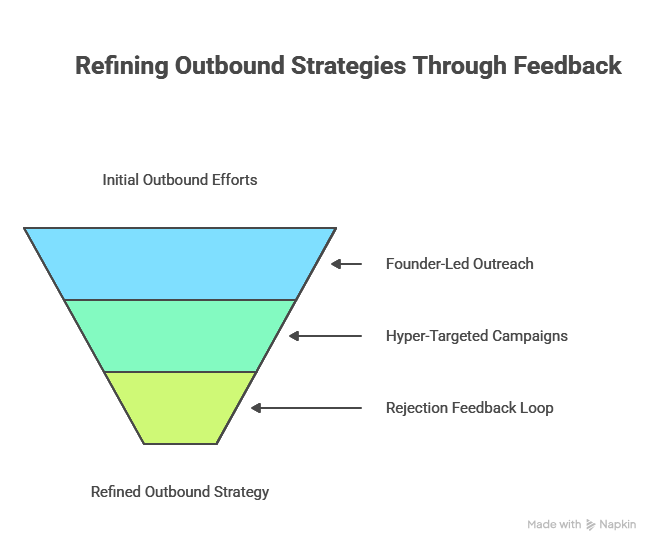
    • Founder-led cold outreach gets you into conversations faster than inbound can ramp. It’s often the best way to validate your ICP assumptions.

    • Hyper-targeted outbound teaches you more about your market than externalcompetitor GTM audits ever could.

    • Every rejection = a free data point to refine your pitch. That’s a more immediate feedback loop than waiting for market sizing data to catch up.

      Refining Outbound Strategies Through Feedback
      Refining Outbound Strategies Through Feedback

    Outbound isn’t optional at Seed. It’s your lifeline for proof points, logos, and the traction investors want to see.

    Example: We helped an early-stage FinTech startup run tightly segmented outbound campaigns. Within 90 days, they landed 10 pilot customers and shortened their feedback cycle by 40%. Those outbound learnings later powered their inbound messaging.

    Series A: Time for the Hybrid Hustle

    By Series A, outbound-only won’t cut it. Investors expect repeatability and an early inbound engine to show signs of scaling.

    Here, the model shifts into a hybrid 60/40 mix:

    • Outbound → Direct control of pipeline creation.

    • Inbound → Early signs of demand generation that compounds over time.

    Think of outbound as the sprint and inbound as the marathon. You need both. For example:

    The real unlock at this stage is integration. A singleGTM dashboard should track both motions, ensuring outbound efforts are feeding inbound insights (and vice versa).

    If your inbound engine isn’t showing signs of traction by late Series A, Series B will be a painful climb.

    Example: For a Series A FreightTech company, we built a hybrid model. Outbound provided the immediate pipeline, while inbound content and SEO reduced CAC by ~30%. Together, they created predictability that unlocked their Series B.


    Series B: Inbound Engine Takes the Wheel

    By Series B, outbound has done its job: it got you customers, traction, and market credibility. But scaling outbound headcount is expensive and CAC bloats quickly. This is where inbound must take the wheel.

    Your inbound motion should now be the engine driving growth:

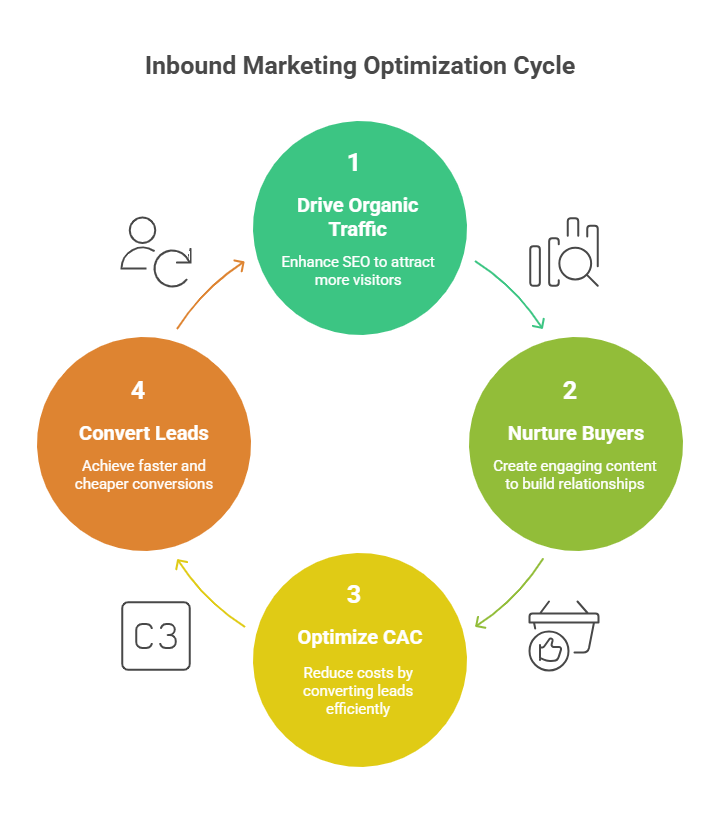
    • Consistent organic traffic growth throughSEO-led GTM channels.

    • A content flywheel that nurtures buyers – one of the best levers forCAC optimization.

    • Leads that convert at lower CAC and faster velocity than outbound prospects.

      Inbound Marketing Optimization Cycle
      Inbound Marketing Optimization Cycle

    Outbound doesn’t disappear – it evolves into surgicalaccount-based GTM plays triggered by buyer intent.

    The trap here? Founders keep funding SDR headcount instead of building inbound marketing muscle.

    Example: We worked with a SaaS company at Series B. Their outbound pipeline was steady but costly. By building a content-led inbound engine and layering RevOps attribution, we reduced CAC by 25–30% and shortened sales cycles by ~30%.

    Later Stage: Outbound Returns, But Smarter

    Once you’ve built a strong inbound foundation, outbound makes its comeback – but smarter, leaner, and more efficient.

    • Account-Based Marketing (ABM): Multi-channel campaigns targeted at your most strategic accounts, often supported by RevOps automation.

    • RevOps Alignment: Clean attribution ensures you know whether pipeline originated from inbound or outbound, a key metric in GTM maturity models.

    • Signal-Based Outbound: Using inbound intent signals (site visits, content downloads, event participation) as triggers for outreach. This modern approach is at the heart of cold outreach frameworks.

    At this stage, inbound and outbound no longer compete. They reinforce each other. Inbound generates signals. Outbound capitalizes on them.

    Investor Perspective: Growth-stage investors increasingly scrutinize whether your GTM is capital efficient. Without inbound-outbound alignment, you risk looking fragile.

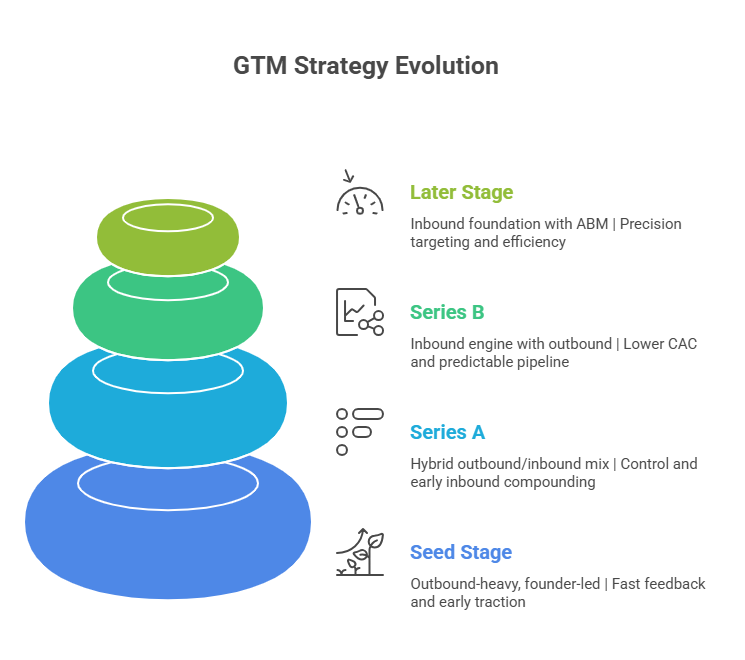
    The Stage-by-Stage GTM Roadmap

    Stage

    GTM Focus

    Why It Works

    Seed

    Outbound-heavy, founder-led

    Fast feedback + early traction

    Series A

    Hybrid (60/40 outbound/inbound)

    Control + early inbound compounding

    Series B

    Inbound engine + surgical outbound

    Lower CAC + predictable pipeline

    Later

    Inbound foundation + ABM outbound

    Precision targeting + efficiency

    GTM Strategy Evolution
    GTM Strategy Evolution

    Founder Takeaway

    Your GTM mix is never a one-time decision.

    • Outbound gets you off the ground.

    • Inbound keeps you in the air.

    • ABM ensures you don’t stall at scale.

    The biggest GTM failures don’t come from bad products. They come from founders running the wrong motion at the wrong stage. The winners are those who pivot early, rebalance their GTM mix, and build systems for predictable, sustainable growth.

    Ready to Balance Your GTM?

    At Phi, we’ve seen this pattern across FreightTech, FinTech, and SaaS. From helping AtoB capture 7% U.S. market share to transforming FreightTech sales engines, we know what stage-appropriate GTM looks like.

    If your pipeline feels inconsistent and you’re unsure where to double down, let’s talk. We’ll help you design a GTM roadmap that balances outbound and inbound – and scales with your stage.

  • The GTM Fit Matrix: Picking the Right Motion to Scale

    The GTM Fit Matrix: Picking the Right Motion to Scale

    Go-to-market (GTM) success isn't just about sales channels or flashy campaigns. It begins with a deeper, foundational question:

    Which GTM motion actually aligns with how your buyers want to discover, try, and buy your product?

    In 2025, founders face a paradox of choice. The GTM playbook has expanded to include Product-Led Growth (PLG), Sales-Led Growth (SLG), Community-Led Growth (CLG), Ecosystem-Led Growth (ELG), and hybrids of them all. But more options often create more confusion.

    Most startups don't stall from a lack of effort – they stall because they choose a motion that doesn't match their product, buyer behavior, or market dynamics.

    That's why the GTM Fit Matrix exists: a strategic decision framework to help founders intentionally choose (and evolve) the right GTM motion based on five critical variables: price, product complexity, buyer type, market maturity, and urgency of monetization.

    Founder insight: The best GTM motion isn't the one that worked for another startup – it's the one that matches your buyer's decision-making process.

    What Is a GTM Motion and Why It's Foundational

    A GTM motion defines how your company brings a product to market. It's not just how you sell – it's how users:

    • Discover your product

    • Engage with it

    • Evaluate it

    • Convert and expand

    Understanding this distinction is critical. Many founders confuse GTM channels with GTM motions. Channels are where you reach buyers. Motions are how you orchestrate the entire journey from awareness to close.

    Also explore how we define GTM execution success in our 10-part GTM audit framework.

    Common GTM Motions Explained

    Motion

    Best For

    Key Characteristics

    Sales-Led Growth (SLG)

    High-ACV, complex B2B

    Top-down, outbound-driven, consultative demos

    Product-Led Growth (PLG)

    Self-serve, intuitive products

    Freemium/free trial, short time-to-value

    Community-Led Growth (CLG)

    Emerging categories, developer tools

    Evangelists, user-generated content, peer influence

    Founder-Led GTM

    Early-stage, trust-dependent

    Storytelling, credibility, personal relationships

    Ecosystem-Led Growth

    API-first, integration-heavy

    Partnerships, marketplaces, co-selling

    Your motion influences everything: hiring plans, onboarding design, pricing, compensation models, and channel mix. Yet too many startups default to whatever motion worked for someone else – even if the fit is wrong.

    When we work with early-stage SaaS founders, the first question isn't "what's your sales process?" – it's "how does your ideal customer want to buy?"

    The GTM Fit Matrix: A Diagnostic Framework

    This matrix simplifies motion selection using 5 key inputs:

    Input

    PLG

    SLG

    CLG

    ACV (Price Point)

    <$2K/year

    >$10K/year

    Flexible

    Product Complexity

    Easy to self-serve

    Requires onboarding

    Easy to try, sticky

    Buyer Behavior

    Bottom-up (user-first)

    Top-down (committee)

    Peer influence

    Market Maturity

    Crowded

    Niche/Enterprise

    Emerging

    Monetization Speed

    Gradual

    Fast

    Long-term affinity

    This matrix isn't rigid. Think of it as diagnostic, not prescriptive – a decision-making aid rooted in your actual business, not startup hype.

    Understanding how CAC optimization influences your motion choice is essential. A $29/month product can't justify enterprise sales overhead, while a $60K/year contract demands consultative selling.

    Five Principles for GTM Motion Selection

    1. Anchor to ACV and CAC Logic

    Your average contract value (ACV) is the starting point for every motion decision.

    • Selling a $29/month product? You can't justify a sales team. Your GTM must be lean and product-led.

    • Selling $60K+/year enterprise contracts? Then you need reps who can build trust and drive urgency.

    Your CAC-to-LTV ratio tells you if a motion is viable:

    • PLG leans on efficient acquisition loops and viral growth

    • SLG justifies higher CAC with larger deal sizes and longer retention

    • CLG lowers CAC over time, but requires patience and momentum-building

    With a Series B fintech client, we combined PLG onboarding with SLG expansion – resulting in a 35% shorter sales cycle and a 25% CAC improvement. The key was recognizing that individual users wanted to self-serve, but budget holders needed sales validation.

    2. Know Who the Buyer Actually Is

    Does your user make the buying decision? This single question determines motion fit:

    Motion

    Decision Maker

    PLG

    User = Buyer

    SLG

    Buyer ≠ User (multi-stakeholder)

    CLG

    User evangelists influence buyers indirectly

    Misalignment causes friction. Building a self-serve product for a persona who expects sales validation? That's a recipe for abandoned trials. Hiring an SDR team before users are ready to talk? That's wasted burn rate.

    See how modern outbound teams fix buyer-fit issues, or learn how to scale your sales team the right way.

    3. Don't Just Look at Product – Look at the Journey 🗺️

    A great product isn't enough. Your evaluation journey matters just as much:

    • PLG thrives on fast onboarding, UI clarity, and immediate "aha" moments

    • SLG depends on consultative selling, urgency framing, and stakeholder alignment

    • CLG wins through community trust, social proof, and peer recommendations

    When we advised a FreightTech startup, their PLG-style dashboard failed initially because buyers couldn't understand its full value without a sales demo. We introduced guided product tours and deal support – unlocking a 40% conversion bump.

    Know why product storytelling matters in 2025 GTM. In a crowded, AI-saturated market, buyers don't just need to know what your product does – they need to understand why it exists, who it's built for, and how it fits their workflow.

    4. Consider Market Timing and Maturity

    Motion success = market timing × category signals.

    • In new markets (like AI-first tools), founder-led or community-driven GTM helps educate and inspire early adopters

    • In mature markets, aggressive sales motions or PLG wedges work better to capture existing demand

    • In crowded SaaS, dual-motion plays – SLG for key accounts, PLG for velocity – often unlock growth

    Explore FreightTech-specific GTM challenges we've solved for high-growth teams, where market maturity varies dramatically by segment.

    5. GTM Isn't One-and-Done – It Evolves 🔄

    GTM is not a fixed play – it's a progression:

    • Slack: Started PLG → added SLG → leaned into CLG

    • Notion: Grew via CLG → added sales-assist → scaled via PLG flows

    • Tome & Runway: Redefining PLG with AI-first onboarding (aha moment in <30 seconds)

    We often build motion evolution roadmaps tied to product-market fit milestones – especially post-Series A when the pressure to scale revenue intensifies.

    Investor perspective: VCs increasingly evaluate GTM motion fit during due diligence. A misaligned motion signals operational risk and extended runway requirements.

    Quick Diagnostic for Founders

    Ask yourself these five questions:

    1. Is your product intuitive enough to self-serve?

    2. Is the buyer a solo user or a buying committee?

    3. Can you afford 6+ months to build community traction?

    4. Does your narrative resonate in cold outbound?

    5. Are users naturally referring to others already?

    Scoring:

    • If 3+ answers lean user-first → start PLG

    • If 3+ lean decision-maker driven → start SLG

    • If "peer-driven" and "long-term" show up → CLG can be a layering motion

    For a deeper dive into channel selection, explore our guide on GTM channels to grow your startup.

    The Hidden Cost of Motion Mismatch

    When we conducted GTM audits for approximately 30-40 startups last year, a clear pattern emerged: motion mismatch was the #1 silent killer of growth.

    Common symptoms include:

    • High CAC with low payback periods

    • Sales cycles 2-3x industry benchmarks

    • Product engagement that doesn't convert to revenue

    • Marketing spend that generates leads but not pipeline

    One B2B SaaS company we advised was running a full enterprise sales motion for a $3K/year product. Their CAC exceeded LTV by roughly 40%. After transitioning to a hybrid PLG-with-sales-assist model, they reduced CAC by approximately 35% while increasing average deal size through product-qualified upsells.

    Fit Beats Flash

    Startups don't fail from a lack of tactic they fail from lack of GTM fit.

    Too many founders over-invest in tech stacks, tooling, and SDR headcount without asking: Does this motion make sense for our product and buyer journey?

    The GTM Fit Matrix forces that conversation before resources are committed.

    Three actions you can take today:

    1. Audit your current motion using the GTM execution playbook

    2. Stay ahead with 2025 GTM trends

    3. Learn why AI is now a core GTM engine

    Want Help Mapping Your GTM Motion?

    Choosing the right GTM motion isn't just a strategic exercise – it's the foundation for how you'll scale, hire, market, and close revenue.

    At Phi, we specialize in helping VC-backed startups engineer their GTM from first principles. Whether you're navigating early-stage product-market fit or trying to scale into repeatable revenue, we help you:

    • Diagnose your current GTM gaps

    • Align your motion to buyer behavior, ACV, and product maturity

    • Build execution plans across sales, marketing, and RevOps

    • Layer motions as you evolve (PLG → SLG, or SLG → CLG)

    • Turn GTM into a growth engine – not just a slide deck

    Let's talk GTM Fit and build your motion to scale with confidence.

  • Fixing a Stalled B2B Sales Pipeline: The GTM Audit Every Startup Needs

    Fixing a Stalled B2B Sales Pipeline: The GTM Audit Every Startup Needs

    “Pipeline isn’t a product of effort – it’s a product of alignment.” 
    – A founder client after our first audit

    Modern founders live this pain daily: spend on ads rises, SDR dials climb, yet the dashboard stays flat. Before you buy another tool or blame the market, step back. A stalled pipeline is a systems problem, not a hustle problem.

    Here’s a GTM tune-up that shows where misfires happen, how to run a 360° audit and where to go next. We’ve drafted it for founders, CROs and investors who need clarity, speed and predictable scale.

    Why Pipelines Stall in 2025

    Founders often assume “not enough leads.”

    In reality, we see five systemic culprits:

    Symptom

    Root Cause

    Quick Diagnostic

    Flat demo count

    ICP drift

    Compare last 20 deals to ideal-fit profile

    Low reply rate

    Feature-first messaging

    Run the “So-what?” test on cold email openers

    Stale channels

    Buyer hangouts shifted

    Map where top customers now engage (Slack, Discord, LinkedIn)

    Finger-pointing

    Siloed GTM teams

    Check if CS feedback reaches Marketing weekly

    No signal in CRM

    Bloated tooling

    Count tools → ask “Which ones talk to each other?”

    Investor viewpoint: A VC partner looks at the same table and sees burn rate compounding. Every misfire is a month’s runway lost.

    For a deeper dive into recurring blockers, skim our rundown on common execution pitfalls.

    The 5-Step Phi GTM Audit Framework 

    We’ve refined this audit across 70+ SaaS, FinTech, and FreightTech engagements. Most clients see a lift in 30 days – not by adding fuel, but by realigning the engine.

    1. ICP + Signal Fit

    Key question: Are we pursuing the right accounts based on today’s buying triggers?

    • Parse win/loss notes for patterns

    • Track tech-stack changes with Clay

    • Monitor hiring bursts (e.g., adding RevOps head → readiness to scale)

    • Watch regulatory deadlines in FinTech & FreightTech

    Phi tip: Dynamic, living ICPs outperform static PDFs by ±30 % in conversion. Want a step-by-step?
    Grab our GTM audit checklist.

    2. Narrative Alignment

    Are we selling urgency or features?

    • Cold email: First line should trigger pain, not demo curiosity

    •  Calls: 60-second “diagnose > demo” flip

    •  LinkedIn: Founder-to-founder voice > sequence feel

    When narrative clicks, pipeline velocity can lift ~30-40 %. For inspiration, see how data storytelling powers wins in our data-powered GTM insights.

    3. Channel Strategy

    Are we where the buyer is – or where our team is comfy?

    • Identify top-performing mediums by meeting booked / attempt

    • Mix voice, video, LinkedIn DMs, and intent-scored email

    • Avoid channel monoculture (over-relying on cold email ≠ strategy)

    4. Systems & Stack

    Less tools, tighter loops.

    • Map every touchpoint from first view → renewal

    • Integrate a lean Clay → HubSpot → Instantly loop

    • Ensure attribution is science, not guesswork

    Read how AI replaces headcount in our guide on scaling GTM with AI.

    5. Feedback Loops

    Build a learning GTM culture.

    • Weekly GTM syncs with Marketing, Sales, CS

    • Track live objections in a shared doc

    • Conduct Closed-Won reverse-engineering sessions

    • Hold loss post-mortems within 48 hrs

    A solid loop reduces CAC by roughly 20-30 % – details in our CAC optimization playbook.

    Real-World Proof: GTM Systems In Action

    Case 1 – FreightTech (Series A)

    Their SDRs were running hard – dozens of outbound messages daily, plenty of opens… but demos weren’t landing. The team was focused on mid-market logistics companies, thinking faster shipping ops were the hook.

    What We Found:

    A quick GTM audit showed the real buying motion was happening at the enterprise level and the primary pain wasn’t speed. It was compliance. Procurement teams were under regulatory pressure, and needed audit-ready freight workflows. That insight changed it all.

    What We Fixed:

    •  Moved from volume shippers to compliance-sensitive 3PLs

    • Rebuilt outreach to lead with regulatory readiness, not delivery speed

    • Used hiring patterns and RFP activity as intent signals

    The Result:

    • 4.5× increase in booked meetings in 30 days

    • 38% faster sales velocity across the board

    • Reps stopped “spraying,” started converting

    Deeper story: See the full TruckX transformation 

    Case 2 –  FinTech (Growth Stage)

    The team had traction, funding and a full-stack GTM team. But CAC was ballooning and pipeline growth had plateaued. Despite hiring, nothing moved.

    Stalled Pipeline Symptom:

    The team had traction, funding and a full-stack GTM team. But CAC was ballooning and pipeline growth had plateaued. Despite hiring, nothing moved.

    What We Found:

    There were 11 disconnected GTM tools in the stack, from enrichment to attribution to engagement. No one trusted the dashboards. Reps were relying on anecdotal wins. Data lived everywhere –  and nowhere.

    What We Fixed:

    • Reduced GTM tooling from 11 to 4

    • Created unified dashboards for funnel, conversion, and CAC

    • Built source-to-close visibility and proper follow-up logic

    The Result:

    • 25–35% drop in CAC within a quarter

    • Pipeline doubled QoQ with the same headcount

    • Board confidence rose and so did Series C valuation

    Implementation Roadmap (Founder View) 

    Week

    Action

    Owner

    Expected Impact

    0-1

    Kick-off audit workshop

    Founder + Phi

    Shared definitions, data access

    1-2

    ICP + signal mapping

    GTM Engineer

    15 % increase in qualified list size

    2-3

    Narrative revamp sprints

    Marketing Lead

    +20 % open / reply rates

    3-4

    Channel mix pilots

    SDR Manager

    Identify top conversion combo

    4-6

    Stack consolidation

    RevOps

    Reduce cost & noise

    6-8

    Feedback loop rituals

    CRO

    Continuous optimization

    Customer-journey lens: Buyers feel the shift immediately – messages reference real triggers, demos address real stakes and follow-up is contextual.

    FAQ: Common Founder Objections 

    Q1. “Can’t I just hire more AEs?” 
    A: You’ll scale inefficiency. Fix alignment first, then add headcount – see our guide on scaling your sales team.

    Q2. “Is this only for SaaS?”
     A: No. We’ve applied the framework to FinTech, Cloud and FreightTech. Core principles stay, signals differ.

    Q3. “What if we’re seed-stage?”
     A: The audit still matters, but scale scope down. Focus on ICP clarity and narrative; complex stack work can wait.

    Trending Signals to Watch in H2 2025 

    • AI-assisted outbound goes mainstream; SDRs wield GPT call coaches.

    • Privacy-driven CMP laws tighten email deliverability – shift more touches to opted-in channels.

    • PLG+SLG hybrids surge; founders blend freemium triggers with high-touch sales. – Dig deeper in our piece on AI & GTM strategy shifts.

    Final Take: Systems > Tactics

    Your startup’s growth engine isn’t a stack of tools or a superstar VP. It’s a living system of precision ICPs, compelling narratives, right-fit channels, lean tech and tight learning loops.

    If your dashboard’s flat-lining, audit before you accelerate. 

    Tune the Engine, Don’t Just Add More Fuel

    A stalled pipeline isn’t always a signal to spend more. It’s often a sign to realign your system.

    In 2025, the startups that scale consistently aren’t just chasing more leads, they’re building better engines: Engines powered by evolving ICPs, pain-driven messaging, channel-fit outreach and real-time feedback loops.

    GTM isn’t a one-time launch. It’s a continuous system of testing, tuning, and tightening execution.

    If your sales pipeline has slowed down, before you hire more SDRs or double your ad budget – audit the motion. Look under the hood. Find what’s dragging. Rebuild where necessary.

    Because in a market moving this fast, the real advantage isn't speed – it’s clarity.

    Want to See What That Looks Like for Your Startup?

    We specialize in done-with-you GTM audits that go far beyond strategy decks or playbook PDFs. Our audits translate into 30-60-90 day execution roadmaps, tailored to your stage, industry and motion. We dig into your ICP, your outbound engine, your tool stack and your messaging – and then help you rebuild what’s not working.

    Think of us as your GTM co-pilot – we don’t just point at what’s broken. We help you fix it, test it and scale it.

    Book a discovery call – let’s tune the engine, not just add more fuel.

  • AI Isn’t a GTM Add-On Anymore – It’s Your Execution Engine

    AI Isn’t a GTM Add-On Anymore – It’s Your Execution Engine

    Most B2B startups today can list the AI tools in their stack faster than they can explain how those tools move the pipeline.

    They’ll say things like:

    “We use ChatGPT for content.”“
    We automated outbound with Clay.”
    “We added AI call summaries to our CRM.”

    Sounds modern. But here’s the uncomfortable truth: 

    Adding AI ≠ building an AI-powered GTM motion.

    In 2023–2024, AI was a tactical add-on, mostly a marketing sidekick.

    In 2025, it's something else entirely:

    AI is now a GTM operating model – not just a set of tools.

    A model that drives how you target, sequence, qualify, close and retain customers.
    But if your AI lives inside disconnected tools, you’re not scaling GTM, you’re scaling chaos.

    The First Wave: AI for Speed, Not Strategy

    Let’s rewind to the early AI hype cycle:

    • Content teams used AI to generate SEO blogs

    • SDRs used it for intro-line personalization

    • Marketers relied on ChatGPT to spin up landing pages fast

    This brought surface-level efficiency, but it masked deeper issues.

    Because underneath all that AI activity, the GTM engine – your ICP, segmentation, attribution, buyer modeling and win-loss feedback remained untouched.

    As we outlined inMistakes in B2B Go-To-Market Strategy, speed without orchestration is a vanity upgrade. Not a system.

    The Shift: AI as Infrastructure for Modern GTM

    The most forward-leaning teams we work with – from FinTech to FreightTech, aren’t just using AI. They’re operating on it.

    AI isn’t a dashboard feature. It’s the underlying OS powering sales, marketing, CS, RevOps and product decisions.

    At Phi, we call this the AI-Powered GTM Engine – an evolution from static funnels to intelligent feedback systems.

     Explore: The GTM Multiplier: How Cross-Functional Alignment Accelerates Execution

    What That Actually Looks Like (Not Just Talk) 

    1. Smart ICP + TAM Discovery

    Don’t build your ICP from a whiteboard session.

    But, analyse:

    • Hiring data + messaging shifts

    • Tech stack indicators

    • Buyer intent from public sources

    • LinkedIn activity + competitor engagement

    With Clay and enrichment systems, train AI to find real buyer signals, not just idealized personas.

    And if you're still guessing your TAM?

    Read: What Is Total Addressable Market (TAM)?

    2. Signal-Based Segmentation

    Forget “industry + headcount.” Instead, segment on urgency, activation likelihood and product relevance – and your models should learn from every campaign.

    For deeper insight: Explore: Customer Segmentation in a Successful GTM

    3. Playbooks That Learn

    Every outbound that runs should inform the next.A/B testing tones, CTAs, offer sequencing shouldn’t come with gut feel, but with AI pattern recognition.

    Over time, your GTM motion becomes smarter, faster and more relevant.

    This ties into our thinking on Winning GTM Strategies Through Data Analytics – where strategy isn’t static. It’s adaptive.

    4. RevOps That Orchestrates, Not Reacts

    Most teams treat RevOps like a reporting layer. Instead, treat it like an operating layer.

    GTM velocity demands AI-powered RevOps that connect systems, not just monitor them.

    How to use AI across the funnel:

    • Lead scoring adapts to funnel velocity

    • Routing logic updates based on close rate by segment

    • Sales enablement is powered by win/loss call summaries

    • Attribution is stitched across channels + tools

    Explore more in RevOps Automation for Startups

    5. Human-AI Handoffs Built In 

    Don’t chase “full automation.” Build collaborative workflows:

    • SDRs using AI-curated insights to personalize better

    • AEs getting coaching from AI call summaries

    • CS teams using usage analytics to reduce churn

    It’s all about orchestration, not replacement.

    Learn more: AI SDRs Explained: Redefining Sales Development

    Why Most Startups Get This Wrong

    In most teams we audit:

    • Marketing owns ChatGPT

    • Sales uses Gong AI

    • The founder plays with prompts on weekends

    • RevOps is buried in dashboards

    No one connects the dots. So the “AI stack” grows, but nothing improves.

    The result?

    Faster noise. Not smarter GTM.

    We diagnose these siloes in our Go-To-Market Audit: 10 Areas to Diagnose Your Startup GTM

    What Founders Should Ask Themselves:

    • Is AI surfacing revenue insights or just writing faster copy?

    • Are we using AI to prioritize GTM investment?

    • Is our GTM strategy improving, or just our task speed?

    If the answer is “no”,  then you don’t have an AI-powered GTM system. You have AI noise.

    The AI-Powered GTM Model: What’s Required

    1. Shared GTM playbooks across teams

    2. RevOps as the AI orchestrator, not a passive reporter

    3. ICP + segmentation defined by signals, not hunches

    4.  Feedback loops that train your systems

    5.  QA layers for AI outputs

    6. Cross-functional ownership (not just “Marketing’s toys”)

    Need a blueprint?

    Start here: How Cross-Functional Teams and AI Make GTM Strategy Effective

    Real Results From Real Teams 

    With a FinTech startup we advised:

    • AI-enabled segmentation improved conversion rates by 35%

    • Sales cycle reduced by ~30%

    • CAC dropped by ~25%

    With a FreightTech company:

    Our signal-based outbound playbooks unlocked $400K in new pipeline in 6 weeks

    Retention improved after AI insights were routed to CS weekly.

    Both built using systems we outlined in our AI Agent Models for GTM

    AI Is Not the Answer – It’s the Framework

    Startups winning in 2025 aren't using more AI, they're using it differently.

    They've stopped treating AI like a sidekick and started using it as their GTM Operating system.

    You don't need a 10-person RevOps team. You need a partner who builds systems, not dashboards.

    Want to see how we’d structure your AI-powered GTM motion?
    Let’s talk!

  • Cold Calling in the AI Era: Smart Scripts, ICP Targeting & GTM Alignment

    Cold Calling in the AI Era: Smart Scripts, ICP Targeting & GTM Alignment

    Cold calling isn’t dead.

    But random dials, one-size-fits-all scripts and untargeted lists? Very much dead – and if you’re still relying on them, they’re dragging your GTM engine downstream.

    We’re in the AI-powered GTM era, where sales motions should be as smart, dynamic and insight-driven as your product. Yet cold calling is still often treated as a low-value, high-volume afterthought.

    The cold truth:

    Cold calling still works. But only when it's rebuilt around three 2025-proof pillars:

    • Smart scripts powered by real context

    • Precise ICP targeting with signal-based triggers

    • Full alignment with your GTM strategy – not siloed SDR hustle

    Founders aren’t asking “Should we still cold call?” They’re asking,
    “How can our cold call strategy match the precision of our product?”

    Why Cold Calling Breaks Down

    Most cold calling issues stem from a breakdown in GTM integration – something we unpack deeply in The GTM Strategy Execution Playbook.

    Here's how it usually fails:

    • SDRs get huge, generic contact lists

    • Scripts are static and unpersonalized

    • Calls happen with no regard for buyer timing or signals

    • The CTA is always “book a demo”, no matter the stage

    No surprise: low pick-up rates, ghosted demos and burnt-out SDR teams.

    The fix? Treat cold calling like a GTM-layered motion, not a one-off tactic.

    Cold Calling as a Strategic GTM Feedback Loop

    When cold calling is done right, it connects with your entire GTM engine – like this:

    → ICP research → Signal-based scoring → AI-personalized context → Cold call
    → Insights back into GTM ops

    It becomes a live testing ground for:

    This loop transforms cold calls from an “interruptive tactic” to an insight engine.

    Smart ICP Targeting: Beyond Job Titles

    By 2025, static ICPs are obsolete.

    Your cold call list shouldn’t just be “RevOps at Series A SaaS companies.” It should be filtered by buying signals, such as:

    • Recent HubSpot or Salesforce installs

    • Teams hiring AEs or BDRs

    • New region launches or go-to-market teams

    • Recent funding rounds or org restructures

    To do this, teams now rely on tools like Clay and Apollo to integrate real-time triggers directly into their GTM workflow.

    For a detailed guide, check out Account-Based Go-To-Market Strategy.

    Timing is everything. When you show up in the moment of need, you’re not cold
    – you’re crucial.

    Smart Scripts That Don’t Sound Scripted

    Today’s cold calls start with diagnosis, not a pitch.

    Outdated:

    “Hi John, I’m calling from [company name]. We help companies like yours save time…”

    2025 version:

    “Hey John, noticed you hired 3 SDRs and just rolled out Salesforce – curious how you're managing territory assignment?”

    It’s context-first. And it only works if you:

    • Build dynamic, modular templates

    • Pull in real-time firmographic + technographic data

    • Adjust tone and CTA based on buying stage

    We break down this personalization engine in How to Build a High-Performing SDR System.

    Smart scripts today = 70% reusable structure + 30% contextual modulation. And that 30% drives 90% of conversions.

    The 5-Step Cold Call Framework (Phi-Style)

    Here’s how we’ve helped clients modernize their calling motion:

    1. Micro‑Segment Your ICP

    • Stop targeting all SaaS. Start with:

    2. Build Signal‑Driven Lists

    Each call should answer:

    • Why now?

    • What’s the trigger?

    • What’s their current challenge?

    Example: “Company X just hired 4 AEs” – perfect time to pitch onboarding automation.

    3. Personalize the First 20 Seconds

    AI-generated intros like:

    “Saw your Dubai launch – building outbound there yet?”

    “Congrats on the $10M raise – exploring RevOps hires or outsourcing?”

     These spark strategic convos – not sales resistance.

    4. Align Cold Calls with GTM Goals

    Not every call should lead to a demo. Match your CTA to the buyer’s stage:

    • Awareness → Insight share

    • Warm ICP → GTM workshop

    • Late-stage → Direct AE connect

    For broader strategy alignment, see Laws of GTM Strategy Success

    5. Turn Calls into Content & Strategy

    Every call is a market interview.

    Capture:

    • Pain points

    • Language patterns

    • Objection themes

     Then loop that back into:

    • Email & ad copy

    • Sales playbooks

    • Product messaging

    You’ll see how Cross-Functional Teams Accelerate GTM Execution

    Founders: You Should Be Calling Too

    If you’re a founder – your best GTM insights won’t come from dashboards.
    They’ll come from 10 real conversations with actual buyers.

    Founders who dial:

    • Hear unedited buyer feedback

    • Build sharper positioning and messaging

    • Understand psychological buying moments

    For Series A-B founders, see How Startups Achieve Product-Market Fit

    Even 10 dials a week can reshape how you build, sell, and scale.

    Metrics That Actually Matter in 2025

    Move beyond vanity KPIs (dials, talk time).

    Instead, track:

    • % of calls tied to live buying signals

    • First 15s engagement rate

    • Insight surfaced per call

    • Call → conversation → opportunity pipeline conversion

    This is how cold calls shift from filler to revenue multiplier.

    Cold Calling Isn’t Dead – Just Smarter Now

    Buyers haven’t stopped picking up the phone.

    They’ve stopped listening to bad, contextless calls.

    In 2025, the best GTM teams are those who:

    To make cold calling work in 2025, founders and GTM teams must shift from volume to precision, from templates to signals and from silos to alignment.

    Here’s the quick recap:

    • Cold calling works – but only when powered by AI, real-time context, and GTM alignment

    • ICP segmentation must be signal-based, not static job titles or firmographics

    • Smart scripts are modular, dynamic, and problem-first – not pitch-first

    • Founders should lead or listen in weekly to learn directly from buyer conversations

    • Success is measured by strategic conversations, not just booked demos

    Modern cold calling isn’t about dialing more, it’s about dialing smarter.

    Want to See This in Action?

    At Phi, we don’t just talk about the cold calling strategy, we build it into scalable outbound systems that drive real pipelines.

    We’ve helped a number of B2B startups – especially in FinTech and FreightTech, transform outdated cold calling motions into signal-driven, AI-powered, GTM-aligned outbound engines.

    Founders we work with no longer wonder if cold calling “still works”  – they use it as a real-time insight loop to refine positioning, validate market pain points and engage buyers when timing matters most.

    If you're scaling and want a cold calling strategy that doesn’t just book meetings but moves the needle on revenue, retention and reputation –  we’d love to show you how.

    Let’s build an outbound engine your buyers actually want to answer!

  • The GTM Multiplier: How Cross-Functional Alignment Accelerates Execution and Revenue

    The GTM Multiplier: How Cross-Functional Alignment Accelerates Execution and Revenue

    The GTM Multiplier: How Cross-Functional Alignment Accelerates Execution and Revenue

    If you're a B2B founder navigating a crowded market, here's a harsh truth: great products don't scale themselves, and brilliant hires won't fix a broken GTM engine.

    What does? Cross-functional execution that compounds – where Sales, Marketing, and Customer Success operate as an integrated revenue system, not siloed departments. As we've seen in dozens of GTM strategy audits, the most common failure points aren't in vision – they're in execution.

    The fastest-growing startups don't win because they outspend competitors. They win because their teams build together, move together, and learn together.

    The Silo Problem: Where Most GTM Plans Go to Die

    The default state for early-stage startups is disconnected execution:

    • Marketing pushes MQLs without feedback loops

    • Sales chases inconsistent leads with no context on what messaging actually resonated

    • CS fights fires post-sale, blindsided by poor handoffs and misaligned expectations set during the sales process

    This fragmentation leads to predictable failures:

    Campaigns that attract the wrong persona, burning budget on unqualified traffic
    Sales teams struggling with bad-fit demos that never convert
    Onboarding friction from misaligned expectations between what was sold and what can be delivered
    Revenue forecasting that's pure guesswork because pipeline data doesn't reflect reality

    It's not a talent problem – it's a systems problem. And it's costing you 25-40% of potential revenue velocity.

    "Most GTM issues we diagnose aren't strategy flaws – they're execution breakdowns caused by silos."
    – From our GTM Execution Audit Guide

    When we worked with a Series A logistics startup, their sales team was closing deals 30% slower than industry benchmarks. The root cause? Marketing was targeting mid-market accounts while Sales had optimized their pitch for enterprise buyers. Nobody was tracking conversion rates by segment, so the misalignment persisted for eight months before we caught it.

    That's the hidden tax of silos: slow-burning inefficiency that looks like individual underperformance but is actually organizational design failure.

    Why Founders Must Rethink GTM as a Team Sport

    Your go-to-market strategy isn't just a Sales play – it's an organizational capability that requires revenue operations thinking from day one.

    When functions operate in silos:

    • Marketing lacks visibility into pipeline velocity and can't optimize campaigns for actual revenue outcomes

    • Sales has no context on churn drivers or CS insights that could prevent deals from going sideways post-close

    • CS can't prioritize expansion because they're fixing broken onboarding caused by unrealistic promises made during the sale

    With cross-functional GTM alignment:

    Traditional GTM

    Cross-Functional GTM

    Handoff-based workflows

    Continuous collaboration across stages

    Departmental KPIs (MQLs, quota, CSAT)

    Shared revenue metrics (ARR growth, deal size, retention)

    Static ICPs updated annually

    ICPs refreshed weekly with Sales + CS input

    Marketing owns awareness

    Marketing co-owns pipeline + revenue execution

    Sales owns close

    Sales informs product roadmap with frontline insights

    CS owns retention

    CS drives expansion and feeds objections back to Sales

    Cross-functional GTM turns isolated effort into revenue predictability – something we explore in our breakdown of data-driven GTM strategies.

    The difference isn't incremental. When we embedded a cross-functional GTM pod with a freight tech client, they compressed their sales cycle length from 87 days to 52 days in one quarter. Not because they hired faster closers, but because Marketing, Sales, and CS were finally sharing the same playbook.

    What Cross-Functional GTM Looks Like in Practice

    1. Marketing: From Top-of-Funnel to Pipeline Architects

    In a silo, Marketing optimizes for lead volume. In a pod, they optimize for pipeline acceleration and revenue contribution.

    How to get it right:

    Co-build ICPs with Sales based on closed-won insights, not assumptions
    Use CS feedback to personalize pain-point messaging that addresses real post-sale friction
    Feed real-time experiment insights (email open rates, content engagement) into outbound motion
    Attend revenue syncs – not just campaign standups – to calibrate messaging by cohort and buyer persona development

    At Phi, our marketing analysts often join weekly revenue calls. Why? Because the best marketing and sales alignment happens when marketers hear exactly why deals stall, what objections kill momentum, and which value props actually close.

    When a proptech startup we advised shifted their content strategy based on CS churn data, they saw a 35-40% improvement in demo-to-close rates within 60 days. The shift? Addressing implementation concerns in the marketing content instead of waiting for Sales to handle objections live.

    Explore: Components of a B2B GTM Strategy

    2. Sales: From Solo Hunters to Collaborative Closers

    Without context, Sales wastes 30-50% of their time on the wrong personas or poorly qualified leads.

    With a pod in play:

    • Sales + Marketing sync weekly to refine segments by win rates and velocity

    • CS shares friction points (implementation delays, API complexity, onboarding gaps) that preempt churn during demos

    • Sales insights update ICP models weekly, not quarterly — creating a feedback loop that sharpens targeting in real time

    This type of sales enablement is what separates scalable systems from founder-led heroics, as we explore in how startups align sales execution with GTM vision.

    Real-world impact:
    A fintech company we worked with was burning through SDR capacity chasing accounts that never converted. After implementing weekly Sales-CS sync calls, they identified that accounts with <10 employees churned at 3x the rate of mid-market deals. Sales immediately shifted focus, and within 45 days, average deal size increased by roughly 28% while sales productivity per rep jumped 40%.

    3. Customer Success: From Support to GTM Co-Designers

    Post-sale teams are insight goldmines that most startups completely waste.

    High-performing CS teams:

    Share churn signals + expansion flags with GTM teams in real time
    Identify product use-cases that become outbound storytelling assets
    Nominate customers for case study loops and reference calls
    Feed objection patterns back to Marketing for content creation
    Map customer journey friction points that Sales can address pre-close

    Dive deeper: Why You Need to Build CS Into Your Startup's DNA

    When CS owns a seat at the GTM table, magic happens. A cloud infrastructure startup we supported saw a 22-30% lift in expansion revenue after CS started flagging high-usage accounts to Sales for upsell conversations. The key? CS had been sitting on product adoption data that Sales didn't even know existed.

    The Operating System: GTM Pods > Departments

    This isn't about more meetings – it's about a new unified GTM motion.

    GTM Pods are agile, cross-functional teams composed of Sales, Marketing, and CS owners aligned to a segment, motion, or strategic play. They operate as mini-revenue engines with:

    • Shared OKRs tied to pipeline, close rates, and retention

    • Weekly sync rituals focused on what's working and what's breaking

    • Real-time data loops (CRM, product usage, support tickets) accessible to all members

    • Authority to experiment and iterate without waiting for executive approval

    The results speak for themselves:

    – Reduce lead-to-demo friction by 30-50%
    – Shrink feedback loops from weeks to days
    – Drive post-sale expansion up to 35-40% in some quarters

    When paired with RevOps automation, pods become the engine of compound learning and growth.

    Example: A FreightTech GTM Pod in Action

    Let's say you're targeting mid-market freight platforms using an account-based go-to-market strategy:

    Week 1:

    • Marketing identifies 30 high-signal accounts via hiring data + topic intent signals

    • Sales enriches leads using Clay-powered workflows and confirms decision-maker contacts

    Week 2:

    • Sales runs initial outreach with messaging informed by Marketing's content engagement data

    • CS flags onboarding friction patterns (e.g., API latency concerns) from similar accounts

    Week 3:

    • Marketing updates nurture sequences to address API concerns before the demo

    • Sales adjusts pitch deck to include technical implementation timeline

    • CS prepares onboarding checklist addressing known friction points

    The result? Sharper messaging, shorter sales cycles (from 75 days to 48 days), and fewer onboarding surprises that cause early churn.

    This is GTM execution at its finest – not theory, but a living system that learns and adapts.

    Metrics That Matter in Cross-Functional GTM

    Your dashboards should reflect team outcomes, not just departmental vanity metrics.

    Key metrics to track:

    Metric

    What It Reveals

    Win rate by segment

    Messaging and ICP alignment quality

    Demo-to-close velocity

    Pre-sale collaboration effectiveness

    Expansion within 60 days

    Onboarding + adoption signal strength

    Churn reasons by cohort

    CS feedback loop quality

    Pipeline velocity

    Cross-functional coordination efficiency

    Average deal size

    Targeting precision and value delivery

    We explore these in detail in our GTM Success Metrics Guide.

    Pitfalls to Avoid

    Even great teams struggle without structure. Watch out for:

    Meeting overload – Use async updates + shared dashboards instead of daily syncs
    Blurry accountability – Assign clear motion owners for each pod initiative
    Misaligned incentives – Create shared KPIs across functions (not competing metrics)
    Tool sprawl – Consolidate your GTM tech stack to reduce friction
    No feedback mechanism – Build structured retros into your pod rhythm

    Pro tip: Use customer segmentation to assign pods to verticals or ICP slices, ensuring focus and expertise depth.

    Why This Matters More in 2025 Than Ever Before

    AI has made outbound easier and noisier. The buyer journey is multi-threaded, long, and complex, with buying committee engagement spanning 6-12 stakeholders in enterprise deals.

    Only companies with cross-functional coordination can:

    Personalize at scale without sacrificing authenticity
    Move fast on real-time buyer signals
    Create trust-rich, feedback-driven journeys that close faster
    Deliver on promises made during the sale

    We highlight this evolution in our 2025 GTM Predictions and why cross-functional teams are the bedrock of scalable execution.

    Final Word for Founders

    Don't build GTM around individuals. Build systems that scale.

    The best teams don't just sell together – they learn together, iterate faster, and win the market through compounding execution advantages.

    So ask yourself:

    "Do I have great people in Sales, Marketing, and CS?"

    Or the better question:

    "Do those people build together?"

    Because that's how you don't just scale pipeline – you scale trust, learning, and revenue.

    Ready to Build Your GTM Pod?

    At Phi, we specialize in embedding cross-functional GTM consulting systems that scale – faster, smarter, and with precision. Our pods are purpose-built to drive revenue outcomes, not departmental metrics.

    Book a free GTM strategy audit
    See how we embed RevOps, Sales, and Marketing into one motion
    Get access to proven playbooks that compound pipeline and retention

    |Schedule your GTM review now

    More Guides to Deepen Your GTM Strategy:

  • B2B Startups: Why Your GTM Stack Isn’t Your Strategy

    B2B Startups: Why Your GTM Stack Isn’t Your Strategy

    If you're a B2B founder – especially in SaaS – here's a tough truth:

    Jumping into go-to-market (GTM) tools before nailing your strategy is like pouring fuel into a car with no engine. You burn money, make noise, but you don't go anywhere.

    We get it. Tools like Clay, Zapier, and Instantly are tempting. AI agents promise scale. Automations promise speed.

    But here's the core issue:

    GTM isn’t built on your tech stack. It’s built on strategic clarity.

    If you're unsure where to start, check out our GTM Strategy for B2B Startup Founders, explore Components of B2B GTM Strategy, or learn from the GTM Execution Playbook.

    To scale pipeline, you need:

    • Deep customer insight

    • A repeatable motion

    • A system for measurable execution

    Tools amplify what works, but they can’t fix broken GTM. Let’s unpack where founders go wrong – and how to get it right.

    What Most Founders Get Wrong About GTM 😬

    You launch your product. You’re excited. You start seeing Clay flows, Zapier automations, and cold email hacks in Slack groups and Twitter threads.

    Before long, you're deep into onboarding sequences and workflows without ever asking:

    • "What is our core GTM motion?"

    • "Who are we targeting, and why now?"

    Without clarity, this is what happens:

    • You confuse activity for traction

    • You build stacks instead of systems

    • You overlook product-market fit signals buried in customer feedback

    Tools without strategy are distractions – not growth levers.

    In our GTM audits, we see this mistake in 7 out of 10 early-stage startups. And the root cause is always the same: they skipped the fundamentals.

    GTM Strategy First. Always. 🌟

    Before touching tools, every founder should confidently answer these five questions:

    Strategic Question

    Why It Matters

    Who exactly are we selling to?

    Defines ICP, buyer personas, and segments

    What problem are we solving—and how urgently?

    Validates positioning and buyer intent

    How do we reach them?

    Clarifies whether your motion is inbound, outbound, PLG, or hybrid

    What does the buyer journey look like?

    Aligns content, messaging, and RevOps handoffs

    What does success look like at each stage?

    Anchors your funnel to measurable outcomes

    These questions sound simple, but skipping them leads to:

    Only when these foundations are set should tools enter the picture.

    Tools Have a Place – But Only in Service of Strategy 🔧

    When used after GTM clarity, tools become force multipliers. Here’s where they shine:

    1. Lead List Building

    Lead sourcing isn't a volume game—it’s about quality, intent, and timing. Once your ICP is defined:

    • Clay automates multi-layered lead research

    • RB2B, Vector add real-time intent signals

    • ZeroBounce, NeverBounce handle validation

    Read: Customer segmentation in a successful GTM

    2. Messaging & Non-Voice Outreach

    Your SDRs don’t need more tools – they need message-market fit:

    • ChatGPT, Gemini, Claude for copy generation

    • Instantly, Smartlead for multichannel sequencing

    • Heyreach, Aimfox for LinkedIn outreach

    • Maildoso for domain warming

    But first? Nail your outbound messaging frameworks.

    3. Automation Infrastructure

    Automation ≠ Execution.

    Use:

    • n8n or Make to route leads

    • Zapier for logic workflows

    • Clay to tie sequencing + logging

    Only after your buyer journey is mapped.

    See: GTM execution challenges most B2B startups face

    What Happens When You Start With Tools First ⚡

    Startups that go tool-first often:

    • Burn $10K–30K+ with no pipeline impact

    • Waste weeks building automations that never convert

    • Confuse motion ownership between founders, RevOps, and SDRs

    • Misalign sales vs marketing messaging

    Tools don’t fix broken GTM. They just look good in screenshots.

    You can read 50 threads on GTM stacks – but without a system underneath, you're building noise.

    From Chaos to Clarity: A Fintech Case Study ✅

    A fintech startup we advised was stuck at ~$2M ARR. They had:

    • Clay flows

    • Wiza enrichment

    • A/B tested sequences

    But no clear ICP. SDRs wrote their own messaging. Buyer journey? Nonexistent.

    We rebuilt the GTM architecture in 10 days. Within 30 days:

    • Reply rate increased from 0.2% to ~3%

    • Demo volume tripled

    • CAC dropped by 25–30%

    Read the full story

    Clarity was the unlock. Not more tools.

    The Future of GTM Is Clarity-First 🔄

    Feeling stuck in tool fatigue? Here’s your move:

    Start by zooming out. Revisit your GTM architecture:

    • Is your ICP real, or a persona from a whiteboard?

    • Is your motion sequenced? Do you know the first step, handoff point, and exit criteria?

    • Is your messaging aligned across channels?

    Read: GTM Strategy for B2B Startup Founders

    Founders Who Win:

    They don’t chase hacks. They:

    • Lead with a strong POV

    • Iterate in-market, not in Notion

    • Build systems that scale, even when headcount doesn't

    See: Scale GTM with AI Instead of Headcount

    At Phi, we don’t just plug in tools – we architect systems.

    In our work with scaling B2B startups, tools only unlock results when plugged into strategic execution engines.

    Whether you're:

    • Transitioning from fractional RevOps to full-scale GTM

    • Aligning sales execution with your GTM vision

    • Or optimizing CAC across your funnel

    ⭐ It all starts with strategy.

    If you're ready to stop stacking tools and start building systems, schedule a strategy call with our team today.

    Let’s build something that compounds.