Category: GTM

  • The 90-Day Blueprint to Build Your Contact-Based Marketing Engine

    The 90-Day Blueprint to Build Your Contact-Based Marketing Engine

    The Problem No One Wants to Say Out Loud

    You've got pipeline reviews where the answer to "what happened?" is always some version of timing.

    "They went dark." "The budget got frozen." "They're evaluating next quarter."

    Meanwhile, your CRM is full of accounts that were "hot" six months ago. Your reps are working off personal spreadsheets. Marketing is running campaigns to a list no one trusts. And every board meeting ends with the same question:

    Why didn't we see this pipeline sooner?

    Here's what's actually happening: You're running outbound like it's 2019. Spray and pray with a better subject line. Maybe some intent data that goes into a report no one reads.

    The companies pulling ahead – the ones hitting 140% of quota while you're explaining away a miss – aren't working harder. They built a system.

    This is that system.

    What You're Actually Building: A Contact-Based Marketing Engine

    Contact-Based Marketing isn't a campaign. It's infrastructure.

    Think of it this way:

    ABM says: "Let's target these 50 accounts with a coordinated campaign."

    CBM says: "Let's build a system that identifies which accounts are ready to buy, alerts the right rep at the right moment, and activates personalized outreach automatically."

    ABM is episodic. CBM is continuous. If you're still treating account-based motions as campaign bursts, you're leaving pipeline on the table. The distinction between account-based go-to-market strategy and CBM is subtle but critical – ABM is a targeting philosophy, CBM is an operational system.

    By Day 90 of this blueprint, you'll have:

    • A living TAM that updates itself with signals and intent

    • Awareness scoring that tells you exactly where each account sits in their buying journey

    • Slack intelligence routing alerts to the right owner the moment something changes

    • Automated triggers that launch the right sequence when an account turns warm

    No more guessing. No more "we should have reached out sooner." A machine that converts intent into pipeline.

    How the 90 Days Break Down

    Phase

    Days

    Focus

    Outcome

    Month 1

    1–30

    Data Intelligence

    ICP clarity, enriched TAM, tiered accounts, contact maps

    Month 2

    31–60

    Signal Engine

    Live signal tracking, awareness scoring, Slack intelligence

    Month 3

    61–90

    Activation

    Multichannel campaigns, signal-driven triggers, playbooks

    Each month builds on the last. Skip a step and the system breaks downstream.

    Month 1: Data Intelligence (Days 1–30)

    The Foundation That Makes Everything Else Work

    Month 1 is unglamorous. It's the work your competitors skip because it doesn't feel like "doing outbound."

    But here's what happens when you skip it: You build campaigns on bad data. You target the wrong accounts. You waste cycles on companies that were never going to buy.

    Month 1 is where you decide who actually matters and why.

    When we work with Series A and B startups on fixing a stalled B2B sales pipeline, roughly 60-70% of the time, the root cause traces back to weak ICP definition or incomplete TAM data. The pipeline wasn't stalled – it was built on sand.

    Week 1-2: ICP Modeling & Strategic Positioning

    The goal: Define exactly who you're targeting with enough specificity that a new rep could identify a qualified account in under 60 seconds.

    What to document:

    Firmographic Criteria

    • Industries (be specific – "SaaS" is too broad; "vertical SaaS serving healthcare providers" is useful)

    • Company size ranges (headcount, revenue proxies)

    • Geographies

    • Business model (B2B, B2B2C, marketplace, etc.)

    • Maturity indicators (funding stage, team composition, tech complexity)

    Pain Point Mapping

    For each ICP segment, document:

    • Operational bottlenecks they're experiencing

    • Revenue gaps they're trying to close

    • Team constraints limiting growth

    • Compliance or regulatory pressure

    • Strategic initiatives on their roadmap

    This becomes your messaging foundation. Every email, every LinkedIn touch, every retargeting ad pulls from this.

    From a founder's perspective: The ICP exercise isn't just for sales. It should inform product roadmap prioritization, partnership decisions, and even hiring. When a fintech startup we worked with tightened their ICP from "financial services companies" to "Series B+ embedded finance platforms with $5M-50M in transaction volume," their sales cycle compressed by approximately 35-45%.

    Positioning Narrative

    Build a clear story that answers:

    • What problem are they stuck with?

    • Why does it matter now?

    • What outcome do we deliver?

    • Why is our approach different from alternatives?

    Validate this with your AEs, CSMs, and 2-3 existing customers. Don't assume—pressure test.

    Deliverables:

    • ICP Canvas (1-page visual)

    • Positioning Canvas

    • Persona-Value Alignment Sheet

    • Pain Point → Messaging Map

    Week 2-3: TAM Mapping & Account Enrichment

    The goal: Build the complete universe of accounts that fit your ICP, enriched with every data point you'll need for scoring and personalization.

    Understanding customer segmentation in a successful GTM isn't optional – it's the difference between spray-and-pray and precision targeting.

    Where to source accounts:

    Don't build a single-source TAM. Pull from multiple places and dedupe:

    • LinkedIn Sales Navigator

    • Apollo

    • Clay

    • Ocean.io

    • Industry-specific directories

    • Your existing CRM (often under-leveraged)

    Enrichment fields (non-negotiable):

    Category

    Data Points

    Firmographic

    Headcount, revenue proxy, geo, sub-industry

    Technographic

    Tech stack, integrations, platforms

    Model

    B2B/B2C/marketplace/hybrid

    Signals

    Hiring trends, funding, growth indicators

    Segment into verticals:

    Group accounts into clusters that share characteristics and pain points. Examples:

    • Vertical SaaS (healthcare, fintech, logistics)

    • Marketplaces

    • E-commerce/DTC

    • Enterprise software

    Each vertical may need different messaging angles.

    Deliverables:

    • Master TAM spreadsheet (fully enriched)

    • Vertical segmentation

    • Data completeness audit

    Week 3-4: Account Tiering & Contact Mapping

    The goal: Prioritize accounts so reps know exactly where to spend time, and ensure every account has the right people mapped.

    Account Tiering Model:

    Tier

    Criteria

    Treatment

    Tier 1

    Perfect ICP fit, strong tech alignment, ideal size, active signals

    High-touch, personalized, multi-threaded

    Tier 2

    Good fit, acceptable tech stack, growth potential

    Sequenced outbound, selective personalization

    Tier 3

    Marginal fit, long sales cycle, nurture candidates

    Automated sequences, retargeting only

    Scoring inputs to consider:

    • Industry match (weighted heavily)

    • Tech stack alignment

    • Headcount in target range

    • Geography

    • Business model fit

    • Recent hiring for relevant roles

    Contact Mapping:

    For each Tier 1 and Tier 2 account, map:

    Role Type

    Description

    Decision Makers

    VP+, budget authority

    Champions

    Directors/Managers who feel the pain daily

    Influencers

    Technical evaluators, procurement

    End Users

    People who'll use the product

    For each persona, document:

    • Their specific KPIs

    • Their daily frustrations

    • Common objections they raise

    • Messaging hooks that resonate

    • Appropriate CTA (meeting vs. resource vs. intro)

    Deliverables:

    • Tiered account list (tagged in CRM)

    • Scoring model documentation

    • Contact database with persona tags

    • Multi-threading coverage report (contacts per account)

    Month 1 Checkpoint

    By Day 30, you should have:

    • ICP documented with specificity

    • Complete TAM enriched with firmographic + technographic data

    • Accounts tiered and tagged in CRM

    • Key contacts mapped with persona classifications

    • Messaging foundation built from pain points

    If any of these are incomplete, do not move to Month 2. The signal engine you're about to build depends on this foundation.

    Month 2: Signal Engine (Days 31–60)

    Making Your Data Come Alive

    Month 1 built a static snapshot. Month 2 turns it into a living system.

    This is where accounts stop being rows in a spreadsheet and start behaving like entities with movement, intent, and timing signals that tell you when to engage.

    Most teams skip this entirely. They have "intent data" that goes into a weekly report no one acts on. That's not a signal engine. That's a graveyard.

    The rise of RevOps automation for startups has made signal tracking more accessible than ever. What used to require enterprise budgets and dedicated data engineers can now be built with mid-market tools and smart workflow design.

    Week 5-6: Signal Tracking Infrastructure

    The goal: Capture every meaningful signal that indicates an account is moving toward a buying decision.

    Signal Categories to Track:

    1. Technographic Signals

    • New platform adoptions

    • Integration changes

    • Tech stack additions/removals

    • API activity indicators

    Why it matters: Tech changes often indicate budget allocation, strategic shifts, or pain points your solution addresses.

    2. Intent Signals

    • Website visits (especially pricing, case studies, comparison pages)

    • Content engagement

    • Search behavior (via intent data providers)

    • Job postings for relevant roles

    Why it matters: Direct indicators of active evaluation or problem awareness.

    3. Business Event Signals

    • Funding announcements

    • Leadership changes

    • Partnerships/acquisitions

    • Product launches

    • Expansion news

    Why it matters: Business events create windows of opportunity – new budget, new priorities, new decision-makers.

    4. Engagement Signals

    • Email opens/clicks (with recency weighting)

    • LinkedIn profile views

    • Content downloads

    • Webinar attendance

    Why it matters: Shows warming interest and helps prioritize within tiers.

    Build the Signal Table:

    Signal Type

    Source

    Trigger Threshold

    Action

    Pricing page visit

    Website tracking

    2+ visits in 7 days

    Alert + priority sequence

    Hiring SDR/AE

    LinkedIn/job boards

    Any

    Competitive sequence

    Series B funding

    News monitoring

    Within 30 days

    Exec outreach

    Tech stack change

    Technographic tools

    Platform switch

    Integration-focused sequence

    Deliverables:

    • Master signal taxonomy

    • Signal source integrations

    • Routing rules (signal → action)

    Week 6-7: Awareness Scoring System

    The goal: Score every account based on how close they are to a buying decision, updated automatically as signals flow in.

    Awareness Stage Definitions:

    Stage

    Definition

    Typical Signals

    1. Identified

    In TAM, no engagement

    None—cold account

    2. Aware

    Knows you exist

    Website visit, ad impression, content view

    3. Interested

    Actively engaging

    Multiple touches, email engagement, LinkedIn connection

    4. Considering

    Evaluating solutions

    Pricing page, case study downloads, demo request

    5. Selecting

    In the active buying process

    Meeting booked, proposal requested, procurement contact

    Scoring Logic:

    Build point values for each signal type. Example:

    Signal

    Poins

    Website visit (any page)

    +5

    Pricing page visit

    +15

    Email open

    +3

    Email click

    +10

    LinkedIn connection accepted

    +8

    Job posting (relevant role)

    +12

    Funding announcement

    +10

    Set thresholds:

    • 0-10 points: Stage 1

    • 11-25 points: Stage 2

    • 26-50 points: Stage 3

    • 51-75 points: Stage 4

    • 76+: Stage 5

    Decay logic: Points should decay over time. A pricing page visit 90 days ago isn't as meaningful as one yesterday. Build in 30/60/90 day decay rates.

    Understanding how to measure GTM execution success for B2B startups becomes critical here – your awareness scores should correlate with conversion rates. If Stage 4 accounts aren't converting at 20-30%+ to meetings, your scoring model needs recalibration.

    Deliverables:

    • Awareness scoring model

    • CRM field + automation setup

    • Stage-based reporting dashboard

    Week 7-8: Slack Intelligence System

    The goal: Make Slack your real-time CBM command center, not your inbox.

    Why Slack, not email:

    • Faster response times

    • Easier routing to the right owner

    • Creates visible accountability

    • Enables team-wide signal awareness

    Channel Architecture:

    #signal-alerts → High-priority signals requiring action

    #awareness-updates  → Stage changes across accounts

    #tier1-digest → Daily/weekly rollup for top accounts

    #outreach-replies → Positive/negative reply notifications

    #meetings-booked → Celebration + visibility channel

    Alert Format (standardize this):

    SIGNAL ALERT

    Account: [Company Name]

    Tier: [1/2/3]

    Signal: [Description]

    Awareness Stage: [Current] → [New]

    Owner: @[rep-name]

    Context: [Brief summary of why this matters]

    Suggested Action: [Specific next step]

    [Link to CRM record]

    Digest Cadence:

    • Daily: Tier 1 accounts with any signal activity

    • Weekly: Full Tier 1 + Tier 2 summary with stage movements

    • Real-time: High-intent signals (pricing page, demo request, positive reply)

    Deliverables:

    • Slack channel structure

    • Alert templates

    • Routing rules (CRM owner → Slack ID)

    • Digest automation workflows

    Week 8: QA & Reply Routing

    QA Layer:

    Every week, validate:

    • CRM property sync is working

    • Slack routing is accurate

    • Awareness scores are calculating correctly

    • No signal sources have broken

    Build a simple checklist and assign ownership.

    Outreach Reply Routing:

    Centralize all sequence reply notifications in Slack:

    • Positive replies → #outreach-replies + owner DM

    • Meeting booked → #meetings-booked

    • Negative replies → #outreach-replies (for coaching/learning)

    • Daily summary → #team-digest

    Deliverables:

    • Weekly QA checklist

    • Reply notification automation

    • Error logging system

    Month 2 Checkpoint

    By Day 60, you should have:

    • Signal tracking live across all categories

    • Awareness scoring updating automatically in CRM

    • Slack acting as the intelligence hub 

    • Zero manual tracking – everything flows through the system

    • Reps receiving alerts within minutes of high-intent signals

    If signals are being captured but not acted on, the system isn't done. Go back and fix routing before moving to activation.

    Month 3: Activation (Days 61–90)

    Where Intelligence Becomes Pipeline

    Month 3 separates operators from amateurs.

    Most teams collect signals but never operationalize them. They have dashboards that show intent but no automated response. They know an account is warming but still rely on a rep remembering to follow up.

    You're going to build the system that removes that gap.

    Week 9-10: Multichannel Campaign Launch

    The goal: Activate Tier 1 and Tier 2 accounts with segmented, coordinated outbound across channels.

    Channels to activate:

    Channel

    Use Case

    Personalization Level

    Email sequences

    Primary outreach, nurture

    High—signal + persona specific

    LinkedIn (connection + messaging)

    Relationship building, warm intros

    High—profile-informed

    Retargeting ads

    Air cover, brand reinforcement

    Medium—segment-based

    Direct mail

    Tier 1 breakthrough

    Very high—1:1

    The 9-step cold outreach framework we've refined across hundreds of campaigns provides a proven sequence structure. But the magic of CBM is layering that framework with signal context – the same sequence, personalized by what triggered enrolment.

    Segmentation Matrix:

    Don't run one campaign. Segment by:

    • Vertical: Different pain points, different proof points

    • Persona: Decision-maker vs. champion vs. user

    • Awareness stage: Cold vs. warming vs. engaged

    • Signal type: Tech signal vs. hiring signal vs. funding signal

    • Tier: Tier 1 gets higher touch

    Example campaign structure:

    Campaign: Fintech_VP-Sales_Stage-2_Tech-Signal

      → 5-touch email sequence

      → LinkedIn connection + 2 follow-ups

      → Retargeting pixel active

      → Trigger: Awareness score 25+

    Deliverables:

    • Campaign segmentation matrix

    • Sequence copy (by segment)

    • Channel activation tracker

    • Audience sync to ad platforms

    Week 10-11: Signal-Driven Triggers

    The goal: Build automated triggers that launch the right outreach the moment an account signals intent.

    Example Trigger Workflows:

    Trigger

    Condition

    Action

    Pricing page visit (2x in 7 days)

    Tier 1 or 2 account

    → Start priority sequence + Slack alert to owner

    Hiring for relevant role

    Any tiered account

    → Competitive displacement sequence

    Funding announcement

    Tier 1

    → Exec-level outreach + direct mail

    Stage change (2 → 3)

    Any account

    → Accelerated sequence + retargeting activation

    Email reply (positive)

    Any

    → Stop sequence + Slack alert + CRM task

    Build the logic:

    Signal detected →

    Check account tier →

    Check current awareness stage →

    Route to appropriate sequence →

    Alert owner in Slack →

    Log in CRM

    The emergence of AI SDRs and intelligent automation has made trigger-based outreach significantly more sophisticated. Where you once needed a human to craft every response, AI can now handle initial personalization at scale—but only if your signal engine feeds it quality data.

    Deliverables:

    • Trigger logic documentation

    • Automation workflows (in your automation tool)

    • Slack alerts for trigger events

    • Sequence enrollment rules

    Week 11-12: Sales Enablement & Playbooks

    The goal: Give sales everything they need to act fast and act right.

    Playbook Components:

    1. Signal Response Playbooks

    For each signal type, document:

    • What the signal means

    • Why it matters

    • Recommended response (timing + channel + message)

    • Common objections and responses

    • Success metrics

    2. Persona Messaging Guides

    For each persona:

    • Opening hooks that resonate

    • Pain points to lead with

    • Proof points to reference

    • Objections to anticipate

    • CTAs that convert

    3. Sequencing Templates

    Pre-built sequences for:

    • Cold outreach (by vertical)

    • Signal-triggered (by signal type)

    • Warm follow-up (post-meeting)

    • Re-engagement (gone dark)

    4. System Training

    Short Loom videos explaining:

    • How to read Slack alerts

    • How to interpret awareness scores

    • How to use signal context in outreach

    • How to update CRM correctly

    If you're building a team alongside this system, understanding how to build a high-performing SDR system becomes essential. The CBM engine amplifies good reps – but it can't fix fundamental hiring or enablement gaps.

    Deliverables:

    • Signal playbook library

    • Persona messaging guides

    • Sequence template library

    • System training videos (< 5 min each)

    Week 12: Reporting & Optimization Loop

    The goal: Tie all activity to pipeline and build the feedback loop for continuous improvement.

    Dashboard Requirements:

    Report

    Purpose

    Deals by Tier

    Validate tiering accuracy

    Stage conversion rates

    Identify awareness stage bottlenecks

    Signal → Meeting attribution

    Prove which signals drive pipeline

    Sequence performance

    Optimize messaging and cadence

    Rep activity by segment

    Ensure execution consistency

    Time-to-response on signals

    Measure operational speed

    Monthly Optimization Cycle:

    1. Review: What worked? What didn't?

    2. Adjust ICP: Any segments over/underperforming?

    3. Refine tiering: Are tiers predicting conversion?

    4. Improve signals: Any signals not correlating with pipeline?

    5. Update messaging: What hooks are landing?

    6. Evolve triggers: Any new trigger opportunities?

    Deliverables:

    • CBM dashboard

    • Monthly review template

    • Optimization backlog

    Month 3 Checkpoint

    By Day 90, you should have:

    •  Multichannel campaigns live across Tier 1 and 2 accounts

    • Signal-driven triggers automatically enrolling accounts

    • Sales enablement library complete

    • Attribution reporting connecting signals to pipeline

    • Monthly optimization process documented and scheduled

    What Exists on Day 91

    If you executed this blueprint as written, here's the system you now operate:

    Strategic Foundation

    • ICP with enough specificity to train a new rep in one read

    • Enriched TAM that's a living database, not a static export

    • Tiered accounts with scores that actually predict conversion

    Intelligence Layer

    • Signal engine capturing tech, intent, business, and engagement signals

    • Awareness scoring that updates in real-time

    • Slack intelligence routing alerts to owners in minutes, not days

    Activation Layer

    • Multichannel campaigns segmented by vertical, persona, stage, and signal

    • Automated triggers that start outreach at the right moment

    • Personalization at scale (not 1:1 for every touch, but contextual)

    Operational Layer

    • Playbooks so reps know exactly how to respond

    • Reporting that ties signals to pipeline

    • Monthly optimization cycle that compounds improvement

    This is the difference between "doing outbound" and "running a revenue system."

    The companies scaling GTM with AI instead of headcount are building exactly this infrastructure. They're not replacing humans—they're amplifying them with systems that surface the right accounts at the right time.

    Common Questions About Contact-Based Marketing

    What is contact-based marketing?

    Contact-based marketing (CBM) is a go-to-market system that starts with a defined ICP and enriched TAM, maps the right contacts at each target account, tracks signals indicating buying intent, and triggers personalized multichannel outreach when accounts show movement. Unlike campaign-based approaches, CBM operates continuously – identifying, scoring, and activating accounts in real-time.

    How is CBM different from ABM?

    Account-based marketing (ABM) is typically campaign-led – you select accounts, run a coordinated campaign, measure results, repeat. CBM is system-led. It builds infrastructure for continuous signal capture, automated awareness scoring, and trigger-based activation. ABM asks "which accounts should we target this quarter?" CBM asks "which accounts are showing intent right now?"

    How long does it take to build a CBM engine?

    A functional CBM engine can be built in 90 days following this blueprint: Month 1 for data intelligence (ICP, TAM, tiering), Month 2 for signal engine (tracking, scoring, Slack routing), Month 3 for activation (campaigns, triggers, playbooks). Cutting corners on early months creates downstream problems.

    What makes a CBM engine predictable?

    Predictability comes from: (1) ICP clarity that ensures you're targeting accounts likely to buy, (2) a complete TAM so you're not missing opportunities, (3) account and persona scoring that focuses effort on the right places, (4) a signal engine that surfaces intent as it happens, (5) awareness stages that show where accounts sit in their journey, and (6) automated triggers that ensure timely response regardless of rep attention.

    What tools do I need for CBM?

    Core stack typically includes: CRM (HubSpot or Salesforce), enrichment tools (Clay, Apollo, or similar), signal tracking (combination of website analytics, technographic providers, and intent data), automation platform (for triggers and sequences), and Slack (for real-time routing). The specific tools matter less than the system design.

    Can a small team run CBM?

    Yes. CBM is actually more valuable for small teams because it multiplies effectiveness. A 2-person outbound team with a working CBM engine will outperform a 6-person team doing manual spray-and-pray. The automation handles the monitoring; humans handle the conversations.

    With a logistics tech startup we advised, a 3-person GTM team using this exact blueprint generated approximately 25-35% more qualified pipeline than their previous 5-person team running traditional outbound. The system did the signal detection; the humans focused on high-value conversations.

    Ready to Build Your CBM Engine?

    If you want this running in your org in 90 days, Phi Consulting builds CBM engines end-to-end for B2B startups and scaleups through our outbound GTM pods.

    We handle: ICP and positioning, TAM enrichment, signal infrastructure, awareness scoring, Slack intelligence routing, and multichannel activation that converts signals into qualified meetings.

    To start the conversation, reply with:

    1. Your current ICP (or best guess)

    2. Your CRM (HubSpot/Salesforce/other)

    3. Channels you use today (email, LinkedIn, paid, etc.)

    4. Biggest pipeline challenge right now

    We'll map a practical 90-day rollout tailored to your team, stack, and revenue targets.
  • Outbound GTM in 2026: The Signal-Led System That Will Define Predictable Pipeline

    Outbound GTM in 2026: The Signal-Led System That Will Define Predictable Pipeline

    We are entering 2026 with clarity: outbound still works, but the playbook has fundamentally changed.

    Here is what we learned in 2025 that will define the year ahead:

    Shift

    What Changed

    Impact on Your GTM Motion

    Buyer behavior hardened

    61% prefer rep-free experiences, 73% actively avoid irrelevant outreach (Gartner 2024)

    Generic sequences get ignored at scale

    Deliverability became non-negotiable

    Google and Microsoft requirements tightened; AI spam detection matured

    Volume-first strategies destroy sender reputation

    AI-generated content hit saturation

    Buyers recognize pattern-matched personalization

    Pitchy messaging reduces replies by approximately 55-60%

    If your 2025 outbound motion felt expensive, inconsistent, or brand-risky, 2026 is the year to rebuild it.

    This guide shows you what will work: deep signal intelligence, deliverability excellence, trigger-based segmentation, human-quality messaging, coordinated multi-channel sequences, and weekly learning loops tied to pipeline creation.

    Why Outbound GTM Will Look Different in 2026

    The Buyer Behavior Trend Is Not Reversing

    Gartner's 2024 B2B sales survey revealed what we all felt in 2025. Buyers complete 65% or more of their journey before engaging sales. Peer review communities like Reddit, Discord, and private Slack groups are replacing cold outreach as primary discovery channels. Buyers have been trained by poor outreach to ignore everything that does not immediately demonstrate relevance.

    What this means for your GTM strategy: Relevance is not a nice-to-have. It is the entire game.

    Deliverability Standards Will Get Stricter

    Google and Microsoft enforced new requirements in February 2024. Throughout 2025, we watched teams struggle to adapt.

    What is coming in 2026:

    AI-powered spam detection will mature. Inbox providers are now using machine learning to detect pattern spam, sender reputation trajectories, and content authenticity signals. Engagement will matter more than authentication. SPF, DKIM, and DMARC get you to the table, but inbox placement will be determined by historical recipient engagement, reply rates, and speed to unsubscribe. The 0.1% spam complaint threshold becomes standard.

    The AI Content Flood Changes the Messaging Game

    2025 was the year AI-generated outreach became ubiquitous. Buyers developed pattern recognition for openings like "I noticed you're hiring" or "Congrats on the recent funding."

    What will work in 2026:

    • Specific triggers over generic personalization

    • Human voice over AI polish

    • Insight over flattery

    • Questions over pitches

    If your message could have been written by a tool, it will be ignored.

    The 6-Part Outbound System That Will Work in 2026

    Use this framework to build, audit, and scale outbound in the new year:

    Component

    Focus

    Why It Matters

    Signals

    Prospect moments of acute pain, not static account lists

    Timing creates urgency that lists cannot

    Inbox Placement

    Treat deliverability as a GTM dependency, not an IT task

    No inbox = no pipeline

    Groups

    Segment by trigger + persona, not persona alone

    Same role, different context = different message

    Narrative

    Write messages that sound human and demonstrate insight

    Pattern recognition kills template-based outreach

    Actions

    Orchestrate coordinated multi-channel sequences

    Email-only is easy to ignore

    Learning

    Measure pipeline outcomes, not activity metrics

    Sends and dials are inputs, not results

    Signal Intelligence: The 2026 Approach to Prospecting

    In 2026, your competitive advantage is not list size. It is signal intelligence.

    The teams winning outbound in the new year will answer three questions better than everyone else. What changes create acute pain for our ICP? How do we detect those changes at scale? How fast can we act on them?

    The 10 Signal Categories That Will Drive Meetings

    Build your 2026 signal library around these triggers:

    1. Leadership change – New CRO, VP Sales, Head of RevOps hired in last 30 days

    2. Hiring velocity – 3+ roles posted in your problem space within 2 weeks

    3. Tooling change – Stack migration announcements, tool replacement, consolidation moves

    4. Compliance deadlines – SOC 2 sprints, regulatory audits, procurement mandates

    5. Operational incidents – Outages, public reliability issues, customer complaints trending

    6. Market expansion – New segment entry, geography launch, product line extension

    7. Efficiency mandates – Layoffs, budget cuts, "do more with less" signals in earnings calls

    8. GTM pivots – Pricing changes, packaging overhauls, ICP shifts

    9. Competitive threats – New entrant fundraising, competitor wins in their accounts

    10. Customer friction – Churn signals, review sentiment shifts, renewal risk indicators

    What is different in 2026: Signal decay is faster. A funding announcement is stale after 7-10 days, not 30. A new hire is best contacted on days 15-45, not days 60-90.

    ICP 2.0: Filter + Trigger + Buyer Map + Timing

    A 2026 ICP requires four components, not three:

    Component

    What It Defines

    Example

    Filter

    Firmographics

    $10M-$100M ARR, 50-500 employees, Series B-D funded

    Trigger

    The change event

    New VP Sales in seat 14-45 days

    Buyer Map

    Decision structure

    Pain owner: VP Sales, Budget owner: CRO, Blocker: RevOps

    Timing Window

    Best contact period

    Days 14-45 after trigger event

    If you cannot define all four, you do not have a 2026-ready ICP.

    When we helped TruckX scale from $2M to $16M ARR, a significant part of the acceleration came from tightening signal-based targeting. Rather than spray-and-pray, the team focused on fleet operators showing specific expansion signals within tight timing windows.

    Inbox Placement: Deliverability Will Make or Break Your 2026

    If you do not land in the inbox, everything else is theater.

    Your 2026 Deliverability Setup Checklist

    Infrastructure (set up once, monitor weekly):

    Category

    Requirements

    Domain architecture

    Dedicated sending domain for cold outbound (never use primary domain), separate subdomains for cold, marketing, and transactional email, age domains 30+ days before sending

    Authentication stack

    SPF record published and validated, DKIM keys generated and published, DMARC policy set to p=quarantine

    Unsubscribe infrastructure

    List-Unsubscribe header implemented, one-click unsubscribe, process completes within 2 hours

    Reputation monitoring

    Google Postmaster Tools configured, spam complaint tracking weekly, inbox placement testing tool active

    Operational discipline (daily and weekly habits):

    • List hygiene – Email verification on every new list, remove unengaged contacts after 90 days

    • Volume management – Start new domains at 50 sends per day, ramp 20% per week only if deliverability holds

    • Content quality – Avoid link-heavy messages in first 30 days, vary message content, keep emails under 1,500 characters

    The Most Common 2026 Failure Mode

    Teams will think messaging is broken when deliverability is broken. They will increase volume to compensate. Deliverability will get worse. They will conclude outbound does not work in 2026.

    Outbound will work fine in 2026. Their sender reputation will not.

    The diagnostic before blaming messaging:

    Send 100 emails to a tool like GlockApps or Mail-Tester. Check inbox placement rate across Gmail, Outlook, Yahoo. If placement is below 70%, stop sending and fix infrastructure. If placement is above 75%, then optimize messaging and triggers.

    Segmentation by Trigger + Persona: The 2026 Model

    Most teams segment by persona alone. In 2026, that is not enough. You need to segment by trigger + persona because the trigger changes the entire narrative.

    Trigger Group A: New Initiative

    Element

    Detail

    Signals

    New leader hired, budget approved, board mandate announced

    Primary emotion

    Optimism, pressure to deliver fast

    Best angle

    Help them win in first 90 days, avoid common pitfalls

    Proof

    "Here's what worked for the last 5 VPs Sales in their first quarter"

    Timing window

    Days 14-45 after hire

    Trigger Group B: Visible Pain

    Element

    Detail

    Signals

    Missed targets, high churn, hiring scramble, operational breakage

    Primary emotion

    Urgency, fear, pressure from leadership

    Best angle

    Stop the bleeding with a targeted, fast fix

    Proof

    "We stabilized this for a similar company in 6 weeks"

    Timing window

    Immediate (signals decay in 7-14 days)

    Trigger Group C: Forced Change

    Element

    Detail

    Signals

    Compliance deadline, tool migration, incident recovery, vendor consolidation

    Primary emotion

    Risk aversion, timeline stress

    Best angle

    De-risk the transition, meet the deadline without disruption

    Proof

    "3-week implementation, zero downtime, handled this multiple times in 2025"

    Timing window

    30-60 days before deadline

    For each trigger group, document your best opening line, strongest proof point, primary CTA, common objection, and timing window. This is how you scale relevance without hand-crafting every email.

    Messages That Sound Human Will Win in 2026

    In 2025, we watched AI-generated outreach flood inboxes. In 2026, the winning messages will be the ones that do not sound AI-generated.

    What Buyers Will Ignore in 2026

    Generic AI personalization: "Hi FirstName, I noticed Company is growing fast based on your recent LinkedIn post…"

    Every prospect gets 50 versions of this per week. It is noise.

    Pitchy product intros: "We're a leading provider of category solutions that help persona achieve outcome…"

    Data showed this reduces replies by approximately 55-60%. That gap will widen in 2026.

    Manufactured urgency: "I'm following up because I haven't heard back…"

    This worked in 2020. In 2026, it is a delete signal.

    The 4-Line Relevance Format That Will Work

    Use this structure for 80% of your 2026 cold outbound:

    Line

    Purpose

    Trigger

    What specific change you noticed (be precise)

    Impact

    What that change typically causes (demonstrate insight)

    Proof

    Why you are credible for this exact situation (specific, not generic)

    CTA

    A small, helpful next step (not a demo request)

    Example: New VP Sales (Day 30 in Seat)

    Subject: First 90 days and pipeline build

    Hi FirstName,

    Saw you joined Company as VP Sales a month ago. Congrats.

    Most VPs inherit an outbound motion they did not build, with a Q1 number already locked in. The pressure is usually: validate what works, kill what does not, and show pipeline progress by day 60.

    We ran this exact sprint for several VPs in Q4 2025. Signal-based targeting, deliverability audit, multi-channel sequences that created 2-3 qualified meetings per rep per week within 45 days.

    Worth a 20-minute compare notes, or should I send over the diagnostic framework we use?

    Best, Name

    Why this will work: Specific trigger. Demonstrates understanding of their situation. Proof point tied to trigger. Low-friction CTA.

    Your 2026 Messaging Quality Bar

    Every message you send must pass these tests:

    Test 1: The specificity test – Remove the company name and recipient name. Could this email be sent to 100 other companies? If yes, rewrite with more specific trigger and impact details.

    Test 2: The CEO test – Show this email to your CEO. Would they approve it going out under your brand? If no, rewrite for tone, specificity, and value.

    Test 3: The AI detection test – Does this message have the same pattern and structure as 50 other emails the prospect received this month? If yes, add human insight, vary structure, remove template phrases.

    Multi-Channel Sequences That Will Feel Coordinated

    Email-only outbound is easy to ignore. Multi-channel done right feels like a consistent, valuable narrative.

    Data from 2025 showed cold calling nearly doubled email reply rates (approximately 3.4% vs 1.8%), even without live connects. In 2026, this multi-channel lift will be table stakes.

    A 2026-Ready 10-Business-Day Sequence

    Day

    Action

    Notes

    Day 1

    Email 1

    Trigger-led, 4-line format, zero pitch

    Day 2

    Call 1 + Voicemail

    20-second message, same trigger reference, helpful tone

    Day 3

    LinkedIn Connection Request

    One-line context tied to trigger, no pitch

    Day 5

    Email 2

    New angle tied to same trigger (risk, missed opportunity, timeline)

    Day 6

    Call 2

    Routing question: "Who owns this problem on your side?"

    Day 8

    LinkedIn Touch

    Comment on their content OR send a relevant resource

    Day 10

    Breakup Email

    Polite, short, clear routing option, genuine tone

    What is different in 2026:

    • Sequences are shorter: 10 days max (was 14-21 days in 2024)

    • Touches are fewer: 7 touches (was 10-15 touches previously)

    • Value density is higher: Every touch must feel helpful, not persistent

    The Coordination Principle

    Every touch in your sequence should reference the same trigger, build on the previous touch's narrative, add new information or angle (not repeat), and feel like it came from a human who is paying attention.

    If your email, call, and LinkedIn message could have been sent by three different people, your sequence is not coordinated.


    Metrics That Will Matter in 2026

    In 2025, too many teams measured activity theater: emails sent, calls made, touches delivered. In 2026, the teams that win will measure pipeline truth: what creates meetings, what creates SQLs, what creates revenue.

    The Weekly Dashboard You Need

    Deliverability and channel health:

    Metric

    Target

    Bounce rate

    Below 2%

    Spam complaint rate

    Below 0.1% for primary inbox placement

    Inbox placement rate

    Above 75% primary

    Positive reply rate

    4-6% for signal-based lists

    Funnel quality:

    Metric

    Target

    Meeting show rate

    Above 60%

    Meetings held to SQL conversion

    Above 40%

    SQL to pipeline created

    Above 35%

    Efficiency:

    Metric

    Target

    Attempts per meeting held

    Below 50 for signal-led outreach

    Cost per meeting held

    Track and optimize

    Pipeline created per rep per month

    Track against goals

    Where the System Will Break (and How to Spot It)

    Use this diagnostic when performance drops:

    Symptom

    Likely Cause

    Fix

    Positive reply rate below 2% after 90 days

    Targeting is broken

    Audit signal quality, tighten ICP filters, test new trigger categories

    Meeting show rate below 50%

    Qualification is loose or CTA friction is high

    Add qualification questions in booking flow, make meeting purpose clear

    SQL conversion below 25%

    Messaging-market fit is off, or discovery quality is weak

    Review lost-meeting notes, tighten buyer map, improve AE handoff context

    Pipeline-to-close below 20%

    Deal quality is poor

    Strengthen qualification earlier in funnel, align outbound ICP with closed-won profile

    Deliverability below 70%

    Everything else is contaminated

    Stop sending, fix authentication and domain reputation, ramp slowly

    The 30-Day Rollout Plan for 2026

    Do not scale headcount until you have validated the motion works. Here is how to de-risk your Q1 2026 outbound rollout:

    Week 1: Infrastructure and ICP Definition

    Objective: Build the foundation before you send a single email

    • Provision dedicated sending domain (or age existing domain for 30 days)

    • Configure SPF, DKIM, DMARC (set DMARC to p=quarantine)

    • Document ICP filter, list 10 trigger categories, map buyer structure, define timing windows

    • Build 2 email sequences per trigger group

    • Write call scripts and LinkedIn connection messages

    Deliverable: A complete outbound system ready to test at low volume (below 100 sends per day)

    Week 2: Signal Engine and List Quality

    Objective: Build repeatable list generation that stays relevant

    • Connect data sources (ZoomInfo, LinkedIn Sales Nav, Apollo, Clay)

    • Set up weekly signal list generation process

    • Create signal scoring model (1-10 scale based on recency, intensity, relevance)

    • Source 200 accounts with trigger scores 7+

    • Run email verification and manual QA on 20 accounts

    Deliverable: A repeatable weekly process for generating high-signal outbound lists

    Week 3: Low-Volume Launch and Qualitative Learning

    Objective: Validate messaging and gather real buyer language

    • Load 200 accounts into sequences

    • Send at 50 emails per day

    • Track every reply: positive, negative, neutral, question, objection

    • Log call outcomes and most common responses

    • Document 3 proven email angles per trigger

    Deliverable: Messaging grounded in real buyer language, not assumptions

    Week 4: Scale What Is Validated

    Objective: Increase volume only when metrics are stable

    Check these gates before scaling:

    • Positive reply rate above 3%

    • Inbox placement above 75%

    • Spam complaint rate below 0.1%

    • Meeting show rate above 55%

    If gates are passed:

    • Increase send volume by 20% weekly

    • Add new trigger categories one at a time

    • Test additional channels

    If gates are not passed:

    • Do not scale volume

    • Fix root cause (deliverability, targeting, or messaging)

    • Re-test at low volume

    Deliverable: A scalable outbound motion with validated unit economics

    What AI Will Actually Help With in 2026

    AI is not the strategy. It is the efficiency layer. Here is where AI will create leverage and where it will not.

    Where AI Will Help

    Signal detection and enrichment: Pull raw data and use AI to summarize what changed, score signal quality, suggest messaging angles, and generate account briefs. Time saved: 15 minutes per account to 2 minutes.

    First-draft email generation: Feed AI your 4-line framework, trigger details, and proof points. Get a first draft that follows structure. Critical rule: Always edit before sending. AI drafts are templates. Humans add specificity, voice, and judgment.

    QA and consistency checks: Before sending, run messages through AI quality filter. Ask AI to score on trigger specificity, impact relevance, proof strength, and CTA friction. If score is below 7, rewrite.

    Sequence routing and trigger classification: Feed AI your signal data and trigger definitions. Have it classify accounts by trigger category, recommend which sequence to use, and flag accounts that do not fit any trigger.

    Where AI Will Hurt Your 2026 Outbound

    Generic personalization at scale: The trap is using AI to generate 1,000 "personalized" first lines based on LinkedIn profiles. Every message sounds like everyone else's AI-generated outreach. Buyers ignore it.

    Volume without targeting: AI makes it easy to send 10,000 emails. But deliverability crashes, spam complaints spike, and domain reputation tanks.

    Tool sprawl without workflow: Adding 5 AI tools for signal detection, enrichment, personalization, QA, and sending creates complexity without performance improvement.

    The 2026 AI principle: Use AI to draft, research, score, and route. Never use AI to replace human judgment on what to send and when.

    Brand-Safe Outbound Rules for 2026

    Outbound done poorly will damage your brand faster in 2026 than in any previous year. Buyers have been trained to associate bad outreach with bad companies.

    The 6 Rules That Keep Outbound Safe

    1. Lead with triggers, not pitches – Pitching reduces reply rates by approximately 55-60%. Every message must reference a specific, recent trigger. No trigger = no send.

    2. Make opt-out frictionless – Honor unsubscribes within 2 hours (not 2 days). Do not require login to unsubscribe. Disrespecting unsubscribes is brand damage.

    3. Prioritize fewer, better accounts – 200 highly relevant, well-timed accounts beat 2,000 spray-and-pray sends. When you send to the wrong people, they talk.

    4. Use calm, professional language – No hype. No urgency manipulation. If your CEO would not approve the tone, do not send it.

    5. Route fast and follow through – Speed to lead matters. But so does follow-through. Promise to send something, then actually send it.

    6. Run a weekly learning loop – Every Friday, review what worked, what did not, what you will test next week, and any red flags.

    How Does ACV Determine If Outbound Makes Sense?

    Run the unit economics.

    ACV Range

    Outbound Fit

    Recommendation

    Below $15K

    Expensive relative to payback

    Focus on inbound, PLG, or community

    $15K-$50K

    Works if highly targeted and efficient

    Signal-led outbound with tight ICP

    Above $50K

    Must-have GTM motion

    Outbound should be a core channel

    The math test: If it takes 50 attempts to get 1 meeting, and 1 in 10 meetings close, you need 500 attempts per deal. At $5K ACV, that is $10 revenue per attempt. At $50K ACV, that is $100 revenue per attempt. Calculate your cost per attempt. Does the math work?

    Should You Still Cold Call in 2026?

    Yes, but as part of a coordinated multi-channel motion.

    Data showed calls lift email reply rates even without live connects. But do not call in isolation. Use calls to reinforce the same trigger mentioned in email, ask routing questions, and leave 15-20 second voicemails that add value.

    What does not work: High-volume dialing with generic pitches.

    Will AI Replace SDRs in 2026?

    No. But AI will change what SDRs do.

    What AI will handle:

    • Signal detection and enrichment

    • First-draft email generation

    • Data entry and CRM hygiene

    • Sequence routing

    What humans will still own:

    • Signal interpretation (is this actually relevant?)

    • Message customization (adding insight and voice)

    • Live conversations (calls, discovery, objection handling)

    • Learning loops (what is working? what should we test?)

    The winning model in 2026: AI handles research and drafts, SDRs handle judgment and conversations.

    What Metrics Should Executives Actually Care About?

    Pipeline outcomes, not activity metrics.

    Weekly:

    • Meetings held (not booked, held means they showed)

    • Positive reply rate (target: 4-6%)

    • Inbox placement rate (target: above 75%)

    • Meeting show rate (target: above 60%)

    Monthly:

    • SQL conversion (target: above 40%)

    • Pipeline created per rep

    • Cost per SQL

    • Pipeline-to-close rate by trigger group

    Ignore: emails sent, calls made, LinkedIn touches. These are inputs, not outcomes.

    Frequently Asked Questions

    What is signal-based prospecting?

    Signal-based prospecting means targeting accounts based on recent changes or events that indicate acute pain, not just static firmographic criteria. Instead of contacting every company that fits your ICP filter, you contact the ones showing active triggers like new leadership, hiring velocity, or efficiency mandates.

    How do I know if my outbound is actually working?

    Track pipeline outcomes, not activity. The key metrics are positive reply rate (target 4-6%), meeting show rate (target above 60%), SQL conversion (target above 40%), and pipeline created per rep per month. If you are measuring sends and dials without tracking what those inputs actually produce, you cannot assess performance.

    How fast does signal decay happen?

    Faster than most teams realize. A funding announcement is stale after 7-10 days. A new hire is best contacted in days 15-45, not days 60-90. If your signal detection and outreach process takes more than 7 days end-to-end, you are losing the timing advantage.

    Can I still use templates in 2026?

    Yes, but templates should be frameworks, not copy-paste content. Use templates to structure your 4-line format (trigger, impact, proof, CTA) but customize the specifics for each trigger group and account. If your message could be sent unchanged to 100 accounts, it will underperform.

    How do I fix deliverability if it is already damaged?

    Stop sending from the damaged domain immediately. Provision a new dedicated sending domain and age it for 30 days. Configure SPF, DKIM, and DMARC correctly. Start with 50 sends per day and ramp 20% weekly only if inbox placement stays above 75%. It typically takes 60-90 days to recover from significant reputation damage.

    What is the minimum viable outbound team?

    One person can run a validated outbound motion at low volume. The real question is whether you have validated the motion before scaling headcount. Start with 200 accounts, run the 30-day rollout plan, and only add people when metrics hit targets.

    How do I balance personalization and volume?

    You do not balance them. You choose relevance. In 2026, 200 highly targeted messages will outperform 2,000 generic ones. The efficiency gain from AI should go toward better research per account, not more accounts with less research.

    Should I use intent data?

    Intent data can be a signal source, but it should not be your only signal source. First-party signals (website visits, content engagement) often outperform third-party intent because you are the only one who has them. Layer intent with other trigger categories, do not rely on it exclusively.

    How long should my sequences be?

    10 business days maximum with 7 touches. Longer sequences with more touches were common in 2023-2024, but they now signal desperation and hurt deliverability. If you have not generated interest in 10 days with 7 coordinated touches, the timing or targeting was wrong. Move on.

    What happens if I do not fix this before Q1 2026?

    Your Q1 pipeline will be more expensive, less predictable, and more brand-risky than it needs to be. Teams that validate signal-based outbound in January will compound the advantage through the year. Teams that wait will spend Q2 or Q3 fixing what should have been fixed in Q1.

    What Will Separate Winners from Losers in 2026

    In 2026, every B2B company will have access to the same tools. AI for signal detection and drafting. Email verification and deliverability monitoring. Multi-channel sequencing platforms. Intent data and enrichment.

    Tool parity is here.

    What will separate winners from losers is not tooling. It is discipline:

    • Discipline to fix deliverability before scaling volume

    • Discipline to target signals instead of spray-and-pray

    • Discipline to write human messages instead of AI templates

    • Discipline to measure pipeline instead of activity

    • Discipline to run weekly learning loops instead of set-and-forget

    The teams that build these disciplines in Q1 2026 will own a predictable pipeline for the rest of the year. The teams that do not will keep saying outbound does not work anymore.

    How to Build This for Q1 2026

    Option 1: Done-With-You Outbound Audit (20 Minutes)

    What we review:

    • Your current deliverability setup (inbox placement test + recommendations)

    • Your ICP and signal strategy (is it trigger-based? are timing windows defined?)

    • Your sequences (messaging quality, cadence, multi-channel coordination)

    • Your pipeline math (does outbound economics work at your ACV?)

    What you walk away with:

    • 30-day validation plan for Q1 2026

    • Your first 3 trigger groups with signal sources

    • Two custom email sequences tailored to your motion

    • Red flags to fix before scaling

    Best for teams who want expert validation before rolling out.

    Book your audit

    Option 2: Done-For-You Outbound Engine (Full Build + Operate)

    What Phi builds:

    • Deliverability infrastructure (domains, authentication, monitoring, reputation management)

    • ICP 2.0 + trigger library customized to your market

    • Weekly signal list generation (we source, score, verify, enrich)

    • Multi-channel sequences (email, call, LinkedIn)

    • Messaging frameworks and rep enablement

    • Weekly learning loops and optimization

    • Pipeline-first reporting (not activity metrics)

    Typical engagement:

    Month

    Focus

    Month 1

    Foundation (infrastructure, ICP, sequences, 200-account validation)

    Month 2

    Scale (volume ramp, channel expansion, AE handoff optimization)

    Month 3+

    Optimize (weekly learning loops, advanced segmentation, ROI analysis)

    Best for teams where outbound is tied to the 2026 number and in-house bandwidth is limited.

    When we built the outbound GTM pod for a Series B fintech company, the signal-based approach generated approximately 30-40% more qualified meetings without increasing send volume. The difference was not tools or headcount. It was targeting discipline and messaging quality.

    To start: Share your ACV range, target persona, and top 3 industries. We will build your first trigger map and two custom sequences.

    Book 20-minute discovery call

    Related Resources

    For teams building or refining their 2026 GTM motion, these resources provide additional depth:

  • The GTM Metrics That Will Define 2026 (And Why Most Companies Will Miss Their Targets Before Q2)

    The GTM Metrics That Will Define 2026 (And Why Most Companies Will Miss Their Targets Before Q2)

    The GTM Metrics That Will Define 2026 (And Why Most Companies Will Miss Their Targets Before Q2)

    The Founder Who Did Everything "Right"… and Still Fell Behind

    In July, a founder of a $25M ARR SaaS company told us something we hear every week:

    "We doubled outbound. We increased spend. We hired more reps. But somehow… we're growing slower."

    Pipeline was up. Activity was up. Marketing was louder than ever.

    Revenue? Flat.

    Then he said the line that defined the entire conversation: "It feels like we're measuring everything… except what actually matters."

    And he was right.

    2026 will be the first year where companies won't miss revenue because of low pipeline or bad execution. They'll miss because they measured the wrong things—or worse, they confused activity metrics with outcome metrics.

    This isn't a new problem. But the stakes have changed. With AI-augmented teams, multithreaded buying processes, and CAC inflation hitting every channel simultaneously, traditional GTM measurement frameworks no longer predict success. They report failure… after it's too late to fix.

    Why 2026 Requires Different Metrics

    The GTM world has fundamentally changed—and most executive teams haven't updated their dashboards to match reality:

    Buyers are multithreaded – 3-7 stakeholders influence every mid-market decision, yet most CRMs still track single-contact deals
    CAC is rising unpredictably – paid gets noisier, organic gets harder, outbound gets less responsive
    AI redefined productivity – your best rep uses AI best, not works longest
    Pipeline is no longer the leading indicator – velocity, ICP accuracy, and retention tell the real story

    From an investor perspective, the companies that secure Series B funding in 2026 won't be those with the biggest pipeline -they'll be the ones who can prove engine efficiency at scale. Boards are asking tougher questions: "What's your GTM efficiency trendline?" and "How does AI impact your CAC payback?"

    For founders still optimizing for pipeline coverage ratios, these questions feel unfair. But they're not. They're the new standard. And building a mature RevOps function is how you get there.

    2026 will be dominated by companies that measure differently, not those that work harder.

    The 12 GTM Metrics That Will Define 2026

    Below is Phi’s 2026 GTM Precision Framework the metrics that predict revenue, not just report it. Each metric addresses a specific failure mode we see across growth-stage companies.

    1. TRM Accuracy Score

    What it is: The percentage of closed-won deals that match your Ideal Customer Profile criteria.

    Why it matters: A FreightTech company we advised believed their TAM was 300,000 fleets. Their revenue came from only one band: 25–99 trucks. Once we fixed their Total Reachable Market definition, everything improved – win rate, CAC, cycle time, expansion.

    If you're winning deals outside your ICP, you're building a retention nightmare. Every misfit customer drags down NRR, creates support noise, and dilutes your product roadmap. From a product perspective, these customers generate feature requests that pull you away from your core market.

    Benchmark: 70%+ of wins should fit your ICP definition.

    Operational insight: When a startup we worked with in the logistics space tightened their ICP from "any trucking company" to "fleets with 25-99 trucks using legacy TMS systems," their win rate jumped from approximately 18% to 41% in 90 days. The deals also closed roughly 30% faster.

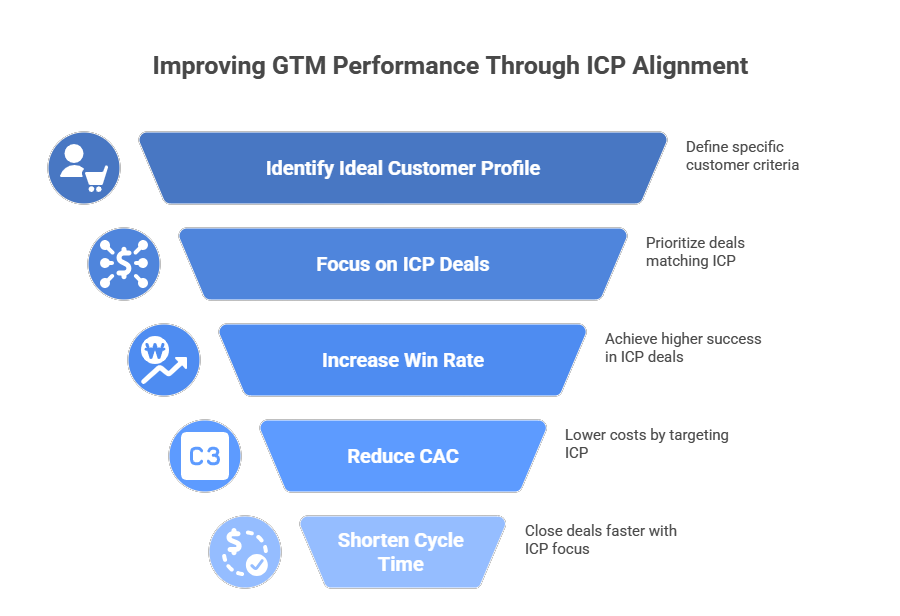
    GTM Performance Through ICP Alignment
    GTM Performance Through ICP Alignment

    2. Pipeline Velocity Index (PVI)

    What it is: A weighted score measuring how fast deals move through each pipeline stage, factoring in conversion rates and time spent per stage.

    Why it matters: A SaaS company had beautiful pipeline numbers but died in Stage 2 (technical validation). Forecast didn't catch it. PVI did. Velocity collapses before revenue collapses – usually 60-90 days before your forecast shows the miss.

    Traditional pipeline reporting shows volume. PVI shows momentum. And momentum is the earliest predictor of revenue outcomes. This is a core element of effective GTM execution measurement.

    Benchmark: Track week-over-week trends. A 15%+ drop is an early warning system.

    CEO perspective: One founder told us, "PVI gave us 8 weeks of runway to fix our demo-to-eval conversion problem before it cratered our quarter. That's the difference between a miss and a save."

    3. Revenue Velocity by Motion (RVM)

    What it is: Revenue generated per day by each GTM motion (outbound, inbound, partner-led, PLG), calculated as:
    (# of deals × avg deal size × win rate) / avg sales cycle days

    Why it matters: A FinTech client thought outbound was their engine. RVM showed partner-led deals were 3× faster and 2× higher margin. Your real GTM engine is often not the one you invest in.

    Most companies allocate headcount and budget based on what's always been done, not on what actually produces efficient revenue. RVM forces motion-level accountability.

    Action: Build motion-level P&L. Kill underperforming motions. This connects directly to choosing the right GTM motion to scale.

    Customer journey insight: From the buyer's perspective, partner-led deals often convert faster because trust is pre-built. The partner acts as a validator, reducing the buyer's perceived risk.

    4. CAC Payback by ICP Tier

    What it is: Time to recover customer acquisition costs, segmented by ICP tier (A, B, C customers).

    Why it matters: One founder bragged about 13-month CAC. Segmented CAC told the truth: A-tier was 7.5 months, B-tier was 12 months, C-tier was 38 months. They didn't realize a third of their customers were unprofitable.

    Blended CAC hides the truth. Segmented CAC reveals which parts of your GTM motion are actually destroying value. For early-stage companies, this is often the difference between efficient growth and a death spiral. Our detailed CAC optimization strategies dive deeper into this.

    Benchmark: C-tier payback should never exceed 18 months. If it does, stop selling to them.

    Investor lens: VCs increasingly ask for CAC payback by cohort and tier. Blended numbers don't cut it anymore. They want to see unit economics at the segment level.

    5. Product Activation Time (PAT)

    What it is: Time from contract signed to customer achieving their first "Aha Moment" (not first login-actual value delivery).

    Why it matters: A client cut activation from 28 days to 8. NRR jumped, churn dropped, expansion surged. Faster activation creates momentum. Momentum creates retention. Retention creates expansion.

    From a customer success perspective, activation is the most critical window. If customers don't see value fast, they start second-guessing the purchase decision. That's when churn risk begins—long before renewal.

    Benchmark: <15 days for SaaS, <30 days for complex enterprise products.

    Operational example: When implementing onboarding optimization for a cloud infrastructure client, we mapped every friction point in their activation journey. By removing unnecessary configuration steps and adding proactive CS check-ins at Day 3 and Day 7, they reduced activation time by approximately 60%.

    6. Expansion Efficiency Ratio (EER)

    What it is: Expansion ARR divided by the cost of your customer success and account management teams.

    Why it matters: New logo CAC is rising. Expansion CAC stays flat. The cheapest revenue is already in your base. 40-60% of growth should come from existing customers in 2026.

    Most companies treat customer success as a cost center. High-performing companies treat it as a revenue engine. EER measures how commercial your CS team actually is.

    Benchmark: EER >3.0 is good. <1.5 means your CS team isn't commercial enough.

    Founder insight: "We had 8 CSMs focused on 'happiness.' Zero expansion. We reorganized around commercial outcomes, trained them on upsell triggers, and EER went from 0.7 to 3.4 in one quarter." – Series B SaaS founder

    7. Margin-Adjusted NRR (MA-NRR)

    What it is: Net Revenue Retention weighted by gross margin percentage of each customer cohort.

    Why it matters: A FinTech client had 128% NRR. When weighted by margin? 91%. They were retaining and expanding low-margin accounts while losing high-margin ones. Traditional NRR hides the truth. MA-NRR exposes it.

    Standard NRR treats all revenue as equal. But not all revenue is created equal. A dollar of 80% margin revenue is worth far more than a dollar of 20% margin revenue-especially at scale.

    Action: Segment CS efforts by customer margin, not just ARR. This is part of a broader data-driven GTM strategy.

    CFO perspective: MA-NRR is the metric that should drive compensation planning for customer success and account management teams. Rewarding retention without considering margin creates perverse incentives.

    8. GTM Efficiency Ratio v3 (GTM ER v3)

    What it is: Net new ARR divided by total GTM costs (sales + marketing + CS + tooling), enhanced with AI productivity factors and cost per funnel stage.

    Why it matters: Boards will ask: "What is your GTM efficiency trendline over the last 90 days?" This is the new "Rule of 40" for growth-stage companies.

    Traditional efficiency ratios don't account for AI impact. A rep using AI for research, email generation, and meeting prep can handle 2-3× the pipeline of a non-AI rep. GTM ER v3 adjusts for this reality.

    Benchmark: >0.8 is good, >1.2 is exceptional.

    Example from our work: With a B2B SaaS startup, we implemented AI-powered sales workflows (research automation, email generation, CRM updates). Their GTM ER improved from 0.6 to 1.1 in two quarters-without adding headcount. Understanding how RevOps steers GTM strategy is critical here.

    9. Revenue Leak Rate (RLR)

    What it is: The percentage of pipeline value lost to preventable causes-unworked leads, stuck deals, single-threaded opportunities, ignored churn signals.

    Why it matters: We found a client was "leaking" more pipeline than they were losing to competitors: 19% inbound unworked, 31% stuck at compliance, 26% single-threaded, 14% churn signals ignored. Fixing leak produced more revenue than doubling top-of-funnel.

    Most companies obsess over generating more pipeline. The best companies obsess over not wasting what they already have. RLR measures execution discipline.

    Benchmark: Total RLR should be <15%. Anything above 20% is a crisis.

    Operational drill-down:

    • Unworked inbound: Leads that came in but were never contacted (routing failures, rep capacity issues)

    • Stuck deals: Opportunities that haven't moved in 30+ days

    • Single-threaded: Deals with only 1 contact (high ghosting risk)

    • Ignored churn signals: Customers showing red flags (low usage, support complaints, no expansion)

    10. AI Utilization Score (AUS)

    What it is: Weighted score (0-100) measuring AI adoption across email generation, meeting intelligence, content creation, research, forecasting, and CRM automation.

    Why it matters: 2026's top-performing reps won't be the hardest-working. They'll be the most AI-augmented. We're seeing 2-3× productivity gaps between high-AUS and low-AUS reps doing the same job.

    The companies that scale efficiently in 2026 won't hire more reps-they'll multiply the output of existing reps with AI. This is the shift from hiring headcount to scaling with AI.

    Benchmark: Team average should be >50 by Q2 2026.

    From the rep's perspective: "I used to spend 4 hours a day on research, email follow-ups, and CRM updates. Now AI handles 80% of that. I spend my time on calls and strategy." – AE at a Series B company

    11. Multithreaded Deal Ratio (MDR)

    What it is: Percentage of deals in Stage 3+ with 3+ active contacts (economic buyer + technical buyer + champion minimum).

    Why it matters: If MDR <50%, your pipeline is lying to you. Single-threaded deals have a 75-85% loss rate in late stages. Deals with only one contact almost always die when that person ghosts, changes jobs, or loses internal political capital.

    Benchmark: >60% for mid-market, >75% for enterprise.

    Buyer journey reality: In 2026, buying decisions in B2B involve 6-10 stakeholders on average. If you're only talking to one, you're not in the real conversation. You're in the polite-no conversation.

    Tactical advice: Track MDR weekly. If a deal enters Stage 3 without 3+ contacts, it should trigger an automatic workflow: "Who else should we involve?"

    12. C.A.T. Score (Clarity, Alignment, Trust)

    What it is: A cultural health score measuring whether teams understand priorities (Clarity), work toward the same goals (Alignment), and trust each other and leadership (Trust).

    Why it matters: We've tracked C.A.T. scores across 40+ companies. Every time it dropped below 70%, revenue missed 90-120 days later. Cultural misalignment destroys execution before it shows up in metrics.

    Most GTM failures aren't technical-they're cultural. When sales doesn't trust marketing's leads, when CS doesn't trust sales' promises, when leadership doesn't trust the forecast-execution collapses.

    Benchmark: >75 is healthy, <65 is danger zone.

    How to measure it: Quarterly anonymous surveys with 10-15 targeted questions. Track trends over time. C.A.T. is a leading indicator of operational health.

    A Founder's Turnaround: What Happens When You Measure the Right Things

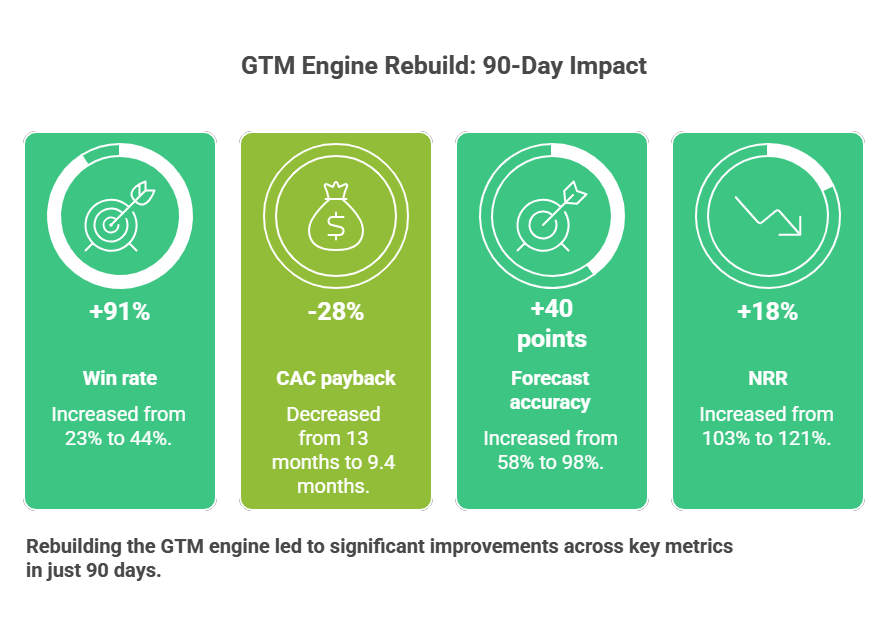
    The founder from the intro rebuilt his GTM engine using this framework. In 90 days:

    -Win rate: +91% (23% → 44%)
    -CAC payback: -28% (13mo → 9.4mo)
    -Sales cycle: -17 days
    -Forecast accuracy: +40 points (58% → 98%)
    -NRR: 103% → 121%
    -Expansion now exceeds new logo revenue

    He told us: "For the first time in 18 months… I actually understand how our revenue engine works."

    Cost of implementation: $47K
    Revenue impact Year 1: $3.2M incremental ARR

    GTM Engine Rebuild
    GTM Engine Rebuild

    That's the power of precision metrics. This transformation followed our GTM strategy execution playbook – focused, measurable, and tied to revenue outcomes.

    Where Competitor Frameworks Fail

    Your competitor's GTM model misses:
    -AI impact
    -Revenue leakage
    -Activation velocity
    -Expansion efficiency
    -Multithreading
    -Motion-level economics
    -Velocity as a leading indicator
    -Margin weighting
    -Cultural alignment

    Most frameworks measure outcomes. Ours measures engines.

    That's the difference between knowing what happened and knowing what will happen.

    What These Metrics Actually Change for CEOs

    These 12 metrics help CEOs answer the only questions that matter:

    Where should we invest? (RVM shows which motions produce revenue, not noise)
    Where should we cut? (CAC by tier shows what destroys margin)
    Where are we leaking revenue? (Fixing leaks is faster than building pipeline)
    How do we hit the number without adding headcount? (AI + precision, not brute force)
    What will cause our next miss? (And how do we prevent it now)

    From a board perspective, these aren't "nice to have" metrics. They're the metrics that determine whether you get your next round, hit your revenue plan, or run out of runway trying.

    2026 Will Reward Teams Who Measure Differently

    Most companies will chase volume, overhire, overspend, misalign, and try to "out-activity" the market.

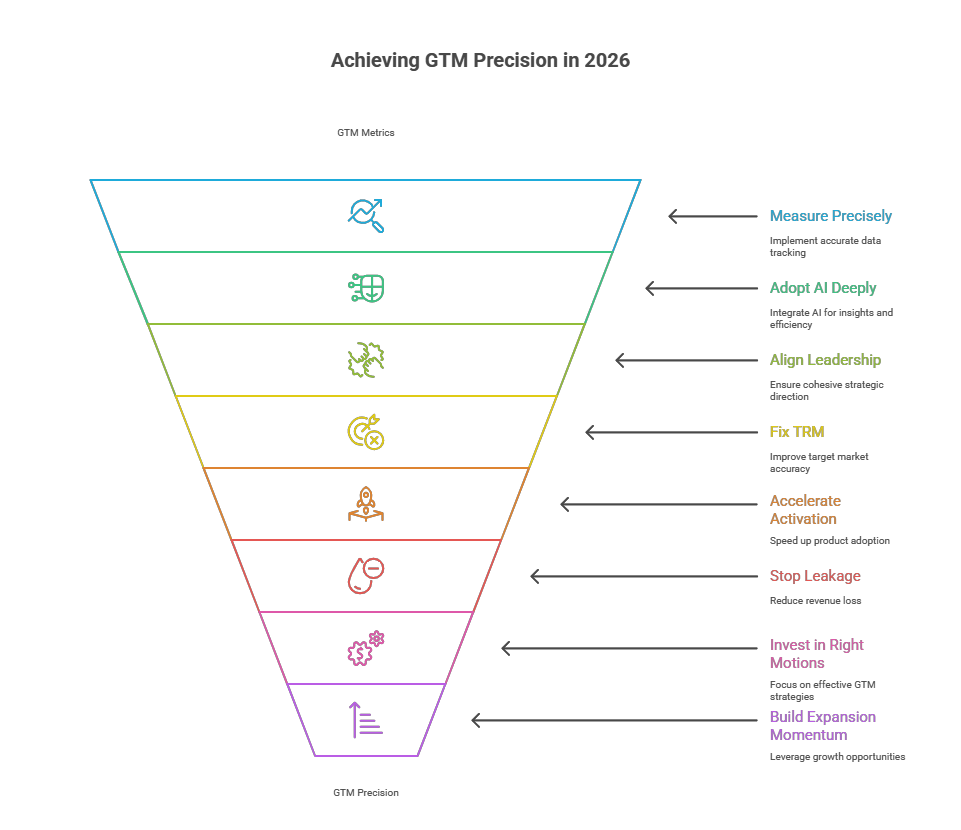
    The companies that win will:
    – Measure precisely
    – Adopt AI deeply
    – Align leadership
    Fix TRM
    – Accelerate activation
    – Stop leakage
    – Invest in the right motions
    – Build momentum from expansion

    2026 doesn't reward effort. It rewards precision.

    Achieving GTM Precision in 2026
    Achieving GTM Precision in 2026

    The startups securing Series B funding won't be the loudest – they'll be the ones with clean unit economics, efficient GTM motions, and predictable revenue engines. Investors are tired of "pipeline theater." They want proof of engine efficiency.

    Build Your 2026 GTM Engine With Phi Consulting

    Phi Consulting has helped:
    AtoB grow from 72 customers to 7% market shareShipwell build a predictable outbound engine
    DataTruck scale 10× via modern GTM systemsTruckX go from $2M to $16M ARR in 14 months

    We don't build dashboards. We build GTM engines that hit the number.

    Book a 15-minute GTM scoping call. No pitch. Just truth.

  • Total Relevant Market (TRM): Why Your GTM Strategy Needs Precision, Not Promises

    Total Relevant Market (TRM): Why Your GTM Strategy Needs Precision, Not Promises

    An executive guide for growth leaders building revenue engines that scale

    Why Most Startups Overestimate Their Market and Underestimate Their Focus

    Most startups spend months calculating their Total Addressable Market (TAM) for investor decks but can't tell you how many accounts they can realistically close this quarter. That gap is where GTM strategies collapse.

    The Total Relevant Market (TRM) changes that. Instead of chasing everyone, TRM defines who you should pursue right now. At Phi Consulting, companies that define their TRM early scale faster and hit numbers more predictably through GTM consulting.

    The test: Can you answer "how many accounts can realistically get us to our next ARR milestone" in under 60 seconds?

    What Happens When You Sell to Everyone

    When everyone is your buyer, no one becomes your priority.

    The reality:

    • Your sales team chases dead ends

    • Your marketing scatters across segments that don't convert

    • Your product roadmap gets pulled in every direction

    Take TruckX as an example. When Phi helped them focus their GTM execution, they scaled from $2M to $16M ARR in 18 months. That's TRM precision creating leverage.

    TRM vs TAM vs ICP: Understanding the Hierarchy

    Most executives confuse these. Here's how they work:

    Concept

    What It Means

    What It Does

    TAM (Total Addressable Market)

    Everyone who could theoretically buy

    Funds your pitch deck

    TRM (Total Relevant Market)

    Accounts you should pursue now

    Funds your GTM strategy

    ICP (Ideal Customer Profile)

    Highest-converting subset

    Funds your quota

    Think of it this way:

    • TAM says "the freight industry is worth $800 billion"

    • TRM says "here are 500 fleets we can win this year"

    • ICP says "these 100 accounts close fastest"

      trm1
      trm1

    How Do You Define Your Total Relevant Market?

    Start with boundaries. Every boundary should be binary: yes or no, in or out.

    The Five Critical Boundaries:

    Boundary

    What It Defines

    Geographic

    Where you can sell and support

    Vertical

    Industries with your workflow pain

    Firmographic

    Size, revenue, structure

    Technographic

    Required integrations

    Trigger-based

    Budget cycles, leadership changes

    Clear boundaries create focused outbound GTM strategies.

    Sizing Your TRM Like an Operator

    Translate boundaries into an account universe using LinkedIn Sales Navigator, ZoomInfo, or your CRM.

    Build three scenarios:

    Scenario

    What It Measures

    Conservative

    Bottom quartile conversion

    Base case

    Median performance

    Aggressive

    Top quartile execution

    Map each to headcount, CAC, and runway.

    Total Relevant Market (TRM) Why Your GTM Strategy Needs Precision, Not Promises - visual selection (1)
    Total Relevant Market (TRM) Why Your GTM Strategy Needs Precision, Not Promises – visual selection (1)

    Prioritizing TRM Segments: Speed, Size, and Story

    Not every segment deserves equal attention.

    Dimension

    What It Measures

    Speed

    How fast accounts convert

    Size

    Initial ACV and expansion potential

    Story

    Will they become reference accounts?

    Focus on segments scoring highest across all three.

    Turning Your TRM Into Daily Execution

    A TRM document in a strategy deck is worthless. It needs to shape your GTM motion:

    Sales: Map territories and quotas to TRM segments
    Marketing: Build campaigns matched to buying stages
    Product: Prioritize features for high-value segments
    Customer Success: Tailor customer experience playbooks by segment
    RevOps: Track penetration and conversion across revenue operations

    Total Relevant Market (TRM) Why Your GTM Strategy Needs Precision, Not Promises - visual selection (2)
    Total Relevant Market (TRM) Why Your GTM Strategy Needs Precision, Not Promises – visual selection (2)

    Measuring What Matters: TRM Health Metrics

    Track these in weekly leadership meetings:

    Metric

    What It Tells You

    Engagement

    % of TRM contacted

    Pipeline

    Which segments generate opportunities

    CAC/LTV

    Economic viability

    Sales cycle

    Where deals stall

    Penetration

    % of TRM won

    TRM health is a leading indicator of revenue health.

    The Quarterly Shrink Rule

    The best GTM strategies get sharper over time.

    Every quarter:

    • Remove segments that didn't convert

    • Tighten qualifying criteria

    • Reallocate to winning segments

    • Add new segments only when current ones are exhausted

    Why Do Startups Skip This Step?

    Because TRM work feels like constraint.

    Founders resist narrowing focus after building for massive markets. Investors push back on targeting 500 accounts instead of 50,000. But from scaling logistics and freight tech startups: constraint creates clarity, and clarity creates conversion.

    Companies that figure this out early raise Series B on traction, not TAM promises.

    Building a TRM-Driven GTM Engine with Phi Consulting

    At Phi Consulting, TRM isn't a strategy deliverable. It's the foundation of your go-to-market execution.

    How we work:

    Phase

    What We Do

    Co-design

    Build your TRM with leadership so strategy and execution align

    Operationalize

    Transform into territories, campaigns, and plays

    Instrument

    Create dashboards showing engagement and conversion

    Our clients include TruckX (scaled $2M to $16M ARR in 18 months), AtoB, and Datatruck. They all started with TRM precision before scaling.

    Know Your Real Market Before Your Budget Runs Out

    If you can't answer how many accounts get you to your next ARR milestone, your GTM plan is built on hope.

    The reality: Most startups figure this out too late.

    Phi Consulting specializes in GTM execution for startups that need precision. We define your Total Relevant Market, build the pods to work it, and deliver pipeline that funds your next round.

    Book a 15-minute TRM Audit. We'll pressure test your assumptions and show you the fastest paths to growth.

    Contact us or email: contact@phi.consulting


    Frequently Asked Questions

    What is Total Relevant Market (TRM)?

    TRM is the subset of your total addressable market you should actively pursue right now based on product fit, buying triggers, and capacity to win.

    How is TRM different from TAM?

    TAM measures everyone who could buy your category. TRM identifies who you should target today based on realistic conversion probability.

    When should startups define their TRM?

    As early as possible, ideally before scaling sales. Companies defining TRM at Seed or Series A avoid spreading resources across too many segments.

    How do we prioritize segments within our TRM?

    Score on Speed (time to close), Size (ACV and expansion), and Story (reference value). Focus on segments scoring highest across all three.

    How often should we update our TRM?

    Quarterly at minimum. Fast-moving startups review TRM monthly to incorporate learnings from wins and losses.

    Who should own the TRM process?

    RevOps and GTM leadership together. TRM requires both strategic thinking and operational execution.

    Can our TRM grow over time?

    Yes, but it usually shrinks first. The best startups narrow TRM to dominate segments before expanding geographies or verticals.

    Should we share our TRM with investors?

    Absolutely. Sophisticated investors appreciate precision over inflated TAM. A well-defined TRM with penetration metrics demonstrates strategic discipline.

    What if our TRM is too small to hit our revenue goals?

    Either expand TRM by loosening one boundary, improve conversion rates, or recalibrate growth expectations to match market reality.

    How do we know if a segment should stay in our TRM?

    Track engagement, pipeline, and conversion by segment. If a segment consistently underperforms despite adequate outreach, remove it and reallocate resources.

  • ARR vs ERR: Why Every Dollar Isn’t Equal in SaaS Revenue

    ARR vs ERR: Why Every Dollar Isn’t Equal in SaaS Revenue

    The AI gold rush has produced impressive growth charts – but dig deeper, and the story changes. Many companies boasting $2M ARR in six months are actually powered by short pilots and experimental AI budgets, not durable commitments.

    This isn't just accounting semantics. It's a fundamental shift in how B2B SaaS companies need to think about revenue sustainability and go-to-market strategy.

    What is ARR (Annual Recurring Revenue)?

    ARR is the annualized value of all recurring revenue from active subscriptions, normalized to a one-year period. It's calculated by taking monthly recurring revenue (MRR) and multiplying by 12, or by summing all annual contract values.

    ARR represents:

    • Predictable, renewable, and contractually locked revenue

    • Customer retention, renewal rates, and conviction

    • The backbone metric for investor confidence and valuation

    • Foundation for sustainable customer lifetime value (CLTV)

    What is ERR (Experimental Run-Rate Revenue)?

    ERR is the annualized projection of current revenue that comes from experimental, pilot, or trial engagements without firm long-term commitments. It's calculated the same way as ARR but lacks the contractual stability.

    ERR consists of:

    • Revenue from pilots, short-term contracts, or "try before commit" agreements

    • Highly volatile income that's misleading if treated as ARR

    • Inflated growth charts that obscure churn risk

    • Budget allocations from innovation funds, not operational budgets

    Every dollar isn't equal. One dollar of ARR predicts the future. One dollar of ERR tests it.

    The AI-Era Shift: From Contracts to Experiments

    In traditional SaaS, ARR was built on year-long or multi-year contracts. In today's AI market, experimentation is the new entry ticket.

    Enterprise buyers now demand 60 to 90-day pilots with easy exits. Their budgets are labeled "AI experiments" – temporary allocations meant to test multiple vendors before committing.

    Albert Lie, CTO of Forward Labs, summed it up in his Forbes Technology Council piece:

    "Much of today's AI ARR could vanish within a year. Buyers are experimenting on two vectors: functionality and vendor."

    The result? Founders report ARR numbers built on revenue that could evaporate in a quarter. This reality demands a different approach to GTM execution and revenue forecasting.

    What's the Difference Between ARR and ERR?

    The core difference between ARR and ERR lies in commitment and predictability:

    ARR characteristics:

    • Minimum 12-month contracts with penalties for early termination

    • Renewal rates above 90%

    • Comes from core operating budgets

    • Deep product integration with high switching costs

    ERR characteristics:

    • Month-to-month or quarterly contracts

    • Opt-out clauses without penalties

    • Funded by innovation or experimental budgets

    • Surface-level integration, easy to replace

    When working with a FreightTech startup we advised, we discovered that roughly 60% of their reported "ARR" was actually ERR – 90-day pilots funded from innovation budgets that could disappear without renewal. This insight completely changed their sales execution strategy.

    Why Fast Growth Without Retention Creates a Revenue Mirage

    Rapid revenue growth can mask structural fragility:

    Low switching costs: AI tools are easy to replace
    Easy replication: Competitors can mimic functionality overnight
    Lack of product stickiness: Customers don't depend on your product to operate

    As Albert Lie warns:

    "AI is either magic or useless. There's no room for 'good enough.'"

    A product that doesn't work perfectly erodes trust faster than it grows revenue. And when trust erodes, ERR collapses before it ever becomes ARR.

    The Founder's Perspective

    From a founder's standpoint, the ERR vs ARR distinction matters deeply when planning burn rate and runway. Forecasting based on ERR creates false confidence – you might think you have 18 months of runway when you actually have 9.

    The Investor Viewpoint

    Investors increasingly scrutinize revenue quality. A company with $2M in ERR trading at a 5x multiple ($10M valuation) might see that drop to 2x ($4M) once investors realize the revenue isn't durable. This directly impacts your ability to raise subsequent rounds.

    Redefining Good Growth for Founders

    Growth Without Retention is Just Noise

    Early momentum is valuable, but retention is the real signal of product-market fit. A startup scaling sales to $400K in 4 months is exciting. But without renewals, it's noise.

    When we helped TruckX scale from $2M to $16M ARR, the key wasn't just adding new customers – it was building a system that converted pilots into multi-year contracts with renewal rates exceeding 95%.

    Engineering Retention Into Your Product

    Retention isn't "wait and see." It's engineered through:

    • Deep integration into customer workflows

    • Clear ROI proof delivered early (within 30 days)

    • Customer adoption processes built by GTM and Customer Success together

    • Success metrics defined before the pilot begins

    Performance as the New Contract

    In SaaS, a "good enough" product can survive on contracts. In AI, performance is the contract. If the model fails even once in production, renewal dies instantly.

    This is why measuring GTM success must include performance benchmarks alongside traditional sales metrics.

    What's the Role of GTM in Converting ERR to ARR?

    ERR isn't bad. It's a leading indicator of demand. The problem is treating it like ARR before it converts.

    The job of GTM strategy, RevOps, and Customer Success is to make that conversion deliberate through four key strategies:

    1. Early Budget Qualification

    Ask every prospect: Is this coming from an experimental AI fund or a core operating budget?

    If it's experimental, map the milestones that graduate you to production spend. This is a critical component of account-based GTM strategy.

    2. Smart Contract Structure

    Create contracts that balance flexibility with commitment:

    • 12-month terms with a 90-day no-fault exit

    • Define success metrics, usage thresholds, and auto-conversion triggers

    • Lock in pricing and expansion clauses in advance

    • Include graduated pricing that incentivizes longer commitments

    3. Pilot Excellence

    Every pilot needs:

    • An assigned champion, success owner, and RevOps tracker

    • Measurable ROI delivered inside 30 days

    • Published "Pilot Scorecards" showing outcomes and next steps

    • Clear conversion criteria established upfront

    A FinTech company we worked with implemented this framework and increased their pilot-to-annual conversion rate from approximately 30-35% to 55-60% within two quarters.

    4. Commitment-Based Pricing

    Avoid free pilots. Charge meaningful fees tied to usage or performance. Customers who pay something are statistically 3x more likely to convert.

    Building Retention Into Your GTM Engine

    Retention isn't a CS metric. It's a GTM outcome. It starts with how you sell, not how you renew.

    Create Real Switching Costs

    Make your product essential:

    • Integrate deeply within customer workflows

    • Make your product the "operating system" for a function

    • Use unique data or network effects that make replacement costly

    • Build multi-threaded relationships across the customer organization

    Community as a Retention Lever

    Create lasting relationships:

    • Form power-user groups or advisory boards

    • Spotlight customer wins early – social proof drives expansion

    • Turn feedback loops into roadmap partnerships

    • Enable peer-to-peer learning among customers

    Cross-Functional Alignment

    When GTM systems and RevOps measure activation, adoption, and renewal together, ERR becomes self-correcting. Bad fits churn in pilot, good fits commit for years.

    This is where cross-functional teams and AI can create unprecedented alignment.

    Five Metrics That Separate Real Growth From Vanity Metrics

    Metric

    Description

    What "Good" Looks Like

    Pilot to Annual Conversion Rate

    % of pilots converting to annual contracts

    50% or higher

    Time to Conversion

    Median days from pilot start to commitment

    90 days or less

    Logo Retention

    % of customers renewing after 12 months

    90% or higher

    Net Revenue Retention (NRR)

    Renewal + expansion minus churn

    120% or higher

    Price Realization

    Pilot price divided by Annual price

    80% or higher

    If your dashboard only measures new revenue, not retained revenue, you're playing the wrong game.

    Understanding these metrics is crucial for measuring GTM execution success at every stage.

    How Can You Tell If Revenue is ARR or ERR?

    Signal

    Category

    Non-cancelable 12+ months

    ARR

    90-day pilot with opt-out

    ERR

    Core operational budget

    ARR

    Experimental AI fund

    ERR

    Security and ROI review complete

    ARR

    Discounted or free trial

    ERR

    The clarity starts here: label your revenue honestly. Then build your GTM execution engine to convert, not to chase.

    The Real AI Advantage: Retention as Your Moat

    The AI revolution rewards speed and performance but punishes volatility. Startups that survive the next wave won't be those that moved fastest. They'll be the ones that built trust, retained customers, and turned experimental dollars into enterprise commitments.

    "The AI race isn't about who gets there first. It's about who stays in the game."
    – Albert Lie, Forbes Technology Council

    From Experimental to Predictable Revenue

    Founders: stop celebrating ERR as ARR.
    GTM teams: design every pilot as a conversion engine.
    Investors: reward sustainable growth, not temporary velocity.

    Because the only thing more dangerous than no revenue is revenue that disappears.

    This principle applies whether you're in FreightTech, Financial Services, or Cloud Computing.

    Turn ERR Into ARR With Phi Consulting

    Phi Consulting helps SaaS and AI startups build GTM systems that convert pilots into predictable growth.

    We:

    • Design outbound and RevOps systems that qualify real ARR

    • Align Product, Marketing, and CS to shorten pilot-to-renewal cycles

    • Replace vanity metrics with durable, retention-driven revenue

    • Build full-funnel marketing systems that nurture ERR into ARR

    Trusted by: Shipwell, AtoB, Outgo, OTR Solutions, DataTruck, and more.
    Ready to scale smarter? → Contact us

  • Inbound vs Outbound: Why Founders Fail to Strike the GTM Balance

    Inbound vs Outbound: Why Founders Fail to Strike the GTM Balance

    Why This Conversation Still Matters

    Founders love binaries. Build or buy. Product-led or sales-led. Inbound or outbound.

    The truth? GTM never works in binaries – especially not today.

    Inbound promises warm leads at scale – until the funnel slows down. Outbound promises pipeline control – until your team burns itself out chasing the wrong accounts. And yet, most founders pick one motion too early, push it too far, and watch the balance collapse just when growth depends on it most.

    For context, our post on common GTM execution challenges shows how founders often fall into this trap early. And if you’re still designing your first strategy, the components of B2B GTM framework is a good starting point.

    The uncomfortable reality: both inbound and outbound are harder than ever. The winners aren’t the ones who “choose” one side. They’re the ones who learn to balance and connect both into one GTM system.

    We outlined this shift in laws of GTM strategy success, where balance – not binaries is the differentiator.

    Why Outbound Is Harder Than Ever

    Outbound isn’t broken, but it’s brutally difficult to execute well. Here’s why:

    1. Messy, fragmented data: It’s not just about getting phone numbers right. The real problem is whether your CRM tells a coherent story – product usage tied to accounts, clean notes, no duplicates. Without it, SDRs “personalize” from broken data. (We explore this in our piece on RevOps automation for startups).

    2. Missing industry context: The market is saturated with shallow personalization (“Congrats on the funding!”). Prospects can smell generic from a mile away. The best outbound is written by people who live the customer’s problem. (Our write-up on modern outbound sales teams highlights how top startups solve this).

    3. Rare orchestration: Even with clean data + strong context, you need operational glue: RevOps or GTM engineers who connect workflows. Few founders invest early here. Our take on the rise of the GTM engineer explains why this role is becoming indispensable.

      Outbound Sales Challenges
      Outbound Sales Challenges

    That’s why so many outbound sequences look like Example 1:

    “Congrats on your Series B. Saw you looked at our pricing page. Worth a quick call?”

    Instead of

    Example 2:

    “Congrats on the $40M raise – saw you’re investing half into distribution. Your product has traction, now you need to fuel pipeline. Took 5 mins to pull every org that had an outage in the US last month. Here’s the list. Two more ideas if you’re open.”

    The difference? Signal + context + action.

    Inbound’s Hidden Limitations

    Founders burned by outbound often run straight into inbound: blogs, SEO, paid ads, community. And it works, but only for a while.

    Inbound’s traps:

    • Linear scaling, then plateau Ten blogs might get traction. A hundred won’t necessarily 10x volume. (See GTM channels to grow your startup).

    • Paid ads kill CAC if you don’t back them with downstream sales engines.

    • Community-driven inbound takes years, time most startups don’t have.

    • Inbound captures intent, but doesn’t create it. Outbound creates demand; inbound waits for it.

    That’s why founders relying only on inbound wake up with “stalled pipeline syndrome.” 

    Demand dries up, content isn’t compounding, and no second motion exists.

    The Real GTM Balance: Orchestrating Inbound + Outbound

    The fix? Stop thinking channel vs channel. Start thinking system orchestration.

    1. Outbound informed by inbound signals: Every signal (downloads, webinar signups, blog clicks) should fuel outbound. If Tom downloads your eBook, don’t just nurture him – call him with context. This aligns with our GTM audit framework, which helps identify where signals are wasted.

    2. Inbound fueled by outbound insights: Outbound calls surface objections, competitors, and use cases. That’s your content calendar. We’ve seen fintech founders turn objection-handling into SEO winners, cutting CAC by ~25%.

    3. Shared data foundation: Your CRM and marketing automation need to tie inbound + outbound. Without this, both motions fail. We outlined this in the hidden role of RevOps.

    Founders: Stop Treating GTM as a Channel War

    Here’s the mistake: treating GTM like a channel choice instead of a system design problem.

    • Outbound isn’t failing because “cold email is dead.” It’s failing because you never invested in RevOps.

    • Inbound isn’t stalling because “content doesn’t work.” It’s stalling because outbound insights never fed into the loop.

      Integrated GTM Ops
      Integrated GTM Ops

    Stage-by-stage balance:

    • Seed → Outbound drives pipeline, inbound seeds trust.

    • Series A → Outbound gives control, inbound lowers CAC.

    • Series B → Motions must be tightly orchestrated, or scale collapses.

    We broke this down in detail in ourGTM maturity curve.

    What Great GTM Balance Looks Like

    A quick checklist:

    • Signals: Are inbound signals fueling outbound?

    • Context: Do outbound messages show deep account knowledge?

    • Ops: Do you have GTM operators tying data together?

    • Loop: Are outbound insights shaping inbound campaigns?

    If not, you’re not balanced yet.

    The Founder’s To-Do List 

    If you’re a founder, here’s where to start:

    • Invest in ops talent. This is the rare hire that unlocks scale.

    • Go deeper on data. Layer in 1st-party usage, customer stories, not just funding news.

    • Kill binary thinking. It’s orchestration, not channels.

    • Audit your message. If your outbound looks like Example 1, you’re commoditized.

    For inspiration, see how we scaled Datatruck from $2M to $16M ARR by connecting inbound + outbound into one loop.

    Closing Thought: GTM Is Balance, Not Bullets

    There is no silver bullet. Outbound will never be “easy.” Inbound will never “scale forever.”

    The winners in 2025 and beyond? The ones who embrace balance – orchestrating signals, data, and insights into one GTM system that compounds over time.

    If your inbound is stalling, it’s because outbound isn’t feeding it. If your outbound is failing, it’s because inbound isn’t supporting it.

    At Phi, we design GTM systems that fix this trap. Explore why many startups now seehiring a GTM execution partner as the missing piece to sustainable scale.

    Stop guessing. Start balancing.

  • The 9-Step Cold Outreach Framework That Wins B2B Deals

    The 9-Step Cold Outreach Framework That Wins B2B Deals

    In B2B sales, your first touchpoint with a potential customer doesn't just introduce you – it sets the tone for every interaction that follows.

    For founders in FreightTech, SaaS, and Logistics, the challenge isn't just reaching the right decision-makers. It's sustaining their attention long enough to create a real business conversation. That's where a structured, value-led cold outreach strategy becomes non-negotiable.

    At Phi, we've refined a 9-step cold email sequence that consistently delivers meetings with high-fit accounts. It's built for markets with long buying cycles, multiple stakeholders, and intense competition — and it works because it balances patience with precision.

    This isn't about sending more emails. It's about sequencing the right messages, in the right order, for the right stage of your company's growth, so prospects move from unfamiliarity to engagement in a deliberate way.

    Why Most Cold Email Campaigns Underperform

    The failure point for most outbound marketing campaigns isn't poor grammar or uninspired subject lines – it's a lack of strategic sequencing.

    Common pitfalls we see when auditing campaigns for B2B startup founders include:

    Selling too early. Leading with a pitch before you've established relevance almost guarantees you'll be ignored. Your sales funnel needs warming before conversion attempts.

    Generic messaging. Copy-pasting the same email to every contact shows no understanding of sector-specific realities. Without a clear ideal customer profile, your outreach becomes noise.

    No follow-up discipline. Two or three unconnected touches aren't enough to land time with senior decision-makers. Research shows most deals require 7-12 touchpoints before a prospect engages.

    "With a Series A logistics startup we advised, we discovered their reply rates jumped from 2% to 11% simply by restructuring their email sequence around value delivery rather than immediate asks."

    In 2025, cold email works when it's deliberate, multi-phased, and tailored – both to your industry and your stage of growth.

    This aligns directly with what we outline in the GTM Maturity Curve, where messaging evolves with your funding and operational readiness.

    The 9-Step Cold Outreach Framework

    Our framework is built around three phases:

    Phase

    Steps

    Primary Goal

    Education

    1-4

    Build credibility and familiarity

    Subtle CTA

    5-7

    Bridge value to solution

    Direct CTA

    8-9

    Secure the meeting

    It reflects how trust is built in B2B sales – gradually, through repeated demonstrations of industry understanding before introducing the ask.

    And there's a second layer: every sales sequence is designed to be stage-aware. The way you speak to the market at Seed stage is not the way you speak at Series C or Enterprise. Understanding when to double down on outbound versus inbound makes or breaks your pipeline velocity.

    Phase 1: Education and Value Delivery (Steps 1-4)

    The goal in the first phase is to position yourself as a credible industry voice before mentioning your solution. This builds familiarity and authority – critical components of any successful lead generation strategy.

    Step 1: Lead with Market Insight

    Share a data point, trend, or regulatory change the recipient can't ignore.

    • For Seed-stage startups: A sharp, niche insight proving you've done your homework

    • For later-stage companies: Broader market impact data tied to industry transformation

    Step 2: Relevant Case Example

    Show a proof point that demonstrates real-world application:

    • Early-stage: A pilot or beta result with specific metrics

    • Growth-stage: A scaled deployment across multiple sites

    When implementing this for a FreightTech client, we crafted case examples showing "Reduced carrier onboarding time by approximately 30-40%" – specific enough to be credible, broad enough to invite conversation.

    Step 3: Practical Resource

    Send something they can use immediately. This is where email personalization meets genuine utility:

    • An operational checklist relevant to their role

    • An industry scorecard or benchmark comparison

    • A short market brief addressing current challenges

    Step 4: Thought Leadership

    Link to an article or framework you've authored that addresses a sector-specific challenge. This positions you as a thought leader while providing genuine value.

    This could connect to content like your winning GTM strategy for logistics and FreightTech startups or similar pillar pieces that demonstrate deep expertise.

    Pro tip: Each of these early touches should stand alone in value. That's why we design sequences so a prospect can enter at any point and still see relevance. Your outreach strategy should never depend on sequential consumption.

    Phase 2: Subtle Call-to-Action (Steps 5-7)

    By now, you've been in their inbox enough to be recognizable. This phase bridges value to your solution without making a hard ask — crucial for lead nurturing without triggering sales resistance.

    Step 5: Connect Value to Their Challenges

    Reference something from earlier in the sequence and tie it to a known operational bottleneck. This demonstrates you've been paying attention and understand their value proposition gap.

    Step 6: Outcome Story

    Highlight a measurable result you've delivered. At Phi, we often reference outcomes like:

    • "Reduced average carrier onboarding time by 25-35% for a FreightTech client"

    • "Improved pipeline velocity by approximately 40-50% through structured SDR processes"

    • "Decreased sales cycle length by roughly 20-30% with better qualification frameworks"

    Step 7: Light Invitation

    Offer to share more relevant examples or industry benchmarks — without yet asking for a meeting. This maintains momentum while respecting their decision-making process.

    At Phi, we often link this stage to insights from our high-performing SDR system playbook so prospects understand the operational rigor behind our results.

    Phase 3: Direct Call-to-Action (Steps 8-9)

    At this point, you've earned the right to ask for a meeting. Your sales cadence has built enough trust to warrant a direct ask.

    Step 8: Clear, Specific Ask

    Make the request concrete and outcome-oriented:

    "Would it make sense to explore how we could reduce your carrier onboarding time by 40%?"

    This framing ties directly to the value you've demonstrated throughout the sequence – it's not a generic "let's chat" but a specific outcome discussion.

    Step 9: Respectful Final Nudge

    If there's no reply, acknowledge timing with grace:

    "If this isn't a priority now, I can reconnect in Q4 – or sooner if your needs shift."

    This preserves the relationship while creating a natural point for future follow-up email touches.

    Tailoring Outreach to Startup Stage

    One of the biggest reasons founders struggle with outbound sales is misaligning the message with the company's maturity. Here's how messaging should evolve:

    Stage

    Focus

    Primary Proof Points

    Seed

    Credibility and market understanding

    Founder expertise, early pilots

    Series A-B

    Balance thought leadership with outcomes

    Customer results, process rigor

    Series C-D+

    Impact at scale and enterprise readiness

    Portfolio metrics, case studies

    Enterprise

    Transformation and multi-stakeholder results

    Strategic partnerships, industry recognition

    This stage-awareness extends to your entire GTM strategy execution. A fintech company we worked with discovered their enterprise messaging was falling flat because they were using Series A proof points – fixing this alignment improved their conversion rate by approximately 25-35%.

    Making Each Email Stand Alone

    A key design principle of Phi's sequences is modular clarity – if a prospect opens email #3 first, they can still understand the context.

    This means:

    • Restating the core context briefly in every touch

    • Making sure the value proposition is self-contained

    • Avoiding references that require having read previous messages

    This mirrors principles in our mistakes in B2B go-to-market strategy guide, where unclear sequencing is one of the top failure points we identify.

    Why This Works in FreightTech, SaaS, and Logistics

    These industries share three traits that make our framework effective:

    1. Multiple stakeholders influence the buying decision

    2. Complex, technical products require education before a sale

    3. High competition means the default is to ignore cold outreach unless it's immediately relevant

    Our clients see higher reply rates and better meeting-to-close ratios because the approach:

    • Establishes familiarity before the ask

    • Delivers industry-specific value in every touch

    • Respects decision-making pace in high-stakes B2B sales

    For more on aligning sales execution with strategic intent, see how startups align sales execution with GTM vision.

    Cold Outreach in 2025 Requires Precision

    Decision-makers are harder to reach not because they're unavailable, but because:

    • AI filters prioritize messages before they see them

    • They receive hundreds of offers each month, most irrelevant

    • Their tolerance for generic outreach is almost zero

    The integration of AI in cold calling and outreach is changing the game – but technology amplifies strategy, it doesn't replace it.

    The only way to cut through is with structured, stage-aware, value-first outreach – exactly the kind we've deployed for FreightTech clients scaling from $2M to $16M ARR in 14 months.

    Closing the Gap Between Outreach and Revenue

    Outbound marketing doesn't fail because your market is closed off. It fails when there's no repeatable system behind it.

    A defined, 9-step framework transforms cold email from a numbers game into a deliberate growth lever — one proven across FreightTech, SaaS, and Logistics.

    At Phi, we don't just write emails. We design GTM execution systems that connect every touchpoint to your revenue goals. Whether you need sales automation infrastructure or complete CRM workflow optimization, the foundation is always strategic sequencing.

    If your current outreach isn't generating the meetings you want, it's not a sign to give up – it's a 

    Ready to see what a structured, stage-aware, value-led sequence can do for your pipeline? Let's talk.

  • The GTM Maturity Curve: How RevOps Evolves from Seed to Series B

    The GTM Maturity Curve: How RevOps Evolves from Seed to Series B

    In the early days of building a startup, GTM feels like instinct. You’re testing, iterating, chasing traction. It’s messy, but it works – until it doesn’t. Somewhere between Seed and Series B, things begin to break. Spreadsheets get clunky. Handoffs fall apart.

    Forecasts lose accuracy. Growth slows – not because your product isn’t working, but because your GTM infrastructure can’t scale with you.

    That’s where Revenue Operations (RevOps) steps in. But not as a last-minute fix. Done right, it becomes the invisible engine that connects people, tools and data – turning chaos into clarity.

    For an in-depth breakdown of what RevOps looks like at early-stage companies, read our foundational guide to RevOps for startups.

    Here we’ve broken down on the GTM Maturity Curve – a framework that explains how RevOps evolves functionally (not just structurally) across Seed, Series A and Series B.
    Think of this as your operational roadmap – not based on titles, but on what RevOps actually enables at each phase.

    “We’ll Bring in RevOps Later” – Why That Logic Fails

    Too many founders see RevOps as a "next-stage hire" – a team brought in after the fact to clean up dashboards, fix Salesforce, or streamline broken handoffs.

    But that mindset is backwards. RevOps isn't reactive. It's foundational.

    You wouldn’t build a product without engineers. So why build a revenue engine without someone to design and optimize its operating system?

    When implemented early, RevOps connects Sales, Marketing, CS, Product, and even Finance into one GTM system. It creates a shared language for decision-making and unlocks speed without sacrificing control.

    Startups that delay RevOps usually end up retrofitting systems under pressure. That’s why we’ve helped founders embed operational clarity from Day 1 – like we did when designing the GTM strategy for a Series B FinTech startup seeking product-market fit.

    Phase 1 – Seed: Scrappy but Structured

    At the Seed stage, everything is duct-taped. The founder is still doing demos. Marketing is a Notion doc. Your CRM is mostly vibes.

    And that’s okay, as long as there’s intentionality behind the chaos.

    The biggest misconception at this stage?

    “We’re too early for RevOps.”

    In reality, this is when you need it most – not to scale, but to create clarity.

    What RevOps Looks Like at Seed

    • Manual but tracked: Even if it’s on a whiteboard, you should know where leads come from, why deals are lost, and how long cycles take.

    • First revenue workflows: Who owns each step from lead to demo to close? Where does handoff friction occur?

    • Basic tool hygiene: Even with 2-3 tools, ask: Are we creating duplicate work? Are things integrated or siloed?

    As a founder, you should ask:

    • Can I see where deals are stalling?

    • Is our GTM motion repeatable or random?

    • Do I trust the data I’m looking at?

    The goal at Seed isn’t automation. It’s visibility.

    For more early-stage structure, explore our framework forbuilding modern GTM strategies without over-engineering them.

    Phase 2 – Series A: From Motion to Model

    At Series A, you’ve found a working motion. You’re hiring, growing headcount, expanding channels and suddenly, things break.

    Sales blames Marketing. Marketing says Sales isn’t following up. CS has no context on new customers. Leadership is forecasting with gut feel.

    This is where RevOps becomes non-negotiable.

    It shifts from an enabler to a GTM systems architect

    .

    What RevOps Looks Like at Series A

    • Pipeline design: Lead routing, scoring models, funnel stages – built intentionally, not reactively.

    • Forecasting infrastructure: Weekly pipeline calls now require precision. RevOps builds the models, tracks conversion health, flags risk early.

    • Tech stack governance: Without clear ownership, tools become a liability. RevOps ensures integration, usage, and adoption.

    • Funnel analytics: RevOps delivers CAC:LTV insights, conversion benchmarks, and channel efficiency reports.

    At this point, RevOps is no longer backend-only. It’s a seat at the GTM strategy table.

    If you’re unsure how to formalize this shift, we’ve builta GTM audit framework to evaluate your execution bottlenecks across data, tools, process and teams.

    Also check out how startups align sales execution with strategic GTM vision – a practical guide from our consulting playbook.

    Phase 3 – Series B: Precision at Scale

    At Series B, you’re no longer just scaling people – you’re scaling systems.

    You’re launching new geos, new product lines, new teams. What got you here

    – scrappy hacks, spreadsheets, duct-tape automation – starts breaking down.

    Forecasts are wrong. Quotas are off. Sales cycles grow. Friction rises.

    What RevOps Owns at Series B

    • Territory & quota design: Based on actual data – not gut feel.

    • Expansion strategy: RevOps guides go-to-market decisions for new segments, verticals and regions.

    • Predictive analytics: Churn modelling, upsell targeting, deal velocity tracking become baseline.

    • Cross-functional GTM orchestration: Shared reporting frameworks, retrospectives and process accountability across Marketing, Sales, CS and Product.

    • Board-level readiness: RevOps owns metric governance, scenario planning and strategic reporting.

    At this stage, RevOps doesn’t just build the engine, it tunes it. Ensuring that as the company grows, clarity scales with it.

    See how we helped TruckX scale from $2M to $16M ARR through RevOps-led execution and data-first GTM design.

    4 GTM Pitfalls That Kill Velocity

    Many startups stall not because of bad products, but because of operational drag. Here are the most common killers of GTM speed:

    1. Delaying RevOps until systems breakBy then, you’re leaking revenue.

    2. Overtooling without ownershipMore tools ≠ more productivity. Without RevOps, they become silos.

    3. Thinking RevOps = Sales Ops RevOps is full-funnel: pre-sale to post-sale. It’s about systems, not support.

    4. No executive alignment If RevOps isn’t in GTM planning, your strategies are disconnected from your operations.

    We broke this down further in our RevOps automation blueprint for early-stage and growth-stage founders.

    GTM as a System – Not a Silo

    The startups winning in 2025 aren’t just better at selling. They’re better at operating.

    They: 

    – Turn data into real-time decisions

     – Close the loop between strategy and execution

     – Create a single GTM truth across all departments

    And all of that? Is powered by RevOps.

    It’s not your janitor. It’s your architect.

    If you're interested in the GTM roles reshaping execution, read about the rise of the GTM Engineer and how RevOps collaborates with them.

    Final Thought: Don’t Build GTM in the Dark

    We’ve worked with dozens of SaaS, FreightTech, FinTech and AI startups. The fastest-scaling ones?

    They don’t “bolt on” RevOps later. They build it in from Day 1.

    They treat it like a strategic function, not a support ticket system. They scale GTM without losing operational clarity.

    So ask yourself:

    Is your GTM running on duct-tape?Or is RevOps building the system beneath your growth?

    Stop Patching Up Your GTM. Start Engineering It.

    Founders who scale fast don’t treat RevOps as a clean-up crew – they treat it as core infrastructure.

    At Phi, we don’t just plug gaps. We embed with your team to architect GTM systems that connect people, data, tools and decisions – so your growth engine isn’t just functional, but frictionless.

    Because duct-tape doesn’t scale. Precision does.

    Let’s build the system that takes you from traction to velocity.

    Book your RevOps consult

  • The Hidden Role of RevOps: Steering GTM, Not Just Cleaning It Up

    The Hidden Role of RevOps: Steering GTM, Not Just Cleaning It Up

    In 2025, founders are expected to move fast, build lean, and execute across multiple channels,  all while hitting aggressive revenue targets and unlocking new markets.

    Yet in this high-stakes environment, many startups still treat Revenue Operations (RevOps) as little more than a behind-the-scenes admin team. In reality, RevOps is a strategic growth function that, when implemented correctly, serves as the operational backbone of your go-to-market motion.

    Instead of being brought in only when systems break, pipelines stall or dashboards stop making sense, RevOps should be embedded from the earliest stages of GTM planning. As we outline in our RevOps fundamentals guide, its role spans aligning sales, marketing and customer success, creating scalable processes and ensuring data-driven decision-making across the revenue engine.


    Many of the most commonGTM execution challenges we see in B2B startups, from misaligned handoffs to broken attribution models are actually symptoms of underutilized or absent RevOps capabilities.

    Here’s the wake-up call: RevOps isn’t your janitor. It’s your GTM co-pilot. If you're only looping them in after the chaos, you're leaving money, momentum and market share on the table.

    The Outdated View: RevOps as Reactive Support

    Too often, RevOps is pigeonholed into post-problem firefighting:

    • “Fix the CRM.”

    • “Clean the pipeline.”

    • “Update the attribution model.”

    • “Audit the sales process.”

    Sound familiar?

    This mindset assumes GTM strategy lives with founders and sales leaders, and RevOps merely implements fixes. But in modern GTM execution, this model is broken, especially as sales cycles get longer, buyer journeys become fragmented and your tech stack is both your biggest operational liability and competitive advantage.

    If your view of RevOps stops at pipeline hygiene, you’re missing its potential as the architect of revenue scalability. For example, our breakdown of modern GTM strategy components shows how operational architecture must be baked into strategy from day one.

    What RevOps Actually Is (And Why It’s Misunderstood)

    RevOps isn’t just a support function sitting quietly in the background. It’s the connective tissue that ties together Sales, Marketing, Customer Success and even Product into a unified revenue engine.

    When executed well, RevOps delivers:

    • Clarity – across your funnel, ICP segments, lead lifecycle, and conversion paths.

    • Control – over workflows, handoffs, and attribution logic.

    • Consistency – in how leads are scored, routed, and retained.

    • Compounding Value – through repeatable GTM playbooks, real-time insights and scalable infrastructure.

    If RevOps isn’t involved in defining ICPs, structuring handoffs or evaluating channel effectiveness, you’re weakening your GTM foundation. This is why many founders benefit from frameworks like our GTM Strategy Execution Playbook, which embeds RevOps thinking directly into execution.

    Founders: If You Own GTM, You Need RevOps at the Table

    Let’s be real: founders love strategy decks, but often underestimate the execution gap between idea and revenue. You can design the perfect outbound playbook – but who’s ensuring it’s operationalized, tracked and iterated?

    RevOps bridges that gap by:

    • Building the GTM engine (not just the car wash)

    • Uncovering friction in your funnel before it compounds

    • Identifying high-value data signals for smarter iteration

    • Orchestrating handoffs across the entire customer journey

    • Aligning systems, people, and processes toward unified goals

    In essence, RevOps turns your GTM hypothesis into testable, measurable execution. This alignment is critical and mirrors principles in our guide on cross-functional alignment.

    Modern RevOps = Cross-Functional GTM Architecture

    The best GTM teams in 2025 don’t silo RevOps – they embed it into decision-making. 

    Here’s how it actively steers GTM at each stage:

    1. ICP & Segmentation Design

    Old model: Sales defines ICP, RevOps tags in Salesforce later.

    Modern model: RevOps co-designs ICP logic based on actual conversion data.

    Dynamic segmentation using behavioral, firmographic and revenue data ensures high-propensity accounts are prioritized early. You can see this approach in practice in our piece on customer segmentation in GTM.

    2. Channel Performance & Attribution

    Old way: Marketing vs. Sales budget battles.

    New way: RevOps runs multi-touch attribution, feeding real insights back into channel and sales strategies.

    You can’t scale what you can’t measure. For deeper attribution models, see winning GTM strategies through data analytics.

    3. Lead Scoring, Routing & Handoff

    Old way: MQLs vanish into a black hole.

    New way: RevOps designs the lifecycle, ensuring fast routing, enriched data, contextual handoffs and pipeline accountability.

    Every minute a lead sits unworked, revenue potential declines. This is why we often pair routing rules with RevOps automation principles like those outlined in RevOps automation for startups.

    4. Pipeline Hygiene & Forecasting

    Old way: Forecasts built on gut feel.

    New way: RevOps sets stage criteria, conversion-based forecasting models and data-backed deal probabilities.

    Predictability is a growth advantage – and a board confidence booster. Our GTM audit framework covers how to diagnose and fix gaps here.

    5. Experimentation & GTM Iteration

    Old way: Launch and pray.

    New way: Controlled GTM experiments with clean cohorts, CRM logic and closed-loop measurement.

    Faster iteration = faster market fit. For context, see how AI is transforming GTM strategies.

    Why Startups That Ignore RevOps Hit a Wall

    From our work with scaling Series A-B teams, the same operational failure patterns appear:

    • Siloed tools = no end-to-end visibility

    • Disjointed handoffs = lost leads, blind CS teams

    • Broken attribution = wrong channels scaled

    • Inconsistent pipeline logic = unreliable forecasts

    • Founder firefighting ops = no time for growth

    The fix isn’t another growth marketer or shiny CRM – it’s embedding RevOps from the start. If you’re unsure when to make that investment, our breakdown on fractional vs. in-house RevOps can help you decide.

    From Cost Center to Strategic Asset: The RevOps Rebrand

    RevOps in 2025 is a strategic growth lever, not an expense line item. When embedded early, it can:

    • Launch multi-geo GTM motions with localized routing logic

    • Improve outbound reply rates by ~25% via ICP-enrichment rules

    • Reduce pipeline leakage by ~40% through lifecycle reengineering

    • Improve CAC/LTV by aligning MarketingOps with CS

    And yes – sometimes it is about cleaning up legacy systems. But the real wins happen before things break. To see how that mindset applies across GTM, explore our piece on laws of GTM strategy success.

    What Founders Should Do Next

    If you’re thinking “we’ll hire RevOps later,” here’s the reality:

    You don’t wait to buy brakes after you’ve crashed.

    Embed RevOps from day one of GTM execution. Whether you’re outbound-heavy, PLG-driven, or partner-led – it can design the scaffolding to make your strategy repeatable, measurable, and scalable. For a full GTM build-out process, see our guide to modern GTM strategies.

    RevOps Is Your Growth Infrastructure

    The startups winning today aren’t just the ones running loud campaigns – they’re the ones with tight GTM execution loops, clear operating rhythms and aligned revenue teams. RevOps is the engine making that possible.

    If you’re only bringing it in to clean up messes, you’re underusing one of your most strategic assets. Bring RevOps into the cockpit. Let them steer.

    You’ll move faster, waste less and scale smarter.

    Phi works with founder-led teams to embed RevOps as a core GTM function – not an afterthought.

    If you're ready to build executional clarity and operational muscle into your growth plan, let’s talk.

  • The GTM Fit Matrix: Picking the Right Motion to Scale

    The GTM Fit Matrix: Picking the Right Motion to Scale

    Go-to-market (GTM) success isn’t just about sales channels or flashy campaigns. It begins with a deeper, foundational question:

    Which GTM motion actually aligns with how your buyers want to discover, try, and buy your product?

    In 2025, founders face a paradox of choice. The GTM playbook has expanded to include Product-Led Growth (PLG), Sales-Led Growth (SLG), Community-Led Growth (CLG), Ecosystem-Led Growth (ELG) and hybrids of them all. But more options often create more confusion.

    Most startups don't stall from a lack of effort – they stall because they choose a motion that doesn’t match their product, buyer behavior, or market dynamics.

    That’s why the GTM Fit Matrix exists – a strategic decision framework to help founders intentionally choose (and evolve) the right GTM motion based on five critical variables: price, product complexity, buyer type, market maturity and urgency of monetization.

    Also explore how we define GTM execution success in our10-part GTM audit framework

    What Is a GTM Motion and Why It’s Foundational

    A GTM motion defines how your company brings a product to market. It’s not just how you sell – it’s how users:

    • Discover your product

    • Engage with it

    • Evaluate it

    • Ultimately convert

    Common GTM Motions:

    Sales-Led Growth (SLG): Ideal for high-ACV and complex B2B offerings. It’s your classic top-down motion – outbound, demos and deal closing. See our fullbreakdown of a sales-led GTM motion.

    • Product-Led Growth (PLG): Growth via self-serve, freemium, or free-trial loops. Works best when your product is intuitive and time-to-value is short. Learn how this fits into modern SaaS GTM strategy.

    • Community-Led Growth (CLG): Fueled by evangelists, creators and user feedback loops. Often found in emerging SaaS and AI categories.

    • Founder-Led GTM: Often used in the early days when storytelling and credibility are founder-driven.

    • Ecosystem-Led Growth: Built around partnerships, integrations and API-first workflows.

    Your motion influences everything: hiring plans, onboarding design, pricing, compensation models and channel mix. Yet too many startups default to whatever motion worked for someone else – even if the fit is wrong.

    The GTM Fit Matrix

    This matrix simplifies motion selection using 5 key inputs:

    Input

    PLG

    SLG

    CLG

    ACV (Price Point)

    <$2K/year

    >$10K/year

    Flexible

    Product Complexity

    Easy to self-serve

    Requires onboarding

    Easy to try, sticky

    Buyer Behavior

    Bottom-up

    Top-down

    Peer influence

    Market Maturity

    Crowded

    Niche/Enterprise

    Emerging

    Monetization Speed

    Gradual

    Fast

    Long-term affinity

    Understand how CAC optimization influences your motion choice and explore theevolution of GTM frameworks in SaaS.

    This matrix isn’t rigid. Think of it as diagnostic, not prescriptive – a decision-making aid rooted in your actual business, not startup hype.

    1. Anchor to ACV and CAC Logic

    Your average contract value (ACV) is the starting point.

    Selling a $29/month product? You can’t justify a sales team. Your GTM must be lean and product-led.

    Selling $60K+/year enterprise contracts? Then you need reps who can build trust and drive urgency.

    Your CAC-to-LTV ratio tells you if a motion is viable:

    • PLG leans on efficient acquisition loops

    • SLG justifies higher CAC with larger wins

    • CLG lowers CAC over time, but requires patience and momentum

    With aSeries B fintech client, we combined PLG onboarding with SLG expansion – resulting in a 35% shorter sales cycle and a 25% CAC improvement.

    2. Know Who the Buyer Actually Is

    Does your user make the buying decision?

    • PLG = user is the buyer

    • SLG = buyer is a decision-maker (think multi-stakeholder)

    • CLG = user evangelists influence buyers indirectly

    Misalignment causes friction.

    Example: building a self-serve product for a persona who expects sales validation or hiring an SDR team before users are ready to talk.

    See how modern outbound teams fix buyer-fit issues or how to scale the sales team the right way.

    3. Don’t Just Look at Product – Look at the Journey

    A great product isn’t enough. Your evaluation journey matters just as much:

    • PLG thrives on fast onboarding and UI clarity

    • SLG depends on consultative selling and urgency framing

    • CLG wins through community trust and social proof

    When we advised a FreightTech startup, their PLG-style dashboard failed initially because buyers couldn't understand its full value without a sales demo. We introduced guided product tours and deal support – unlocking a 40% conversion bump.

    Know Why product storytelling matters in 2025 GTM because in a crowded, AI-saturated market, buyers don’t just need to know what your product does, but why it exists, who it’s built for and how it fits into their workflow. Great storytelling bridges the gap between awareness and conversion, especially when your motion is product-led.

    4. Consider Market Timing and Maturity

    Motion success = market timing × category signals.

    • In new markets (like AI-first tools), founder-led or community-driven GTM helps educate and inspire early adopters.

    • In mature markets, aggressive sales motions or PLG wedges work better.

    • In crowded SaaS, dual-motion plays – SLG for key accounts, PLG for velocity – often unlock growth.

    Explore FreightTech-specific GTM challenges we’ve solved for high-growth teams.

    5. GTM Isn’t One-and-Done – It Evolves

    GTM is not a fixed play – it’s a progression:

    • Slack: Started PLG → added SLG → leaned into CLG

    • Notion: Grew via CLG → added sales-assist → scaled via PLG flows

    • Tome & Runway: Redefining PLG with AI-first onboarding (aha moment in <30 seconds)

    We often build motion evolution roadmaps tied to product-market fit milestones – especially post-Series A.

    Quick Diagnostic for Founders

    Ask yourself:

    • Is your product intuitive enough to self-serve?

    •  Is the buyer a solo user or a buying committee?

    •  Can you afford 6+ months to build community traction?

    • Does your narrative resonate in cold outbound?

    • Are users naturally referring to others already?

    • If 3+ answers lean user-first → start PLG

    • If 3+ lean decision-maker driven → start SLG

    • If “peer-driven” and “long-term” show up → CLG can be a layering motion

    Fit Beats Flash

    Startups don’t fail from a lack of tactics – they fail from lack of GTM fit.

    Too many founders over-invest in tech stacks, tooling, and SDR headcount without asking:

    Does this motion make sense for our product and buyer journey?

    Want Help Mapping Your GTM Motion?

    Choosing the right GTM motion isn’t just a strategic exercise – it’s the foundation for how you’ll scale, hire, market and close revenue.

    At Phi, we specialize in helping VC-backed startups engineer their GTM from first principles. Whether you're navigating early-stage product-market fit or trying to scale into repeatable revenue, we help you:

    • Diagnose your current GTM gaps

    • Align your motion to buyer behaviour, ACV, and product maturity

    • Build execution plans across sales, marketing, and RevOps

    • Layer motions as you evolve (PLG → SLG, or SLG → CLG)

    • Turn GTM into a growth engine – not just a slide deck

    Let’s talk GTM Fit and build your motion to scale with confidence.