Tag: Revops

  • Six Questions to Ask Before Hiring a RevOps Agency

    Six Questions to Ask Before Hiring a RevOps Agency

    Somewhere around month three, you realize the RevOps firm you hired hasn’t touched your pipeline once. They’ve cleaned your Salesforce. They’ve built twelve dashboards. They’ve written a 40-page process doc nobody reads. But the number of qualified deals moving through your funnel is exactly what it was when you signed the contract.

    This is the default outcome when you hire a revops agency that operates like a Salesforce consultancy. And most of them do.

    The framing below is a buyer’s diagnostic. Six questions you ask before you sign anything. Each one is designed to surface whether you’re hiring operators or advisors.

    Why Most RevOps Firms Leave You With a Cleaner CRM and the Same Broken Pipeline

    The market for revenue operations help is genuinely confusing. You have pure-play CRM implementers, RevOps practitioners who focus on pipeline visibility, fractional CROs who advise but don’t execute, and GTM agencies that bolt RevOps onto the side of an outbound engagement. Most of them call themselves a revenue operations agency.

    The distinction that matters isn’t in the name. It’s in what they’re accountable for after the system goes live.

    A CRM rebuild is not a revenue system. It’s table stakes. If your RevOps infrastructure isn’t connected to your outbound motion, your CS team’s retention data, and your pipeline attribution, it’s just a prettier spreadsheet.

    The companies with tools but no revenue system almost always have one thing in common: they paid someone to build a component, not a system. The CRM got rebuilt. The outbound sequences got written. The onboarding playbook got documented. Nothing talks to anything else.

    The Six Questions

    Use these before you sign. They’re not gotcha questions. Any good revops firm will answer them without hesitation. The ones who can’t are telling you something.

    1. Do you operate after you build, or do you hand off and leave? This is the most important question. Most RevOps consultants are project-based. They scope the work, deliver the build, and move on. Ask specifically: who is responsible for running the system in month four? If the answer is “your internal team with our documentation,” you’re buying a build, not infrastructure.
    2. Do you own pipeline outcomes, or just reporting outputs? Anyone can build a dashboard that shows pipeline stage velocity. The question is whether they’re accountable when the numbers go sideways. Ask: what happens if pipeline drops 20% in month two post-launch? Do they adjust the system, or do they send you a report explaining why it dropped?
    3. Does your pod touch outbound and CS, or only the CRM? Revenue operations without a connection to outbound execution is just database management. The same is true on the other side: if your CS team’s retention signals aren’t flowing back into the CRM, your attribution is fiction. Ask which specific systems the team will integrate and operate, not just configure.
    4. Do you integrate across the stack, or does your work silo into one tool? A real RevOps engagement touches your CRM, your sequencing infrastructure, your enrichment layer, your CS platform, and your reporting. If the scope of work only names one tool, you’re getting a consultant, not a system builder. Ask them to describe the last full-stack build they shipped, and name the tools involved.
    5. Do you report on pipeline movement, or just on activity metrics? Activity reports (emails sent, calls logged, tasks completed) are easy to generate and tell you almost nothing useful. Ask what the default reporting cadence looks like and whether it includes deal velocity, stage conversion rates, and ARR attribution by channel. If they start with “here’s how we set up your dashboards,” that’s the wrong answer.
    6. What does the engagement look like six months after launch? This is the simplest tell. A project-based RevOps agency has a defined end date. An infrastructure partner doesn’t. Ask what the team is doing in month six. Are they still running the system? Are they iterating on it based on pipeline data? Or have they wrapped up and invoiced out?

    PhiOperators, not advisorsFind out if your RevOps system is actually runningWe’ll map exactly where pipeline is stalling and what the system needs to fix it.Book an intro

    What a Real RevOps Build Looks Like in Practice

    When Phi built AtoB’s revenue system, the work wasn’t limited to CRM architecture. The RevOps layer connected to their outbound motion, their CS onboarding workflows, and their attribution tracking. Every signal fed back into the same operating layer. Sales knew which channels were producing qualified pipeline. CS knew which customer segments were churning. The system iterated because the team running it stayed embedded.

    Case StudyAtoB: 77 customers to 7% U.S. trucking market shareA full-stack revenue system, not a CRM rebuild, drove AtoB to an $800M Series B valuation.Read the story

    That’s the difference between a RevOps firm that builds and one that operates. The build is maybe 20% of the value. The other 80% is what happens when the system needs to respond to real pipeline data over the following months.

    The Table: What You’re Actually Buying

    What they promiseWhat it usually meansWhat you actually need
    CRM implementationSalesforce rebuild, hand-off, goodbyeCRM architecture connected to live pipeline data
    Revenue reportingActivity dashboards nobody acts onStage conversion and ACV attribution by channel
    Process documentationA 40-page playbook your team ignoresWorkflows embedded in the tools your team already uses
    RevOps strategyA deck with recommendations and no executionAn operator who runs the system after the strategy is set
    Automation setupOne-time workflow build with no iterationA running automation layer that adjusts when the process changes

    One Red Flag Worth Calling Out Directly

    If a revops consultants team’s first deliverable is a discovery report, that’s a signal. Discovery is fine. A 20-page summary of what they found is not a deliverable. It’s a way of appearing to move without actually moving.

    The right engagement starts with a system design, names the specific tools being connected, and puts an operator on the work within the first two weeks. Not a strategist. An operator.

    You can read more about how we think about this at why Phi is different from a typical revenue operations agency. The short version: we build the system and we run it. Those are not the same thing, and most firms only do one.

    The RevOps category is full of smart people who are very good at designing systems and very bad at running them. Before you sign, find out which one you’re hiring.
  • Build a Revenue Engine That Runs Without You

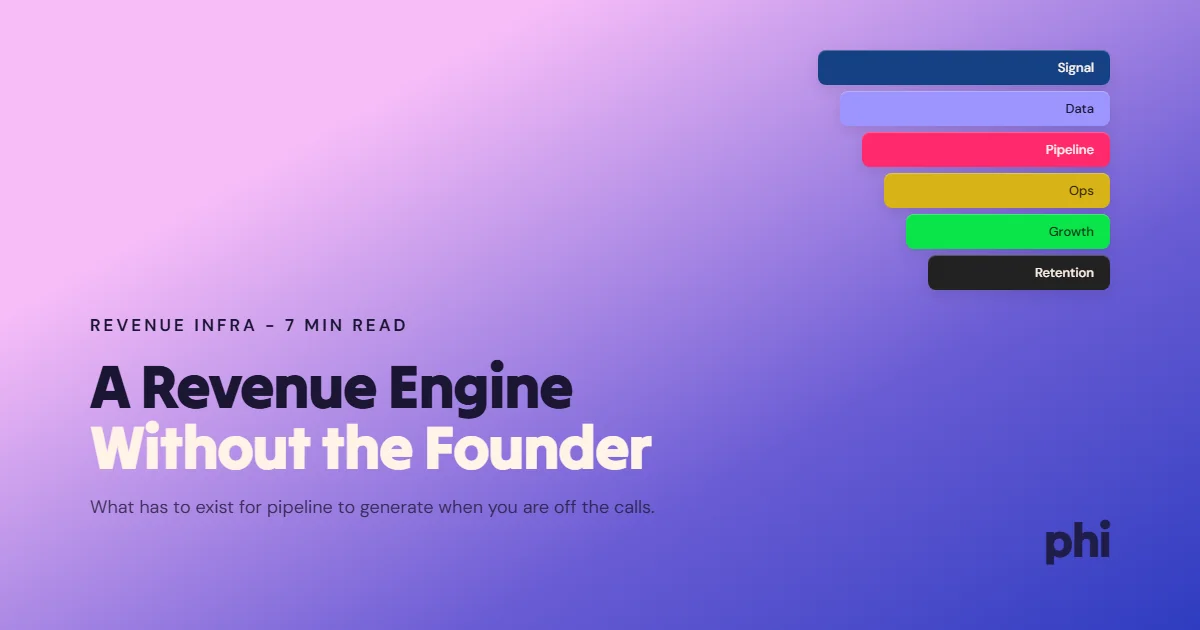
    Build a Revenue Engine That Runs Without You

    At Series A, the founder is almost always the best closer on the team. Not because they are uniquely talented at sales. Because they are the only person who actually understands the product, the customer, and the pitch well enough to run a complete conversation.

    That is not a compliment. That is a structural failure.

    If pipeline depends on your calendar, you do not have a revenue engine. You have a personal service business with a SaaS pricing page.

    Why Founder-Led Sales Breaks at the Worst Time

    The pattern is consistent across Seed and Series A companies. The founder closes the first 10 to 20 customers. Confidence is high. The board wants to see the number grow. You hire two AEs and an SDR. Three months later, the pipeline is thinner than before you hired them.

    Nobody did anything wrong. The problem is that the founder was running on institutional knowledge that never got documented. ICP assumptions that lived in their head. Objection handling that came from 50 conversations nobody else was on. A close that depended on the founder’s credibility, not a repeatable process.

    When you hand that off to a new rep, you are not handing off a process. You are handing off vibes. And vibes do not scale revenue.

    The question is not how to hire better salespeople. The question is how to build the system they run on. The transition from founder led to team led sales is almost always framed as a people problem. It is almost always an infrastructure problem.

    PhiOperators, not advisorsSee what your revenue system is missingIn the first conversation, we map your current GTM architecture and name the exact layer that is breaking pipeline.Book an intro

    The 5 Systems That Replace the Founder in the Pipeline

    There is no single hire that fixes founder-led sales. There is a set of systems that, when they run together, produce pipeline without your involvement. Most companies have one or two of these. Very few have all five.

    1. ICP definition with teeth. Not “companies with 50 or more employees in logistics.” A real definition: firmographic filters, technographic signals, behavioral triggers, and a clear hypothesis for why this customer buys now. The ICP lives in a document everyone can read, not in the founder’s pattern recognition. When this does not exist, every rep targets a slightly different company and generates completely different results.
    2. Outbound infrastructure, not outbound activity. Data enrichment that keeps prospect records current. Sequencing logic built around the ICP’s actual buying triggers. Multi-sender LinkedIn outreach through a tool like HeyReach so the volume is not bottlenecked by one inbox. The outbound pod is not a group of SDRs sending emails. It is a system those SDRs run on.
    3. A defined handoff protocol. The moment a lead moves from SDR to AE is where most pipeline leaks. There is no transfer of context. The AE starts from scratch. The prospect repeats themselves. The deal cools. A real handoff protocol includes a documented summary of the conversation, confirmed next steps, and a CRM record that reflects reality, not aspirations. This is an ops problem, not a people problem, and it belongs inside your sales ops layer.
    4. Pipeline visibility that does not require a meeting to understand. If you need to ask your head of sales “where are we this month,” you do not have a revenue system. You have a reporting ritual. A real RevOps layer means the CRM reflects actual deal status, attribution is connected to real channels, and the weekly number is not a negotiation. Every person on the revenue team sees the same data. More on what this actually looks like in RevOps best practices that move pipeline.
    5. A close process that does not require the founder. This is the hardest one. The close usually depends on the founder because the founder can answer any question, handle any objection, and carry the authority of the company. Replacing that requires documented objection handling, a structured discovery framework, and AEs who have been trained on real call recordings, not a one-week onboarding deck. It also requires that someone is actively reviewing calls and coaching. That coaching function is usually the first thing that disappears when the founder steps back.

    What This Actually Looks Like: Datatruck

    Datatruck came to us at zero ARR. The founder was doing everything. Good product, real market, no system.

    We built the ICP definition from scratch. We stood up the outbound infrastructure on Clay for enrichment and Instantly for sequencing. We built the CRM architecture so the pipeline was visible without anyone having to ask. We embedded a sales pod that ran the full process end to end.

    The founder stopped being the closer. The system became the closer. This is what moving from founder-led to team-led sales actually looks like in practice.

    Case StudyDatatruck: $0 to $2.5M ARR, 97% drop in CACHow replacing founder-led selling with a repeatable revenue engine led to a $12M Series A.Read the story

    The Mistake Founders Make Before They Build the System

    The default move is to hire a VP of Sales and expect them to build the system. Sometimes that works. More often, the VP inherits the same infrastructure gap the founder had, spends six months trying to figure out what is broken, and leaves before the board runs out of patience.

    Knowing how to scale a sales team is not the same as knowing how to build the system underneath it. Most VP hires are operators, not architects. They need a working system to run, not a blank canvas to design.

    The sequencing matters. Build the infrastructure first. Then hire the operators. Doing it in reverse is how you burn through $400K and end up with the founder back in the deals.

    When You Know the System Is Working

    There is a specific moment when the transition from founder-led to team-led sales has actually happened. It is not when you hit a revenue number. It is when a deal closes and you find out about it after the fact.

    You were not in the meeting. You did not send the proposal. You did not have to answer the hard question in the final call. The system ran without you and produced a closed deal.

    That is the test. Not the pipeline chart. Not the forecast call. Not how many SDRs you have. Whether pipeline generates and converts without your calendar being the critical path.

    Scaling B2B sales past founder-led selling is less about adding headcount and more about deciding, deliberately, to build something that does not need you in the room. Most founders know this. Very few actually build it before they desperately need it.

    If you are not sure which of the five systems is the weakest link in your current setup, that is usually the right place to start the conversation at Phi.

  • Five Layers Every B2B Revenue Engine Needs to Work

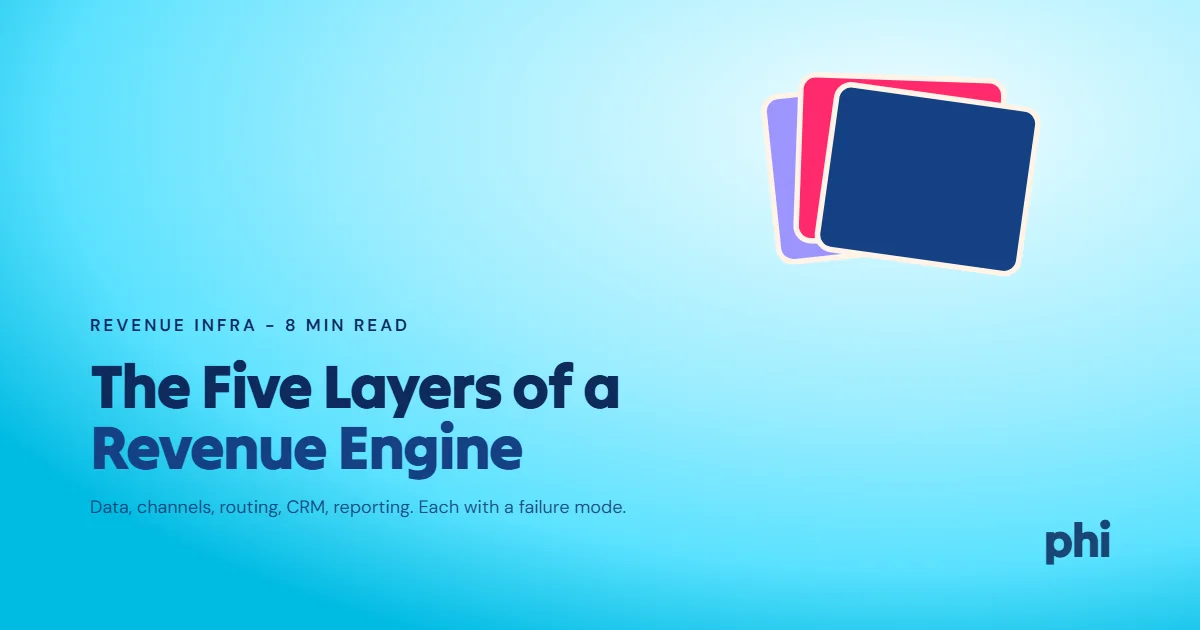
    Five Layers Every B2B Revenue Engine Needs to Work

    AtoB entered the fleet payments space with 77 customers and a market that had been served by the same incumbents for decades. Four years later, they held 7% of U.S. trucking market share and raised at an $800M Series B valuation. The product mattered. So did the category timing. But what actually made the revenue compound was the system underneath it.

    Most founders never build that system. They buy tools. They hire reps. They run campaigns. And when pipeline is inconsistent, they assume the problem is effort. It usually isn’t.

    A real b2b revenue engine is five stacked layers. Each layer has a failure mode that looks like a people problem but is actually a design problem. Here’s what each layer does, how it breaks, and what a working version looks like.

    Layer 1: Data

    This is the foundation. Everything above it depends on it. And most companies have no idea how bad their data actually is.

    The failure mode: your CRM is full of records nobody trusts. Titles are wrong. Companies have churned or been acquired. The ICP you defined 18 months ago hasn’t been validated against the deals you actually closed. Your outbound team is prospecting into a list that was stale before they touched it.

    A working data layer has three things. A defined, validated ICP built from closed-won data, not assumptions. A continuous enrichment process (tools like Apollo run inside our outbound pods to keep signals fresh). And a feedback loop that updates the ICP definition when the market moves.

    Bad data at this layer doesn’t just waste outbound effort. It corrupts your attribution, breaks your routing logic, and makes your reporting meaningless. Fix this first, or you’re building on sand.

    Layer 2: Channels

    Once you know who you’re going after, you need to reach them. The failure mode here isn’t using the wrong channel. It’s running channels that don’t talk to each other.

    Most B2B teams run email sequences, LinkedIn outreach, paid ads, and content in parallel. Each channel has its own owner, its own metrics, and its own definition of a lead. Marketing counts a form fill. Sales counts a meeting booked. Nobody agrees on what “pipeline” means.

    A working channel layer treats outbound and inbound as one system. Outbound surfaces the accounts. Content warms them. Paid retargets the ones who showed intent. Sequences pick up the thread. When a prospect sees your LinkedIn post, gets an email, and then sees a retargeted ad, that’s not coincidence. That’s architecture.

    The specifics depend on your stage. Early companies usually get more from outbound than inbound. Our outbound GTM pods are designed to run this as one integrated motion, not three separate workstreams owned by three different vendors.

    Layer 3: Routing

    This is the layer nobody talks about until it’s broken. And by then, revenue has already leaked.

    Routing is the set of rules that determines what happens to a lead the moment it enters your system. Who owns it? What’s the SLA to first contact? Does it go to a rep based on territory, vertical, company size? What happens if nobody picks it up in 48 hours?

    The failure mode: inbound leads sit in a queue. Hot outbound replies get routed to the wrong rep. AEs get handed accounts with no context on what the prospect already engaged with. The first conversation starts cold even though the prospect has already been through five touchpoints.

    A working routing layer is documented, automated, and owned. Not by a rep. By the system. The rules live in the CRM. The handoff triggers automatically. And there’s a fallback when the primary owner is out. A proper revenue engine b2b layer layers all five of these on top of each other. Building a revenue engine is not a marketing project. It is an infrastructure project.

    This is where sales ops earns its cost. Not in building reports, but in building the logic that makes sure every qualified signal gets the right human response in the right window.

    PhiOperators, not advisorsSee which layer is breaking your pipelineWe’ll walk through your current system and show you exactly where revenue is leaking before you book another rep.Book an intro

    Layer 4: CRM Architecture

    Your CRM is not a database. It’s the operating system for your revenue team. Most companies treat it like a database. That’s the problem.

    The failure mode: deals are created inconsistently. Stages don’t map to actual buyer behavior. There’s no standard for what moves a deal from one stage to the next, so two reps at the same company have completely different stage definitions in their heads. Close dates are guesses. Forecast accuracy is a joke.

    A working CRM architecture starts with stage definitions that reflect reality. Each stage has an entry criterion (what has to be true for a deal to be here) and an exit criterion (what has to happen to move it forward). Fields are standardized. Workflows are automated. The CRM reflects what’s actually happening in the market, not what reps remembered to log.

    This is what RevOps is actually for. Not dashboards. The architecture underneath the dashboards. If you want to know more about how this function works and why most teams underinvest in it, this post breaks it down.

    AtoB’s revenue system was built on CRM architecture that connected outbound signals to deal stage progression to CS handoffs. When you’re scaling from 77 customers to 7% market share, you cannot rely on reps remembering to update records. The system has to enforce consistency.

    Case StudyAtoB: 77 customers to 7% U.S. trucking market shareThis is what happens when all five layers work together inside a single vertical.Read the story

    Layer 5: Reporting Loops

    The fifth layer is where most companies declare victory too early. They build a dashboard. They look at it in the weekly sales meeting. And then nothing changes based on what they see.

    That’s not a reporting loop. That’s a reporting display.

    The failure mode: metrics are tracked but not acted on. You know your open rate dropped. You don’t know why, and nobody owns figuring it out. You know conversion from meeting to proposal is low, but there’s no structured process for diagnosing what changed. Data accumulates without informing decisions.

    A working reporting loop closes the gap between signal and action. When outbound reply rates drop below threshold, the sequence gets reviewed within the week. When a deal stage conversion drops, the rep and their manager review call recordings together. When CAC rises month over month, the ICP definition gets interrogated.

    The companies that have tools but no real system almost always break here. The tools generate data. Nobody has designed the process for turning that data into better decisions. So the system never learns, and results plateau.

    The Sequence Matters

    These five layers aren’t a checklist you can work through in any order. They’re a stack. Each layer depends on the one below it.

    LayerWhat breaks without itWho owns the fix
    1. DataOutbound hits the wrong accounts. Enrichment fails. ICP drifts.RevOps + outbound pod
    2. ChannelsVolume without attribution. Marketing and sales blame each other.GTM architecture
    3. RoutingLeads go cold. Reps work the same account twice. Revenue leaks silently.Sales ops
    4. CRM ArchitectureForecasts are fiction. Deal stage means nothing. Handoffs break.RevOps
    5. Reporting LoopsSystem never learns. Results plateau. Fixes target symptoms, not causes.RevOps + leadership

    Building a revenue machine means building all five. Skip a layer and the ones above it underperform. It’s not a people problem. It’s a sequence problem.

    Most teams have at least three of these layers in some form. The question is whether they’re connected. If your answer is “sort of,” that’s the gap where revenue is disappearing right now.

  • AI Agents in RevOps: What They Actually Fix Today

    AI Agents in RevOps: What They Actually Fix Today

    Half the RevOps vendors in your inbox right now are calling their product an “AI agent.” Most of them mean they added a GPT wrapper to a Zapier flow. The other half built something that genuinely removes human bottlenecks. Telling them apart is the actual problem.

    This is a post about that distinction. Not an AI hype piece. Not a dismissal either. A practical split between what AI agents in RevOps can actually do today versus what still breaks the moment a human steps away.

    The Four Things Agents Actually Handle

    Revenue operations automation has a real use case in four narrow areas. These aren’t edge cases. They’re high-volume, low-judgment tasks that eat 30-40% of a RevOps operator’s week when done manually.

    Data enrichment. Pulling firmographic and contact data, filling gaps in your CRM, scoring records against your ICP definition. Clay does this well when your inputs are clean. The agent runs enrichment on net-new records the moment they hit your system. No human touches the row until it’s complete.

    Lead routing. Territory-based, segment-based, or round-robin assignment. If the logic is deterministic, an agent runs it faster and more consistently than a human checking a spreadsheet. The error rate on manual routing in companies with 3+ territories is significant. Agents get this right because there’s no ambiguity in the rule set.

    Activity logging. Calls, emails, meetings. Syncing them from your sequencing tools into your CRM without a rep remembering to do it. This sounds trivial. It isn’t. Bad activity data is why most RevOps reporting is wrong. Agents log automatically. The pipeline visibility that comes from clean activity data changes how your whole team reads the funnel.

    Follow-up drafting. Pulling context from the CRM, the last call transcript, and the deal stage, then generating a draft follow-up email for the AE to review and send. Not auto-sending. Drafting. The human still approves. But the cognitive load drops by 80% and follow-ups actually happen on time.

    Where the Vaporware Lives

    The vendors stop giving specifics here. Watch for it.

    Deal strategy requires context that agents don’t have. Who’s the real champion in the account? Is the procurement delay a budget issue or a political one? Is the competitor named in the deal actually a threat or just a negotiating tactic? These are judgment calls. An agent can surface the data. It cannot tell you what it means.

    Exception handling is worse. The moment something falls outside the defined logic, an agent either applies the wrong rule or does nothing. A lead that matches two territories. A deal that should skip a stage. A renewal where the billing contact left the company last month. Every one of these requires a human who understands the system well enough to override it correctly. Agents flag exceptions poorly and resolve them worse.

    Forecast calls are the clearest example of where revenue operations still needs humans. Agents can surface the numbers. They cannot read the room. They don’t know which rep sandbagging their pipeline. They don’t know that the account an AE just called “likely to close” has been “likely to close” for three consecutive quarters.

    PhiOperators, not advisorsWe’ll map where agents fit your stackFirst conversation surfaces exactly which RevOps tasks in your system are ready for automation and which ones will break if you pull the human out.Book an intro

    A Decision Matrix for n8n + Clay Stacks

    If you’re evaluating ai revops tooling right now, this is the frame that actually helps. Run every candidate task through two questions: How deterministic is the logic? What breaks if the agent gets it wrong?

    TaskLogic deterministic?Cost of agent errorAutomate?
    Data enrichmentYesLow (fixable)Yes
    Lead routingYes (if rules are defined)Medium (misrouted deals)Yes, with audit trail
    Activity loggingYesLowYes
    Follow-up draftingMostlyLow (human reviews)Yes, human-in-loop
    Deal stage progressionPartiallyHigh (bad pipeline data)No, flag only
    Exception handlingNoHighNo
    Forecast callsNoVery highNo
    Deal strategyNoVery highNo

    The pattern is consistent. Agents earn their place when logic is deterministic and errors are cheap to catch and reverse. They earn nothing in situations where ambiguity is the whole point.

    What n8n + Clay Actually Looks Like in Practice

    When we build outbound pods for clients, the agent layer handles enrichment and sequencing triggers. Clay pulls firmographic and intent data. n8n routes the enriched records into the right sequence in Instantly based on segment. The humans on the pod handle ICP refinement, message strategy, and any account that behaves unexpectedly.

    That split is not arbitrary. It reflects where human time is actually worth spending in a revenue operations automation stack. Enrichment is rote. ICP refinement is not. Routing is rote. Noticing that a full segment stopped replying and diagnosing why is not. RevOps automation is not the same as agent autonomy. Most of what we deploy is deterministic, and the agent surface sits on top.

    The companies that implement this badly are the ones that automate the judgment calls first because those feel like the most painful bottlenecks. They are painful. But they’re painful because they’re hard, not because they’re manual. Making them automated doesn’t make them easier. It makes the errors invisible.

    Case StudyAtoB: 77 customers to 7% U.S. trucking market shareThe RevOps system we built for AtoB connected outbound infrastructure, CRM architecture, and activity logging into one operating layer, so the team had clean data at every stage of the funnel.Read the story

    The Real Question to Ask Before You Buy

    Most founders evaluating ai agents and revops tooling ask “can this tool do X?” That’s the wrong question. The right question is “what does my team do when this tool does X wrong?”

    If your answer is “we’ll catch it in the weekly pipeline review,” you’ve just described a system with a week-long lag on every agent error. That’s not ai revops. That’s automation with a delayed human override, which is often worse than no automation at all because errors compound before anyone sees them.

    If your answer is “the agent flags it for human review before acting,” you’ve built something that actually works. The human stays in the loop on ambiguity. The agent handles volume. That’s the right architecture.

    The vendors selling you “fully autonomous RevOps” are the ones to be skeptical of. Not because agents aren’t powerful. Because “fully autonomous” in a revenue system means “nobody’s accountable when it breaks.” And in revenue, things break constantly. That’s why the job exists.

    Build the agent layer for what it’s good at. Keep humans where judgment lives. If you’re not sure where that line sits in your specific stack, that’s the conversation worth having before you sign the contract.

  • Where Your Pipeline Actually Leaks (It’s Not Your Sales Team)

    Where Your Pipeline Actually Leaks (It’s Not Your Sales Team)

    Most founders, when pipeline stalls, look at their reps. Are they sending enough emails? Are the call numbers up? Is the close rate acceptable? Then they hire a sales coach or fire the SDR lead and reset the clock.

    The pipeline problem is almost never the people. It’s the system they’re plugged into.

    A real revenue audit doesn’t start with rep activity. It starts with the infrastructure underneath the reps: data quality, CRM architecture, handoff protocols, attribution logic, and the visibility layer that tells you what’s actually working. When those break, every rep in the org is flying blind and you’re diagnosing the wrong patient.

    Here are the six places pipeline leaks before it ever reaches a conversation. Walk through these in order before you touch headcount.

    1. Lead Data Quality: The Leak Nobody Measures

    Your sequences aren’t underperforming because the copy is bad. In most cases, they’re underperforming because 30 to 40 percent of the contact data feeding them is stale, incomplete, or miscategorized.

    Check your bounce rate on outbound email. Anything above 5 percent is a signal your data layer has a problem. Check how many records in your CRM are missing firmographic fields, like employee count, revenue range, or tech stack. If your outbound pod is running sequences without enriched ICP data, they’re generating noise, not pipeline.

    The diagnostic question: can your team pull a clean list of 500 ICP accounts with verified contacts, job titles, and technographic fit in under an hour? If the answer is no, your revops strategy has a data problem, not a messaging problem.

    Apollo in the Phi stackOur outbound pods use Apollo to pull verified contacts and layer in firmographic data before any sequence touches a prospect.See how we use it

    2. CRM Architecture: Are You Tracking Deals or Creating the Illusion of Tracking?

    Open your CRM right now and answer three questions. What percentage of open opportunities have a defined next step with a date attached? What percentage of closed-lost deals have a documented reason? And how many deals in your pipeline haven’t been touched in more than 14 days?

    If you can’t answer all three in under two minutes, your CRM is a contact database, not a revenue operating system.

    Bad CRM architecture creates three specific failure modes: reps work the deals they’re comfortable with instead of the ones that need action, managers run forecasts based on gut feel instead of stage data, and nobody can trace why a deal went cold because the history isn’t there. The RevOps pod exists specifically to fix this, building stage definitions, field requirements, and automation workflows that enforce the discipline the CRM was supposed to create.

    3. MQL-to-SQL Handoff: The Dead Zone Where Leads Go to Die

    Marketing sends a list. Sales ignores half of it. Marketing blames sales for not following up. Sales blames marketing for sending garbage leads. This conversation happens every week at companies of every size and it never gets resolved because nobody has defined what a qualified handoff actually looks like.

    The specific things to check here:

    1. Is there a documented SLA for how fast sales must contact a marketing-sourced lead? (The industry benchmark is under five minutes for inbound. Most teams are at 24-plus hours.)
    2. Do MQLs have a minimum data threshold before they route to sales? (Job title, company size, and intent signal at minimum.)
    3. Is there a feedback loop from sales back to marketing on lead quality? Or does that feedback happen in quarterly reviews and get ignored?
    4. What happens to an MQL that sales doesn’t contact within the SLA window? Does it route to a nurture sequence or fall into a void?

    If you don’t have written answers to all four, you have a handoff problem. Your marketing operations and your sales ops need to be one connected system, not two teams with adjacent spreadsheets.

    4. Attribution: You’re Measuring the Last Click, Not the System

    Most B2B companies attribute closed deals to the last marketing touchpoint or the SDR who sent the final email. This tells you almost nothing useful.

    A deal that closed from an outbound sequence touched the prospect through LinkedIn content first, a cold email second, a case study third, and a referral fourth. If your revops roadmap only credits the email that got the reply, you’ll defund LinkedIn, deprioritize content, and cut the referral program. Then you’ll wonder why outbound starts underperforming six months later.

    The fix isn’t a fancier attribution tool. It’s first-touch, multi-touch, and pipeline-influenced attribution running simultaneously, with someone accountable for interpreting the data and translating it into channel decisions. That’s a RevOps function, and most early-stage companies don’t have it.

    PhiOperators, not advisorsRun the revenue audit with operators who fix it afterIn the first conversation, we map your specific leak points and tell you which ones are costing you the most pipeline right now.Book an intro

    5. Handoff from Sales to Customer Success: Where Expansion Revenue Disappears

    The handoff from a closed deal to your CS team is one of the most ignored leak points in B2B revenue. The AE closes, throws the account into an onboarding queue, and moves on. CS inherits a customer they know nothing about, with no context on what was promised during the sale, no visibility into the technical environment, and no playbook for the first 30 days.

    The result: slower time-to-value, lower CSAT scores, and reduced expansion potential. The customer that was supposed to grow into a $200K account renews flat because nobody was tracking health signals in the first 90 days.

    This is precisely what the CS pod fixed at AtoB. Retention systems, onboarding workflows, and health scoring built across thousands of fleets. The outcome was a 40% CSAT improvement.

    Case StudyAtoB: 40% CSAT improvement across thousands of fleetsPhi built AtoB’s retention engine from scratch, connecting onboarding workflows to health scoring so no account went dark in the critical first 90 days.Read the story

    6. Reporting and Visibility: The Audit Nobody Wants to Run

    The final leak point is the one that makes all the others invisible: you don’t have a reporting layer that shows you where pipeline is dying in real time.

    Pull your pipeline velocity report. If you don’t have one, that’s the answer. Pull your stage conversion rates for the last 90 days. If they aren’t tracked by rep, by segment, and by source, you can’t diagnose anything. Pull your average time-in-stage. If deals are sitting in “Proposal Sent” for 30-plus days with no activity logged, something upstream is broken and nobody knows it yet.

    A working revops strategy gives leadership one dashboard that answers four questions: how much pipeline do we have, where is it stalling, what’s the source quality, and what does the next 90 days look like? If your current setup can’t answer those four questions in a single view, you’re making revenue decisions without data. You’re not operating a system. You’re running on feel.

    The companies we work with don’t hire us to diagnose their revenue system and hand them a deck. They bring in the RevOps pod to build the reporting infrastructure, fix the CRM architecture, close the handoff gaps, and run the operation going forward. That’s different from revops consulting or revenue operations consulting services that map the problem and leave. We’re in the system with you.

    If you’re reading this checklist and recognizing your own pipeline, the useful next question isn’t “which of these do we have?” It’s “which one is costing us the most right now?” That’s where the audit starts.

  • How SaaS Companies Accelerate Go-To-Market After Funding

    How SaaS Companies Accelerate Go-To-Market After Funding

    Most SaaS founders close their Series A and immediately post a VP of Sales job description. Six months later they have two AEs, a fractional CMO, and a pipeline that looks exactly like it did the week the wire hit. The round didn’t fix the problem. It funded it at scale.

    How do SaaS companies actually accelerate go-to-market after funding? Not with more headcount. With infrastructure.

    Why Funding Accelerates the Wrong Things First

    PMF tells you your product works for someone. It says nothing about whether you can reach more of those people systematically, close them efficiently, or keep them long enough to matter. Those are GTM problems, and they require GTM infrastructure.

    A freight tech platform we worked with hit $2.5M ARR on founder-led sales and then flatlined for 18 months. The diagnosis wasn’t a bad product or a weak market. Three specific breakdowns were eating the business:

    • Mis-targeted effort. Thirty-seven percent of sales time was going to non-ICP accounts.
    • Broken demand gen. Marketing was generating leads at half the target conversion rate.
    • Fractured onboarding. Customer success had six different onboarding processes running in parallel for the same product.

    That’s not a people problem. It’s a system problem. Raising a round before fixing it just means you burn the capital faster.

    Companies that formalize their GTM framework before scaling grow 2.1x faster than those that bolt it on after. The question isn’t whether to build the system. It’s which layer to build first.

    Narrow Your ICP Before You Expand the Market

    Every company that scaled fast from $1M to $10M ARR did one thing well before they did everything else. They identified the smallest segment where their product delivered fast, measurable value and built the entire GTM motion around that segment first.

    Call it your NOW market. It’s not your TAM. It’s the slice of the market where sales cycles run under 45 days, churn stays under 5% annually, and customers can articulate ROI within the first 30 days.

    • A fintech payments platform targeting “financial institutions” was running 90-day sales cycles and losing deals to procurement drag.
    • They narrowed to mid-market logistics companies with cross-border payment needs.
    • The results were immediate:
    MetricBeforeAfter
    Sales cycle90 days31 days
    Win rate22%47%
    Implementation timebaselinedown 65%

    That’s not a product improvement. That’s a targeting decision.

    The NOW market exercise is simple. Look at your existing customers and find the ones who got to value fastest, required the least support, and referred others without being asked. Build your ICP filters around those traits. Then pause every campaign that isn’t targeting that profile.

    The Revenue Infrastructure Layer Most Founders Skip

    After ICP clarity, the second thing fast-scaling SaaS companies build is a revenue operating layer. Not a CRM. Not a sequencing tool. A system where every function sees the same data, the same pipeline health, and the same customer signals.

    The specific pieces that matter at the $2M to $10M stage:

    • ICP-based lead scoring. Routes the right leads to the right motion before a rep touches them.
    • CRM workflow automation. Enforces handoff SLAs between marketing, sales, and customer success.
    • Multi-touch attribution. Connects marketing spend to closed revenue, not just last-click activity.
    • Qualification framework. Deal reviews built around predictive criteria, not vanity metrics.

    Most sub-$10M ARR companies skip this because it feels like overhead. It isn’t. A logistics payments startup that stood up fractional RevOps before scaling its sales team reduced admin time by 30%, improved forecast accuracy by 45%, and saved $178K annually compared to the cost of a full-time hire. That’s capital going back into pipeline.

    PhiOperators, not advisorsFound the gap? Here’s how to close it fast.In one conversation, a Phi operator will map your biggest GTM infrastructure gap and tell you exactly what to build first.Book an intro

    Why Activation Speed Predicts Scale Better Than MRR Growth

    There’s a metric most boards ignore that predicts whether a SaaS company can actually accelerate after funding. It’s activation velocity: the time between signup and the first moment a customer gets real value from your product.

    The data on this is hard to argue with:

    • 7-day activation. Logistics tech users who activate within 7 days show 3x lifetime value versus those who take longer.
    • 24-hour activation. Correlates with 92% retention at the 90-day mark.
    • Same-day activation in fintech. Companies achieving this see 78% higher expansion revenue.

    These aren’t soft engagement numbers. They’re the leading indicator for everything downstream.

    A logistics visibility platform improved activation rates by 40% through three changes: pre-built integrations with the major TMS platforms their customers already ran, proactive customer success touchpoints at 1, 24, and 72 hours post-signup, and automated data validation that caught issues before they affected operations.

    • No new product features.
    • Just a faster path to value.
    • If your activation sequence is a generic welcome email and a help center link, you’re leaking retention before the ink is dry on the contract.

    Build a Default Go-To-Market Path, Not a Channel Experiment

    Post-funding, most GTM teams test every channel simultaneously. Paid, outbound, content, events, partnerships. Six months later, nothing has enough volume to read clearly and the budget is gone.

    The companies that accelerate fastest pick one primary path and build infrastructure around it before touching anything else. Which path matters less than the commitment to it:

    • Product-led growth. Works when your product has a natural self-serve entry point with measurable activation moments.
    • Outbound. Works when your ICP is identifiable, reachable, and large enough to sustain a sequencing operation.
    • Founder-led enterprise. Works when deal size justifies the time cost and the founder has category credibility.

    The signal that you’ve found your default path: 70 to 80% of closed revenue comes through a single route with a repeatable sequence of steps. Until you see that pattern, you’re in discovery mode, not acceleration mode.

    One payment automation company tried seven channels before finding theirs. Free API access for logistics finance teams, usage-triggered outreach when payment volume crossed a threshold, and AE conversations with CFOs centered on a single ROI calculator. Seventy percent of their $100K-plus deals started as free API accounts. That’s a default path. Build the infrastructure to scale it and ignore everything else for the next two quarters.

    The Hiring Trap That Burns Post-Funding Runway

    There’s a version of go-to-market acceleration that looks responsible on paper: hire a VP of Sales, staff up with AEs, let them run. The problem is the ramp.

    A mid-market AE takes four to six months to reach full productivity. A VP of Sales takes six to nine months to build a real process. In a startup where runway is the constraint, that’s often the whole year.

    • The alternative isn’t outsourcing.
    • It’s embedding an operating layer that runs the system while your internal team ramps.
    • Sales pods with pre-built playbooks, sequencing infrastructure, and industry-specific objection handling can close pipeline in the first 30 days, not the first quarter.

    TruckX used this model to go from $2M to $16M ARR in 18 months. The internal team scaled alongside the operating layer, not instead of it.

    Case StudyTruckX: $2M to $16M ARR in 18 monthsHow an embedded GTM operating layer scaled pipeline 8x while the internal sales team was still ramping.Read the story

    When Customers Become the GTM Engine

    The inflection point for SaaS go-to-market acceleration isn’t when outbound starts working. It’s when customers drive 30% or more of new pipeline without prompting.

    That happens when three things are true at once:

    1. Customers achieve clear ROI fast enough to talk about it unprompted.
    2. They have a peer network you can reach through them.
    3. Your product has natural referral mechanics built into the workflow.

    Most post-funding GTM plans skip this entirely because the referral flywheel feels like a year-two problem. It isn’t. The retention system you build in month six determines whether customers become a channel or a churn statistic.

    That starts with customer success infrastructure: onboarding workflows, health scoring, expansion playbooks. Not a CS manager with a spreadsheet. A system.

    • Build referral tracking into the product early.
    • Create an evangelist tier with real rewards tied to referred ARR, not discounts.
    • Run joint case studies with your best customers before you have a demand gen budget.
    • The companies that accelerate fastest after funding aren’t just building outbound.
    • They’re building all the loops at once.

    If you’re mapping this against your own GTM and finding gaps, how Phi approaches GTM architecture covers the decisions that matter most for companies at the $1M to $15M ARR stage.

  • Revenue Operations Consulting for Early-Stage Startups

    Revenue Operations Consulting for Early-Stage Startups

    Datatruck had no revenue system when Phi started working with them. No CRM workflows. No attribution. No defined ICP. Just a founder selling on instinct and a small team trying to keep up. Twelve months later they had $2.5M ARR, a $12M Series A, and a 97% drop in customer acquisition cost. The product didn’t change. The revenue infrastructure did.

    That’s what revenue operations consulting actually looks like at the early stage. Not a strategy deck. A working system that connects your go-to-market motion into one operating layer.

    Do Early-Stage Startups Need a RevOps Function?

    Yes, and earlier than you think.

    The common assumption is that RevOps is something you bolt on at Series B when things get complicated. By then, you already have three different definitions of a “qualified lead” living in three different spreadsheets, a CRM your sales team uses inconsistently, and a marketing team with no visibility into what happens to the leads they generate.

    • Fixing that mess costs far more than building it right from the start.
    • Early-stage startups benefit from revenue operations setup in a specific way: you’re small enough that the right processes don’t feel bureaucratic, and you’re moving fast enough that bad data compounds quickly.
    • Habits set early become infrastructure later. The definitions, handoffs, and CRM disciplines you build at 10 people are what you scale on at 50.
    • Bad data compounds fast. At low headcount, one wrong ICP assumption poisons every sequence and every pipeline call within weeks.
    • Smaller teams are easier to align. Getting sales, marketing, and CS onto shared definitions is a two-hour conversation at the seed stage. It’s a six-month initiative at Series B.

    Founders who treat RevOps as an early investment consistently outperform those who don’t. Not because they have bigger teams. Because they have better systems.

    What Revenue Operations Actually Is (and Isn’t)

    RevOps is the operating layer that connects sales, marketing, and customer success around shared data, shared definitions, and shared accountability for revenue. It’s not a software category. It’s not a job title you hire for on day one. It’s a system.

    Most early-stage companies run three separate functions that each track different numbers, use different tools, and define success differently.

    FunctionWhat they measureWhat they miss
    MarketingLeads generatedWhich leads actually closed
    SalesPipeline and closesWhich customers expand or churn
    Customer successRenewals and retentionWhich segments were worth acquiring

    Nobody can tell you what a customer actually costs to acquire and keep. That’s the problem RevOps solves. When the system is built correctly, leads flow from marketing into sales with context attached, closed deals hand off to customer success with the right expectations set, and retention data feeds back into ICP refinement. A RevOps pod handles the architecture, the CRM build, the attribution logic, and the reporting layer.

    How to Set Up RevOps at an Early-Stage Startup

    A real revenue operations implementation follows a specific sequence. The order matters: each step creates the foundation the next one depends on.

    Step 1: Define Your ICP Before You Touch Any Tooling

    The most expensive RevOps mistake is building a system around the wrong customer definition. Before you configure a CRM or set up lead scoring, you need a specific, validated answer to one question: who actually closes, stays, and expands?

    Not who you think should buy. Who does buy, at what price point, in what segment, with what triggers. This feeds everything downstream: lead routing logic, qualification criteria, outbound targeting, onboarding triggers. GTM strategy work typically starts here before any RevOps implementation begins.

    Step 2: Pick One CRM and Build It to Reflect Reality

    You don’t need Salesforce at the seed stage. You need a CRM your sales team will actually use, configured to match how deals move through your pipeline. Stages should reflect real buyer behavior, not a template copied from a SaaS playbook.

    The CRM is the foundation of your revenue operations strategy for startups. Everything else connects back to it: attribution, forecasting, pipeline reporting. Retrofitting a broken CRM at Series A is one of the most expensive projects a RevOps team can inherit.

    Step 3: Build Attribution Before You Need It

    Most early-stage startups can’t tell you which channels are actually producing closed revenue. They know where leads came from. They don’t know where customers came from. Those are different numbers.

    Multi-touch attribution doesn’t require expensive software. It requires consistent UTM hygiene, a CRM that captures source at the contact and deal level, and someone who checks the numbers weekly. Set this up in month one. By month six, you’ll have data that actually informs where to invest.

    Step 4: Define Handoff Criteria Between Functions

    The most common revenue leak in early-stage companies isn’t a bad product or weak positioning. It’s leads that fall between sales and marketing with no owner, and customers who churn because nobody defined what a successful handoff from sales to customer success looks like.

    Write down what a marketing-qualified lead looks like. Write down what a sales-accepted lead looks like. Write down what the sales-to-CS handoff checklist contains. These don’t have to be complex. They have to be agreed on by both sides and written down. Sales operations infrastructure often starts with exactly this.

    Step 5: Instrument Before You Hire

    Before you add your next SDR or AE, make sure the system can tell you whether the last hire worked. Three questions to answer with data before you post the job:

    • Conversion rate. What percentage of first meetings turn into closed deals?
    • Sales cycle. What’s the average time from first touch to close?
    • Pipeline coverage. What coverage ratio does the team need to hit the quarter?

    If you can’t answer those questions from your CRM, you’re not ready to hire. Revenue operations setup at the early stage is largely about building the instrumentation that makes your next ten hiring decisions defensible.

    Case Study$0 to $2.5M ARR and a 97% drop in CACDatatruck had no revenue system before Phi. We built one from scratch and they closed a $12M Series A off the back of it.Read the story

    Revenue Operations Consulting vs. Hiring In-House

    Most early-stage startups don’t have enough RevOps work to justify a full-time hire at the right experience level. A strong revenue operations consultant with real architecture experience costs $130K to $180K annually. At the seed and Series A stage, you need about 20 hours a month of that expertise, not 160.

    RevOps consulting fills that gap. You get the architecture expertise and hands-on implementation without the carrying cost of a senior operator you’ll underutilize for the first 18 months. If someone is giving you a strategy document and leaving you to implement it, that’s advice, not consulting. The way Phi operates is embedded execution. We build the system and run it until your team can own it. We don’t hand over a roadmap and call it done.

    The Most Affordable Way to Set Up RevOps as a Startup

    Founders often ask about the most affordable revenue operations software for startups. That’s the wrong frame. The most affordable revenue operations setup isn’t the cheapest software stack. It’s the one that gets used consistently from day one.

    A practical starting stack for pre-Series A companies:

    LayerToolCost
    CRMHubSpot free tier$0
    AttributionUTM hygiene + CRM source fields$0
    AutomationWorkflow layer for lead routing and handoffsLow
    ReportingWeekly pipeline ritual, HubSpot dashboards$0

    That stack costs near nothing and outperforms expensive tooling that nobody uses consistently. For workflow automation, AI-powered automation infrastructure can handle lead routing, CRM updates, and handoff triggers without adding headcount.

    The real cost driver in RevOps isn’t software. It’s the time your team spends on manual work that should be automated, and the revenue you lose because your system doesn’t catch leads at the right moment.

    What to Expect in the First 90 Days of a RevOps Engagement

    The first 30 days of a revenue operations consulting engagement should produce three things: a clean CRM architecture, working attribution, and defined handoff criteria between functions. Not a strategy document. Working infrastructure.

    Days 30 to 60 are about connecting the data layer: dashboards your leadership team will actually check, pipeline visibility that goes beyond “how many deals are open” to “which deals have a realistic path to close this quarter and why,” and forecasting based on stage velocity rather than gut feel.

    • Days 60 to 90 are about feedback loops.
    • Marketing sees which of their leads actually closed and at what value.
    • Sales sees which customer profiles are expanding and which are churning.
    • Customer success flags early warning signals back into the sales cycle.

    When those loops are running, your revenue operations strategy starts compounding. Early-stage startups who build it this way don’t just grow faster. They grow more predictably, which matters more when you’re trying to raise your next round.

    PhiOperators, not advisorsFind out if your RevOps foundation is solidWe’ll walk through your current setup and tell you exactly where the gaps are.Book an intro

    Frequently Asked Questions on RevOps for Startups

    Do early-stage startups need a dedicated RevOps hire?

    Not necessarily. Most pre-Series A startups need RevOps architecture and implementation, not a full-time headcount. RevOps consulting or an embedded RevOps pod gives you the expertise without the carrying cost of a senior operator you’ll underutilize early on.

    • What’s the difference between sales ops and RevOps?

    Sales ops focuses on the sales function: forecasting, territory, rep ramp, quota design. RevOps connects sales ops to marketing ops and customer success so all three functions share data, definitions, and accountability. RevOps is the broader operating layer. Sales ops is one component of it.

    How long does it take to see results from a RevOps implementation?

    • Basic infrastructure including CRM architecture, attribution, and handoff criteria can be live within 30 days.
    • Meaningful pipeline visibility and reporting typically comes in days 30 to 60.
    • The compounding effects build over three to six months of consistent operation.

    What’s the most affordable revenue operations software for startups?

    HubSpot’s free tier handles CRM, basic pipeline tracking, and email sequencing for most pre-Series A companies. Add UTM-based attribution, a lightweight automation layer for lead routing, and a weekly reporting ritual. That stack costs near nothing and outperforms expensive tooling that nobody uses consistently.

    • Can RevOps be implemented without a consultant?

    Yes. The processes described here don’t require outside help if your team has the bandwidth and the willingness to prioritize it. Where a revenue operations consultant adds value is speed and architecture quality. Getting the CRM design right in month one versus retrofitting it at Series A saves more than the consulting cost.