Tag: Revenue Infrastructure

  • Six Questions That Separate GTM Execution From Strategy Theater

    Six Questions That Separate GTM Execution From Strategy Theater

    Somewhere in the last five years, every strategy shop rebranded itself as a “GTM partner.” The decks got better. The frameworks got more proprietary-sounding. And founders kept signing six-figure contracts and ending up with the same thing: a beautiful slide summarizing problems they already knew they had.

    This post is a diagnostic. Six questions you should ask any go to market consulting firm before you hand over a dollar. They’re not trick questions. They just require answers that strategy shops can’t give you.

    Why Most GTM Firms Fail Founders

    The incentive structure is wrong. Consulting firms get paid for time and deliverables, not outcomes. A 90-day strategy engagement ends with a document. Whether that document produces pipeline is, technically, your problem.

    Execution partners are built differently. They stay in the system. They run the sequences, own the CRM architecture, and show up when the numbers are wrong. The distinction sounds obvious. It almost never is in a sales pitch.

    Here’s how to tell the difference before you’re three months in.

    The Six Diagnostic Questions

    1. Can you show me the last system you built, not the last strategy you delivered? Ask for the actual work product. Not a case study PDF. The sequence structure in Instantly. The Clay enrichment workflow. The CRM architecture and attribution model they built for the last client. Execution partners have artifacts. Strategy shops have slides.
    2. Who is doing the daily work inside my account? A lot of go to market consulting services are sold by senior operators and run by junior coordinators. Find out who is actually writing the sequences, enriching the data, and QA’ing the pipeline reports. If the answer is vague, that’s your answer. The best GTM firms embed cross-functional pods directly into your org. Not account managers. Operators.
    3. What tools are your pods running on, and can you show me a live instance? If a firm is serious about outbound execution, they can name the stack immediately: Clay for lead intelligence and enrichment, HeyReach for LinkedIn sender infrastructure, Instantly for email sequencing at scale, n8n for workflow automation. A real outbound pod has an operating environment. Ask to see it. Vagueness here is a red flag, not a privacy concern.
    4. What metrics do you commit to, and what happens when you miss them? Go to market consulting services that are priced as “strategy” rarely commit to pipeline numbers. That’s by design. Execution partners do commit, because they’re the ones running the system that produces the numbers. Ask: what does the contract say about pipeline volume, meeting targets, or ARR contribution? If there’s no accountability clause, you’re buying advice, not infrastructure.
    5. How long until something is running? Strategy shops need 60 to 90 days to “align on positioning” before any execution begins. That’s not onboarding. That’s billable hours. A real execution partner has a deployment model. They know what week one, week two, and week four look like. They’ve done it before. If the answer to “when does pipeline start” is “after we complete the discovery phase,” keep walking.
    6. Can I talk to a founder you’ve worked with, not a contact you’ve prepped? References should be warm introductions to founders who will give you an unfiltered 15 minutes. Not a testimonial page. Not a LinkedIn recommendation. A real conversation with someone who went through the same decision you’re making now. Ask specifically: did the pipeline they built survive after the engagement ended? Or did everything stop when the contract did?

    Case StudyDatatruck: $0 to $2.5M ARR, 97% drop in CACPhi built the revenue system from scratch, then handed over infrastructure that kept running after day one.Read the story

    What Strategy Theater Looks Like in Practice

    Most founders recognize it in retrospect. The pitch emphasizes frameworks and proprietary methodologies. The contract is structured around phases, not outcomes. The QBR shows activity metrics, not pipeline metrics. And when results are flat, the firm’s response is more strategy: a revised ICP, a repositioned value prop, another deck.

    The tell is this: if a firm’s core product is thinking, you’re the one who has to do the doing. That’s fine if you have a team ready to execute. Most early-stage founders don’t. That’s why they hired the firm.

    Real go to market consulting services build the system and then run it. Strategy is one layer of a larger operating model, not a standalone deliverable.

    PhiOperators, not advisorsWalk through the six questions with a Phi operatorWe’ll show you the actual stack, the deployment timeline, and the pipeline model before you commit to anything.Book an intro

    How Phi Answers Each Question

    We’ll be direct about it, because that’s the point of the framework.

    QuestionHow Phi answers it
    Show me the last system you builtWe show the Clay enrichment logic, the sequence architecture in Instantly, and the CRM workflows. Work product, not a case study summary.
    Who does the daily work?A cross-functional pod: SDRs, a RevOps operator, and a GTM engineer. All embedded in your org, not working out of a shared services pool.
    What tools are you running on?Clay, HeyReach, Instantly, n8n. We can pull up a live instance in the first call.
    What do you commit to?Pipeline volume and meeting targets, tied to the contract. Payoneer: 93 meetings booked, 44 closed deals in 4 months.
    How long until something runs?Pipeline starts in 30 days. The system is self-sustaining in 90.
    Can I talk to a founder?Yes. Unscripted. We’ll connect you directly.

    That’s the difference between what Phi is and what most GTM consulting firms sell. Not a longer deck. A system that runs.

    TruckX went from $2M to $16M ARR in 18 months on the back of infrastructure we built and operated. That’s the benchmark we hold ourselves to on every engagement.

    One Last Thing Before You Sign Anything

    Run the six questions on every firm in your shortlist, including us. The ones that hedge on tools, get vague about who runs the account day-to-day, or can’t name a pipeline metric they’ve been held to, those are strategy shops wearing an execution hat.

    The founder who asks these questions in the first call is the one who doesn’t end up paying for another deck.
  • Buying More Sales Tools Will Not Fix Your Pipeline

    Buying More Sales Tools Will Not Fix Your Pipeline

    Somewhere between month six and month eighteen, most founders realize they’ve spent $40k to $120k on sales tools and pipeline hasn’t moved. Not meaningfully. Maybe a few blips. But nothing that looks like a working system.

    The instinct is to buy something else. A better sequencer. A new data provider. An AI layer on top of the CRM that was already not working. The stack grows. The pipeline doesn’t.

    This is not a tools problem. It never was.

    What a Typical Stack Actually Looks Like

    Before diagnosing the failure, it helps to see how common this pattern is. Here’s roughly what a Series A or growth-stage B2B company has accumulated by the time they call us:

    LayerCommon ToolsMonthly Cost (est.)
    Prospecting and dataApollo, ZoomInfo, or both$500-$2,000
    Email sequencingOutreach, Salesloft, or Instantly$800-$3,000
    LinkedIn outboundOne of four tools, often abandoned$300-$800
    CRMHubSpot or Salesforce, partially configured$500-$3,500
    EnrichmentClearbit, Clay, or both$400-$1,500
    ReportingA dashboard nobody opens$200-$600

    That’s $2,700 to $11,400 per month. Annualized, you’re looking at $32k to $136k. And most of those tools have overlapping functions, contradictory data, and no one person who owns the full picture.

    The tech stack for modern outbound sales teams was supposed to solve the volume problem. More accounts, more contacts, more touchpoints. What it created instead was a coordination problem nobody budgeted for.

    Three Reasons Tool-Stacking Fails

    The failure isn’t random. It follows a pattern. Almost every founder who ends up with a flat pipeline and a full stack ran into one or more of these three problems.

    No system owner. Tools don’t run themselves. Someone has to define the ICP, load the lists, write and iterate the sequences, monitor reply rates, update the CRM, and close the feedback loop back to the top. When that person doesn’t exist, or when it’s “the SDR manager plus whoever has bandwidth,” nothing works end to end. Your RevOps layer becomes a graveyard of half-configured automation that nobody trusts.

    No data hygiene. Every tool in a typical B2B tech stack writes data somewhere. The problem is that they write different data in different formats and nobody reconciles it. Your CRM says a prospect is “in sequence.” Your sequencer says they replied two weeks ago. Your enrichment tool has them at a company they left in 2023. You are running outbound against a fiction.

    No feedback loop. The revops tech stack is supposed to answer one question: what is actually working? But when tools don’t talk to each other, when attribution is broken, when reps are logging activities inconsistently, you can’t answer that question. You can’t tell if your sequence is underperforming because the copy is wrong, the ICP is wrong, the data is stale, or the timing is off. So you guess. You change the subject line. Pipeline stays flat.

    PhiOperators, not advisorsTell us what your stack costs, we’ll show gapsIn one conversation, we’ll map exactly where your current setup is leaking pipeline and what a working system looks like instead.Book an intro

    The Sales Enablement Tech Stack Myth

    The sales enablement tech stack category was built on a reasonable premise: give reps better information, better content, and better tools at the moment of contact, and they’ll close more. The problem is that enablement became a product category before most companies had the operational foundation to use it.

    You cannot enable a team that doesn’t have a working ICP definition. You cannot sequence your way out of bad data. You cannot report on a pipeline that isn’t connected to a CRM anyone actually updates.

    Most founders added enablement tools on top of an already broken foundation. The tools got smarter. The system got messier. And the person who was supposed to own all of it, the ops person, the RevOps hire, the SDR manager, was already underwater managing the tools they already had.

    This is not a people failure. It is an architecture failure. The tech stack for modern outbound sales teams is only as good as the operating layer underneath it. Without that layer, you are paying for a car you don’t know how to drive.

    What the Alternative Actually Looks Like

    The companies generating real pipeline in this environment are not running more tools. They are running fewer tools inside a tighter system, operated by a team that owns outcomes, not activities.

    Here is what that looks like in practice. When Phi ran the outbound operation for Payoneer, the pod ran on four tools: Apollo for prospecting and data, HeyReach for LinkedIn outbound across multiple sender accounts, Instantly for email sequences at scale, and n8n for workflow automation. Not twelve tools. Four. Each one with a defined owner and a defined function.

    Case StudyAtoB: 77 customers to 7% U.S. trucking market shareAtoB’s outbound engine scaled an entire vertical with the same pod model: fewer tools, one accountable operating layer, measurable outcomes.Read the story

    The pod did not replace Payoneer’s existing CRM or change their internal processes. It plugged into what they had and ran outbound as one operating layer. 93 meetings booked. 44 closed deals. Four months.

    That result did not come from a better sequencer. It came from an accountable team that owned the full system from ICP definition to closed deal, and had the infrastructure to close the feedback loop every week.

    This is what an outbound pod actually looks like when it works. Not a vendor running campaigns. An embedded operating layer that runs your pipeline system and is accountable for what comes out of it.

    Before You Buy Another Tool

    Run this audit first. For every tool in your current stack, answer three questions:

    1. Who owns this tool’s output, by name, not by team?
    2. Is the data in this tool accurate enough to act on today?
    3. Does this tool’s data feed back into a single place where we can see what’s working?

    If you can’t answer all three for more than half your tools, you do not have a pipeline problem. You have a system problem. Buying more tools will not fix it. It will make it more expensive.

    The b2b marketing tech stack, the revops tech stack, the sales enablement tech stack, all of them are infrastructure. Infrastructure only produces output when someone is operating it. Right now, most companies have infrastructure and no operator. RevOps best practices matter far less than having one person or one pod who owns the full system and is measured on what it produces.

    The companies that are pulling ahead right now are not the ones with the most tools. They are the ones who finally stopped buying and started building. If your pipeline has been flat for two quarters, the next subscription is not the answer.

  • Build a Revenue Engine That Runs Without You

    Build a Revenue Engine That Runs Without You

    At Series A, the founder is almost always the best closer on the team. Not because they are uniquely talented at sales. Because they are the only person who actually understands the product, the customer, and the pitch well enough to run a complete conversation.

    That is not a compliment. That is a structural failure.

    If pipeline depends on your calendar, you do not have a revenue engine. You have a personal service business with a SaaS pricing page.

    Why Founder-Led Sales Breaks at the Worst Time

    The pattern is consistent across Seed and Series A companies. The founder closes the first 10 to 20 customers. Confidence is high. The board wants to see the number grow. You hire two AEs and an SDR. Three months later, the pipeline is thinner than before you hired them.

    Nobody did anything wrong. The problem is that the founder was running on institutional knowledge that never got documented. ICP assumptions that lived in their head. Objection handling that came from 50 conversations nobody else was on. A close that depended on the founder’s credibility, not a repeatable process.

    When you hand that off to a new rep, you are not handing off a process. You are handing off vibes. And vibes do not scale revenue.

    The question is not how to hire better salespeople. The question is how to build the system they run on. The transition from founder led to team led sales is almost always framed as a people problem. It is almost always an infrastructure problem.

    PhiOperators, not advisorsSee what your revenue system is missingIn the first conversation, we map your current GTM architecture and name the exact layer that is breaking pipeline.Book an intro

    The 5 Systems That Replace the Founder in the Pipeline

    There is no single hire that fixes founder-led sales. There is a set of systems that, when they run together, produce pipeline without your involvement. Most companies have one or two of these. Very few have all five.

    1. ICP definition with teeth. Not “companies with 50 or more employees in logistics.” A real definition: firmographic filters, technographic signals, behavioral triggers, and a clear hypothesis for why this customer buys now. The ICP lives in a document everyone can read, not in the founder’s pattern recognition. When this does not exist, every rep targets a slightly different company and generates completely different results.
    2. Outbound infrastructure, not outbound activity. Data enrichment that keeps prospect records current. Sequencing logic built around the ICP’s actual buying triggers. Multi-sender LinkedIn outreach through a tool like HeyReach so the volume is not bottlenecked by one inbox. The outbound pod is not a group of SDRs sending emails. It is a system those SDRs run on.
    3. A defined handoff protocol. The moment a lead moves from SDR to AE is where most pipeline leaks. There is no transfer of context. The AE starts from scratch. The prospect repeats themselves. The deal cools. A real handoff protocol includes a documented summary of the conversation, confirmed next steps, and a CRM record that reflects reality, not aspirations. This is an ops problem, not a people problem, and it belongs inside your sales ops layer.
    4. Pipeline visibility that does not require a meeting to understand. If you need to ask your head of sales “where are we this month,” you do not have a revenue system. You have a reporting ritual. A real RevOps layer means the CRM reflects actual deal status, attribution is connected to real channels, and the weekly number is not a negotiation. Every person on the revenue team sees the same data. More on what this actually looks like in RevOps best practices that move pipeline.
    5. A close process that does not require the founder. This is the hardest one. The close usually depends on the founder because the founder can answer any question, handle any objection, and carry the authority of the company. Replacing that requires documented objection handling, a structured discovery framework, and AEs who have been trained on real call recordings, not a one-week onboarding deck. It also requires that someone is actively reviewing calls and coaching. That coaching function is usually the first thing that disappears when the founder steps back.

    What This Actually Looks Like: Datatruck

    Datatruck came to us at zero ARR. The founder was doing everything. Good product, real market, no system.

    We built the ICP definition from scratch. We stood up the outbound infrastructure on Clay for enrichment and Instantly for sequencing. We built the CRM architecture so the pipeline was visible without anyone having to ask. We embedded a sales pod that ran the full process end to end.

    The founder stopped being the closer. The system became the closer. This is what moving from founder-led to team-led sales actually looks like in practice.

    Case StudyDatatruck: $0 to $2.5M ARR, 97% drop in CACHow replacing founder-led selling with a repeatable revenue engine led to a $12M Series A.Read the story

    The Mistake Founders Make Before They Build the System

    The default move is to hire a VP of Sales and expect them to build the system. Sometimes that works. More often, the VP inherits the same infrastructure gap the founder had, spends six months trying to figure out what is broken, and leaves before the board runs out of patience.

    Knowing how to scale a sales team is not the same as knowing how to build the system underneath it. Most VP hires are operators, not architects. They need a working system to run, not a blank canvas to design.

    The sequencing matters. Build the infrastructure first. Then hire the operators. Doing it in reverse is how you burn through $400K and end up with the founder back in the deals.

    When You Know the System Is Working

    There is a specific moment when the transition from founder-led to team-led sales has actually happened. It is not when you hit a revenue number. It is when a deal closes and you find out about it after the fact.

    You were not in the meeting. You did not send the proposal. You did not have to answer the hard question in the final call. The system ran without you and produced a closed deal.

    That is the test. Not the pipeline chart. Not the forecast call. Not how many SDRs you have. Whether pipeline generates and converts without your calendar being the critical path.

    Scaling B2B sales past founder-led selling is less about adding headcount and more about deciding, deliberately, to build something that does not need you in the room. Most founders know this. Very few actually build it before they desperately need it.

    If you are not sure which of the five systems is the weakest link in your current setup, that is usually the right place to start the conversation at Phi.

  • Five Layers Every B2B Revenue Engine Needs to Work

    Five Layers Every B2B Revenue Engine Needs to Work

    AtoB entered the fleet payments space with 77 customers and a market that had been served by the same incumbents for decades. Four years later, they held 7% of U.S. trucking market share and raised at an $800M Series B valuation. The product mattered. So did the category timing. But what actually made the revenue compound was the system underneath it.

    Most founders never build that system. They buy tools. They hire reps. They run campaigns. And when pipeline is inconsistent, they assume the problem is effort. It usually isn’t.

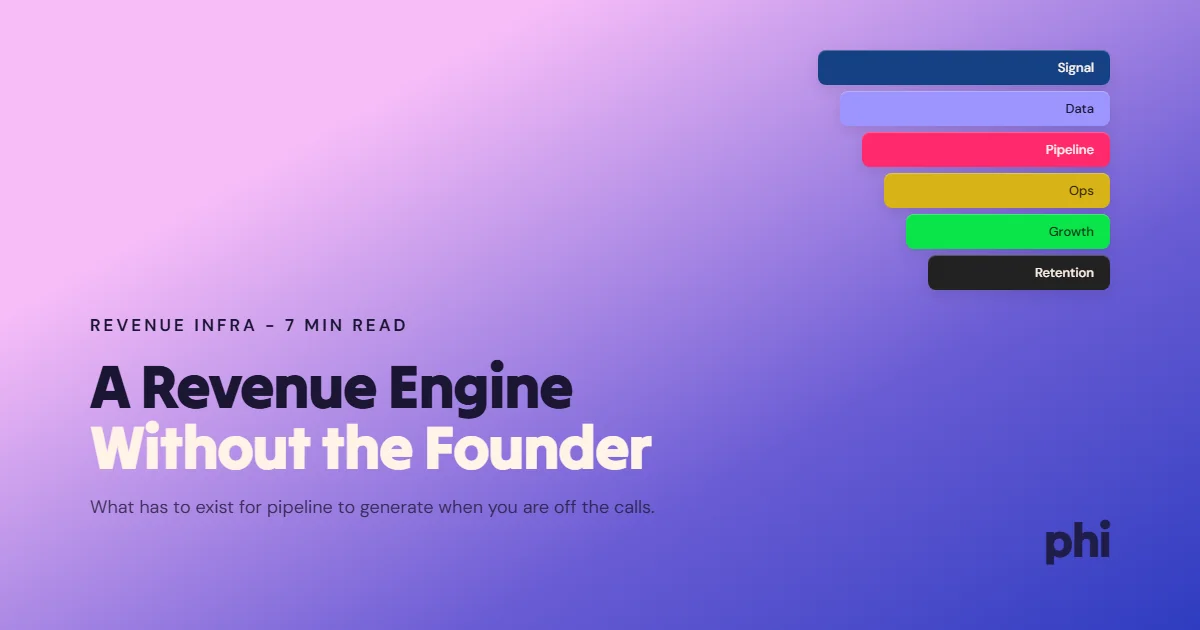
    A real b2b revenue engine is five stacked layers. Each layer has a failure mode that looks like a people problem but is actually a design problem. Here’s what each layer does, how it breaks, and what a working version looks like.

    Layer 1: Data

    This is the foundation. Everything above it depends on it. And most companies have no idea how bad their data actually is.

    The failure mode: your CRM is full of records nobody trusts. Titles are wrong. Companies have churned or been acquired. The ICP you defined 18 months ago hasn’t been validated against the deals you actually closed. Your outbound team is prospecting into a list that was stale before they touched it.

    A working data layer has three things. A defined, validated ICP built from closed-won data, not assumptions. A continuous enrichment process (tools like Apollo run inside our outbound pods to keep signals fresh). And a feedback loop that updates the ICP definition when the market moves.

    Bad data at this layer doesn’t just waste outbound effort. It corrupts your attribution, breaks your routing logic, and makes your reporting meaningless. Fix this first, or you’re building on sand.

    Layer 2: Channels

    Once you know who you’re going after, you need to reach them. The failure mode here isn’t using the wrong channel. It’s running channels that don’t talk to each other.

    Most B2B teams run email sequences, LinkedIn outreach, paid ads, and content in parallel. Each channel has its own owner, its own metrics, and its own definition of a lead. Marketing counts a form fill. Sales counts a meeting booked. Nobody agrees on what “pipeline” means.

    A working channel layer treats outbound and inbound as one system. Outbound surfaces the accounts. Content warms them. Paid retargets the ones who showed intent. Sequences pick up the thread. When a prospect sees your LinkedIn post, gets an email, and then sees a retargeted ad, that’s not coincidence. That’s architecture.

    The specifics depend on your stage. Early companies usually get more from outbound than inbound. Our outbound GTM pods are designed to run this as one integrated motion, not three separate workstreams owned by three different vendors.

    Layer 3: Routing

    This is the layer nobody talks about until it’s broken. And by then, revenue has already leaked.

    Routing is the set of rules that determines what happens to a lead the moment it enters your system. Who owns it? What’s the SLA to first contact? Does it go to a rep based on territory, vertical, company size? What happens if nobody picks it up in 48 hours?

    The failure mode: inbound leads sit in a queue. Hot outbound replies get routed to the wrong rep. AEs get handed accounts with no context on what the prospect already engaged with. The first conversation starts cold even though the prospect has already been through five touchpoints.

    A working routing layer is documented, automated, and owned. Not by a rep. By the system. The rules live in the CRM. The handoff triggers automatically. And there’s a fallback when the primary owner is out. A proper revenue engine b2b layer layers all five of these on top of each other. Building a revenue engine is not a marketing project. It is an infrastructure project.

    This is where sales ops earns its cost. Not in building reports, but in building the logic that makes sure every qualified signal gets the right human response in the right window.

    PhiOperators, not advisorsSee which layer is breaking your pipelineWe’ll walk through your current system and show you exactly where revenue is leaking before you book another rep.Book an intro

    Layer 4: CRM Architecture

    Your CRM is not a database. It’s the operating system for your revenue team. Most companies treat it like a database. That’s the problem.

    The failure mode: deals are created inconsistently. Stages don’t map to actual buyer behavior. There’s no standard for what moves a deal from one stage to the next, so two reps at the same company have completely different stage definitions in their heads. Close dates are guesses. Forecast accuracy is a joke.

    A working CRM architecture starts with stage definitions that reflect reality. Each stage has an entry criterion (what has to be true for a deal to be here) and an exit criterion (what has to happen to move it forward). Fields are standardized. Workflows are automated. The CRM reflects what’s actually happening in the market, not what reps remembered to log.

    This is what RevOps is actually for. Not dashboards. The architecture underneath the dashboards. If you want to know more about how this function works and why most teams underinvest in it, this post breaks it down.

    AtoB’s revenue system was built on CRM architecture that connected outbound signals to deal stage progression to CS handoffs. When you’re scaling from 77 customers to 7% market share, you cannot rely on reps remembering to update records. The system has to enforce consistency.

    Case StudyAtoB: 77 customers to 7% U.S. trucking market shareThis is what happens when all five layers work together inside a single vertical.Read the story

    Layer 5: Reporting Loops

    The fifth layer is where most companies declare victory too early. They build a dashboard. They look at it in the weekly sales meeting. And then nothing changes based on what they see.

    That’s not a reporting loop. That’s a reporting display.

    The failure mode: metrics are tracked but not acted on. You know your open rate dropped. You don’t know why, and nobody owns figuring it out. You know conversion from meeting to proposal is low, but there’s no structured process for diagnosing what changed. Data accumulates without informing decisions.

    A working reporting loop closes the gap between signal and action. When outbound reply rates drop below threshold, the sequence gets reviewed within the week. When a deal stage conversion drops, the rep and their manager review call recordings together. When CAC rises month over month, the ICP definition gets interrogated.

    The companies that have tools but no real system almost always break here. The tools generate data. Nobody has designed the process for turning that data into better decisions. So the system never learns, and results plateau.

    The Sequence Matters

    These five layers aren’t a checklist you can work through in any order. They’re a stack. Each layer depends on the one below it.

    LayerWhat breaks without itWho owns the fix
    1. DataOutbound hits the wrong accounts. Enrichment fails. ICP drifts.RevOps + outbound pod
    2. ChannelsVolume without attribution. Marketing and sales blame each other.GTM architecture
    3. RoutingLeads go cold. Reps work the same account twice. Revenue leaks silently.Sales ops
    4. CRM ArchitectureForecasts are fiction. Deal stage means nothing. Handoffs break.RevOps
    5. Reporting LoopsSystem never learns. Results plateau. Fixes target symptoms, not causes.RevOps + leadership

    Building a revenue machine means building all five. Skip a layer and the ones above it underperform. It’s not a people problem. It’s a sequence problem.

    Most teams have at least three of these layers in some form. The question is whether they’re connected. If your answer is “sort of,” that’s the gap where revenue is disappearing right now.

  • Land and Expand SaaS: A 6-Month GTM Roadmap

    Land and Expand SaaS: A 6-Month GTM Roadmap

    A $30K deal closes on a Tuesday. Eighteen months later, that same account is paying $200K ARR and just signed a three-year renewal. No new logo required. The team that pulled this off did not run a better campaign. They ran a better system.

    Companies executing a real SaaS land and expand strategy post net dollar retention above 120%. They start each year with more revenue from existing customers than they closed the prior year, before a single new deal is signed. Most mid-market teams understand the concept. Few have the GTM infrastructure to run it consistently.

    Why the SaaS Land and Expand Strategy Works in Mid-Market Specifically

    Mid-market buyers sit in a specific window: 100 to 2,500 employees, budget authority at the VP level, and procurement cycles that move in weeks, not quarters. They are growing fast enough that pain compounds quickly. They are small enough that one department’s win becomes visible to adjacent teams within the same quarter.

    That visibility is the structural advantage. When your product solves a real problem for the marketing team, the head of sales sees it in three months. You do not pitch the expansion. The champion surfaces it for you.

    • Selling to an existing customer closes at 60 to 70% probability.
    • Selling to a net-new prospect closes at 5 to 20%.

    A saas land and expand strategy is not a philosophical position. It is the better bet, arithmetically. Traditional enterprise sales fights these odds by demanding large upfront commitments and C-suite access before you have proven anything. Mid-market buyers will not give you that. The land and expand model earns the right to grow by delivering first.

    The 6-Month GTM Engineering Roadmap for Mid-Market B2B SaaS

    Most teams treat land and expand as a philosophy. The ones posting 130%+ NDR treat it as an engineered sequence. Here is what the 6-month gtm engineering roadmap example mid-market B2B SaaS teams actually run looks like, phase by phase.

    Month 1 to 2: Land with a Constrained Wedge

    The opening contract should feel small on purpose. One department. One use case. One pain point with a measurable outcome attached.

    A data analytics SaaS does not land with “full revenue operations.” It lands with campaign reporting for 50 marketing seats at $30K ARR. The CSM is assigned within 48 hours of close. Success metrics are defined collaboratively in week one. Not dictated. Agreed on.

    Onboarding outcomeAnnual gross churn rate
    Strong onboarding, fast ROIBelow 6%
    Onboarding treated as afterthought15 to 25%

    Time-to-value is the only metric that matters in this phase. If the buyer does not see ROI within 90 days, they do not expand. They churn. The target: 85% product adoption within 60 days. When you hit that number, the champion has something to talk about internally. That is when gtm expansion planning begins.

    Month 3 to 4: Run Trigger-Based Expansion Plays

    Expansion is not a conversation you initiate when you feel like it. It is a set of plays that fire when specific signals appear in your data. The CSM runs them on a 45 to 60 day cadence. Systematically, not ad hoc.

    The four signals that matter:

    • Product adoption above 85% in the landing team. The wedge is working. Adjacent teams will start asking questions.
    • New hires in departments already using your product. Seat expansion is the lowest-friction upsell that exists.
    • Support tickets pointing at capability gaps. “We need better permissions” is a tier-upgrade conversation waiting to happen.
    • Champion engagement declining. This is the early warning. Act before it becomes a renewal risk.

    The cross-sell play follows a simple structure: identify which features adjacent teams are not using, surface a peer story from a similar company, let the champion do the internal selling. “Company X started where you are. Six months later, their BI team cut reporting errors by 90% using the analytics module.” That one sentence seeds the idea. The champion closes it internally without you in the room.

    Case StudyAtoB: 40% CSAT improvement across thousands of fleetsPhi built the retention and expansion infrastructure that turned AtoB’s CS function into a compounding revenue system.Read the story

    Month 5 to 6: Build the Expansion Pipeline as a Formal System

    By month five, expansion should be tracked with the same rigor as new business. A separate pipeline with defined stages: Identified, Qualified, POC, Negotiation, Closed. Split commission between the AE and CSM. Forecasting that separates expansion bookings from net-new ARR.

    This is where most mid-market teams leak revenue. The opportunity is real. The system to capture it does not exist.

    • The Sales-CS handoff ritual is the infrastructure that prevents this.
    • At contract close, the CSM joins the final sales call.
    • The AE documents champion information, pain points, and the first three expansion signals to watch.
    • A success plan is created within 72 hours.
    • Without this ritual, institutional knowledge stays in the AE’s head and walks out when they hit quota and stop paying attention.
    PhiOperators, not advisorsMap your expansion plays before month threeIn one conversation, we will show you exactly where your current land and expand motion is leaking revenue and what to build next.Book an intro

    GTM Expansion Metrics: The Five Numbers That Tell the Real Story

    You cannot manage a land and expand motion without the right instrumentation. Track these weekly. Not quarterly. A champion’s engagement score drops in week eight. If you catch it then, you can act. If you catch it at renewal, the conversation is already defensive.

    MetricTargetWhat it signals
    Net dollar retentionAbove 120%Expansion is compounding. Below 100% means churn is outpacing growth.
    Annual gross churnBelow 6%Onboarding is working and product fit is solid.
    Expansion ARR ratioAbove 30%Expansion is a material revenue driver, not a bonus.
    Time to first expansionUnder 6 monthsCS has enough signal to surface opportunities early.
    Average expansion cycleUnder 45 daysInternal selling is working and the champion can move quickly.

    For the RevOps architecture that surfaces these numbers automatically, the RevOps pod builds the CRM workflows and attribution layer that connects CS activity to expansion revenue in real time.

    What the Motion Actually Produces at Month 18

    The $30K marketing contract after 18 months of a disciplined GTM expansion motion:

    • Marketing team expanded from 50 to 75 seats: +$15K ARR
    • Sales team adopted the pipeline reporting module: +$45K ARR
    • Finance team using the analytics module: +$30K ARR
    • Upgraded to enterprise tier for SSO and compliance: +$80K ARR
    • New total: $200K ARR on a three-year renewal

    That is not a sales motion. That is a compounding system. The company standardized on your product across four departments. You have C-suite relationships, a multi-year contract, and a reference account you can use in every mid-market conversation next year.

    Mid-market companies are also growing organizations. The 300-person company you landed becomes a 900-person company in three years. You rode the growth curve with them. The expansion headroom was always there. The system is what captured it.

    • The customer success pod at Phi builds this retention and expansion infrastructure for mid-market B2B teams, including the health scoring, onboarding workflows, and quarterly business review cadences that keep accounts compounding rather than flattening.

    Three Pitfalls That Break a Land and Expand SaaS Strategy

    The model is not complicated. The execution is where teams fail.

    • Selling big upfront. A $200K proposal on the first call scares mid-market buyers. They are allergic to vendor lock-in before value is proven. Start at $30K. Earn the right to grow.
    • Disappearing after close. The AE celebrates the deal. The CSM gets a Slack message five days later. The buyer logs in twice, gets confused, and starts looking for alternatives. Onboarding is the entire foundation of the expansion motion that follows.
    • No expansion playbook. The CSM knows the account is healthy. The AE has moved on to new logos. Nobody has mapped the next use case. Nobody owns the trigger. The expansion opportunity passes.

    The companies posting 3x revenue growth are not finding 3x more customers. They are building the system that extracts 3x more value from the accounts they already have. That is the SaaS land and expand strategy run as infrastructure rather than instinct.

    To see how the full GTM architecture fits together, start with the GTM consulting work we do on ICP definition and channel design, then follow it into the TruckX case study, where we took a $2M ARR business to $16M in 18 months by building the system from scratch.

  • GTM Strategy for Logistics and Freight Tech Startups

    GTM Strategy for Logistics and Freight Tech Startups

    Only 23% of logistics tech startups scale past $10M ARR. The product is rarely the problem. The go-to-market strategy for logistics technology startups is almost always built on the wrong assumptions about how freight buyers make decisions.

    Freight is not one market. It is a collection of sub-markets that happen to share trucks. A shipper, a broker, an owner-operator, and a fleet manager each have different budgets, different fears, different approval chains, and completely different definitions of a successful deployment.

    Why Most Logistics Tech GTM Strategies Stall Before $10M

    The most common failure mode is not a bad product. It is a GTM that treats “logistics” as a single segment with a single value proposition.

    Three patterns show up again and again across logistics tech startups that stall:

    • Automating the wrong thing. Pushing automated load matching at owner-operators who value dispatcher relationships above almost everything else. When messaging shifts to “this makes your relationships easier to manage,” sales cycles drop.
    • Skipping compliance depth. ELD mandates, DOT regulations, and insurance requirements vary by region, vehicle class, and carrier type. If the sales team cannot speak to that variance in discovery, procurement gets nervous and timelines extend.
    • Demanding workflow overhauls. A large majority of carriers will reject technology that requires rebuilding how they operate from scratch. The frame that works: “this plugs into what you already do.”

    All three failures share one root cause: the GTM was designed for a generic enterprise buyer, not for the specific humans who run freight operations.

    Logistics Tech Strategies for Startups: Decoding the Sales Cycle

    Enterprise freight tech deals take 7 to 14 months to close. That timeline is not irrational. Look at who has to say yes.

    The Buying Committee in Freight

    The fleet manager wants to know drivers will actually use the product and that ELD training will not take a week. The CFO wants a clear ROI model that accounts for upfront hardware or implementation costs. The IT director wants to know the API documentation is real and the system will not break their existing ERP connections.

    Any one of them can independently kill a deal that looked like it was moving.

    What Shortens the Freight Sales Cycle

    A WMS startup we worked with cut their cycle from 11 months to 6. The changes had nothing to do with the product itself.

    • Role-specific ROI calculators. Built separately for the fleet manager, CFO, and IT director so each stakeholder could validate value on their own terms.
    • Pre-built ERP integrations. Covered the five systems their buyers most commonly ran, removing IT’s biggest objection before it surfaced.
    • Staged proof-of-concept process. Let IT validate the integration before procurement signed anything.

    Enterprise logistics buyers are not buying features. They are buying confidence that implementation will not become a crisis.

    PhiOperators, not advisorsMap your freight buyer committee before you pitchIn the first conversation, we show you where your current GTM motion is losing deals in the logistics sales cycle and what to fix first.Book an intro

    Carrier Adoption Is the Real GTM Metric in Freight

    Signed contracts are not the finish line in logistics tech. Carrier adoption is. A deal that closes but never fully deploys is a churn event waiting to happen, and in freight, churn is expensive to win back.

    Carriers need technology to stay competitive, but they cannot absorb operational downtime during rollout. The solution is not better training decks. It is reducing deployment friction to the point where the rollout barely registers as a disruption.

    • A dashcam provider we worked with reduced deployment time from 14 weeks to 3 days through three focused changes:
    • Hardware compatibility. Built to work with 87% of existing in-cab systems, eliminating the most common installation blocker.
    • Localized training. Short video tutorials in the languages the driver base actually spoke, not translated English decks.
    • Performance-based pilot pricing. Regional pilots with pricing tied to outcomes, removing the financial risk from the first commitment.

    Pilot-to-full-deployment conversion hit 68%. Driver compliance reached 92% against an industry average of 74%.

    TruckX scaled from $2M to $16M ARR in 18 months. The work was not closing more logos. It was building a GTM system where adoption was treated as a revenue metric from the first sales conversation.

    Segmenting the Freight Market So Your Pipeline Is Not a Lottery

    Generic “logistics company” targeting produces generic results. The logistics tech strategies for startups that work start with a segmentation model that reflects how freight operators differ from one another, not how they look in a CRM filter.

    Three segmentation dimensions outperform standard firmographics in freight:

    DimensionWhat it splitsWhy it matters
    Operational maturityPaper BOLs vs. modern TMSDifferent needs, cycle length, and objections entirely
    Fleet compositionOwner-operators vs. large private fleetsOwner-operators decide in days; large fleets take quarters
    Geographic densityRegional lanes vs. national coverageShapes both product requirements and channel strategy

    When a freight visibility platform we worked with rebuilt their ICP around these dimensions instead of firmographics alone, their enterprise demo-to-close rate tripled. Same number of demos. Same product. A completely different conversion rate because the right conversations were happening with the right buyers.

    Shipper behavioral data is underused in this vertical. Shipper requirements often predict broker technology needs well before brokers have articulated them internally. If your product serves both sides of the relationship, the shipper signal is worth building into your targeting. The same segmentation challenge appears in adjacent verticals: a supplynet construction GTM strategy runs into identical problems because buyers inside that vertical split just as sharply by operational maturity as freight operators do.

    What a Logistics Tech Strategy Consultant Actually Builds

    There is a version of GTM advice that produces decks. There is a version that produces pipeline. The difference comes down to whether someone is designing the system or just running it.

    When Datatruck came to Phi, they were at zero ARR with a product that worked. Founder-led sales was the only motion moving deals, and it was not going to scale. Phi built the full revenue system: ICP definition, outbound infrastructure, sequencing, CRM architecture, and a sales motion the team could run without the founder in every room.

    • Datatruck went from $0 to $2.5M ARR, raised a $12M Series A, and dropped CAC by 97%.

    That is what a logistics tech strategy consultant who operates rather than advises actually looks like. Not a framework handed off in a slide deck. A system built and running inside your org.

    The same pattern held at AtoB. Starting from 77 customers, the GTM system Phi built helped take them to 7% of the U.S. trucking market at an $800M Series B valuation. The work was RevOps, outbound infrastructure, and a sales motion designed for the specific buying behavior of fleet operators, not generic enterprise B2B.

    The Metrics That Actually Predict Scale in Freight Tech

    Most freight tech teams track the wrong numbers for too long. Closed-won and MRR matter, but they are lagging signals. By the time they move in the wrong direction, the underlying problem has been compounding for months.

    Three metrics predict scale more reliably in this vertical:

    • Implementation NPS. Measures the rollout experience, not the product. It is the clearest leading indicator of retention in asset-heavy markets.
    • Feature adoption velocity. Tells you whether buyers are extracting value beyond the initial use case. That is what separates expansion revenue from flat accounts.
    • Carrier retention rate. More predictive than overall churn in any logistics product where the carrier relationship is the core unit of value.

    A shipper-facing platform that adopted this framework hit 8.3% month-over-month growth and 79% year-over-year carrier retention. Neither number came from a new campaign. Both came from measuring the right things and building feedback loops fast enough to act on them.

    If you are building a go-to-market strategy for logistics technology startups and you are not tracking adoption and retention as revenue metrics from day one, you are optimizing for a number that will eventually mislead you.

  • Common Pitfalls in Go-to-Market Execution for B2B Startups

    Common Pitfalls in Go-to-Market Execution for B2B Startups

    Most B2B startups don’t have a GTM problem. They have a GTM execution problem. The strategy exists, the ICP is defined (sort of), but the gap between document and system is where pipeline dies. Understanding the common pitfalls in GTM execution starts with recognizing that most of them aren’t strategy failures at all. These are the nine that show up most often across B2B teams, and what actually fixes each one.

    1. The Strategy Never Becomes a System

    The most common pitfall in GTM execution is a plan that lives in a deck and never becomes operational. SDRs use messaging from three months ago. AEs chase accounts outside the ICP because those buyers respond faster. Marketing sends campaigns that don’t match what sales is saying on calls.

    B2B team execution breaks down when there’s no translation layer between strategy and daily motion. That layer isn’t a weekly standup. It’s infrastructure: defined ICP criteria in the CRM, approved sequences tied to specific verticals, battle cards that get updated when positioning shifts, and someone whose job is to own execution quality.

    Case Study$0 to $2.5M ARR with a 97% drop in customer acquisition costDatatruck had a market thesis but no execution layer, so we built the system that turned it into pipeline.Read the story

    2. Founder Knowledge Doesn’t Transfer

    Founder-led sales works because founders carry context that’s almost impossible to document. They know which objections are real and which ones are stalls. They know which problems matter at which company sizes. When a sales team takes over, that context doesn’t transfer automatically. It usually doesn’t transfer at all.

    The result: reps run the playbook, get worse outcomes than the founder did, and everyone assumes the playbook is wrong. Often the playbook is fine. The depth behind it was never captured.

    • The fix isn’t more training.
    • It’s a different kind of documentation:
    • Record real calls. Capture actual objection handling, not a cleaned-up version of it.
    • Run joint selling longer than feels necessary. Don’t hand off accounts until the rep has seen the full cycle at least twice.
    • Transfer judgment, not just process. The goal is for reps to understand the reasoning behind the playbook, not just the steps.

    Our embedded sales pods are built for exactly this transition, so institutional knowledge doesn’t evaporate when the founder steps back.

    3. Signs of GTM Misalignment Hide in Plain Sight

    Signs of GTM misalignment are almost always visible in the data before anyone names them. Sales cycles consistently longer than projected. CAC that doesn’t improve as volume grows. Prospects who technically fit the ICP but never close.

    When these signals appear, most teams add resources. More reps, more sequences, more budget. If the underlying market assumptions are wrong, more execution just burns money faster.

    • The right move is to stop and run structured customer development with prospects who didn’t convert.
    • A financial services client we worked with had built their ICP around a definition that was too broad.
    • Narrowing to a single vertical with consistent pain points was what finally produced repeatable pipeline.
    • This is the diagnostic work that GTM consulting for B2B startups surfaces before a team spends another two quarters proving the wrong hypothesis.

    4. The Integration Headaches Nobody Warns You About

    What are the biggest integration headaches teams face with modern GTM tooling? Almost all of them come down to the same root cause: tools purchased before the architecture was designed.

    The modern B2B GTM stack is genuinely powerful. Clay for enrichment. Apollo for prospecting. Sequencing platforms. CRM workflows. LinkedIn automation. AI-assisted outreach. But these tools don’t self-assemble. Every connection requires design decisions, and most teams make those decisions reactively, after things break.

    • The integration problems that show up most often:
    • Stale CRM records. Enrichment data doesn’t flow in correctly, so reps work off outdated information.
    • Premature sequences. Outreach fires on leads before they’ve been properly qualified, burning contacts before a conversation happens.
    • Parallel outreach with no deduplication. The same prospect gets hit from LinkedIn and email in the same week from different senders.
    • Broken attribution. Revenue can’t be traced to its original source because the handoff between tools wasn’t logged.

    In-house GTM platform management compounds this because whoever owns the tools is usually also expected to own strategy and execution. That’s three jobs, and something always gets dropped. Our AI and automation work is largely about designing these connections before they become a manual cleanup problem.

    PhiOperators, not advisorsWe’ll map where your GTM execution is breakingIn the first conversation, we identify the specific layer where your B2B team execution is losing pipeline.Book an intro

    5. Measuring Activity Instead of Effectiveness

    Activity metrics feel safe. Emails sent, calls made, demos booked. They’re easy to report and they look like progress. The problem is they don’t tell you whether the execution is working.

    A team can hit every activity target and still generate no real pipeline if the targeting is wrong, the messaging doesn’t land, or the leads being worked aren’t real buyers. The metrics that actually matter are leading indicators tied to conversion quality:

    MetricWhat it surfacesWho owns it
    Meeting-to-opportunity rateDiscovery and qualification qualitySales ops
    Pipeline velocity by ICP segmentWhether you’re targeting the right accountsRevOps
    Sales cycle length by verticalFit between offer and buyerRevOps
    Reply rates by message angleMessaging resonanceOutbound pod

    Most teams don’t track these because it requires better CRM hygiene than they have. Our RevOps infrastructure work starts here: build the data layer so the dashboards actually tell you something actionable.

    6. Hiring Before the System Exists

    A startup raises a round, immediately hires three AEs and an SDR manager, gives them tools but no system. Nine months later, they’ve closed a handful of deals and burned through most of the sales budget. The problem wasn’t the people. It was the sequence.

    People need infrastructure to plug into. Without defined ICP criteria, enriched data, tested sequences, and CRM workflows, reps run individual experiments with no shared learning. Every rep develops their own approach. None of it compounds.

    • Build the system first.
    • Validate it with a smaller team.
    • Then add capacity.
    • This is one of the core arguments for outsourced B2B GTM execution in the early stages: you get the infrastructure and the operators simultaneously, without building both from scratch while also trying to close deals.

    7. Pivoting Strategy Before Fixing Execution

    Frequent pivots are often a symptom of poor execution getting misdiagnosed as a strategy problem. The ICP shifts. The channel changes. The messaging gets overhauled. Three months later, the same outcomes appear. The underlying execution infrastructure hasn’t changed.

    Before changing strategic direction, isolate the actual failure point:

    • Outreach not generating meetings. Targeting or messaging problem.
    • Meetings not converting to pipeline. Qualification or discovery problem.
    • Pipeline not closing. A different problem entirely, likely in late-stage process or pricing.

    Treat the GTM strategy as a hypothesis with defined success criteria and a fixed testing window. Adjust based on data, not impatience. B2B GTM process alignment consulting often starts with this diagnostic before any new motion gets stood up.

    8. Communication Breaks Between Sales, Marketing, and the Market

    Sales hears one set of objections from prospects. Marketing runs campaigns built on a different set of assumptions. The founder works from their own read of the market. None of these perspectives are wrong. They’re just not connected.

    The fix is structural. Three mechanisms that actually work:

    • Cross-functional GTM reviews. Sales and marketing look at the same data together, not separate decks in separate meetings.
    • A shared messaging framework. One document, updated by both teams when positioning shifts.
    • A feedback loop from customer conversations into campaign strategy. Not a quarterly review. A standing process.

    When these mechanisms don’t exist, each team optimizes for their own numbers and the system as a whole underperforms. That’s a recognizable sign of GTM misalignment, and it shows up long before anyone names it.

    9. No Feedback Loop from Market to System

    Every GTM system degrades without active maintenance. Prospects change how they buy. Competitive dynamics shift. The messaging that worked six months ago stops landing. If the system has no mechanism for detecting this, teams keep running the same plays while results quietly decline.

    The feedback loops worth building before you need them:

    • Weekly call review. Frontline reps listening to recordings together, not just managers reviewing individuals.
    • Sequence performance by angle. Not aggregate open rates. Specific message angles tracked against reply and meeting rates.
    • A clear messaging owner. Someone with the authority to update positioning without a month of approvals.

    TruckX scaled from $2M to $16M ARR in 18 months partly because the system was built with adaptation in mind, not just for initial launch.

    The common pitfalls in go-to-market execution aren’t random. They follow a predictable pattern: strategy without infrastructure, people without systems, tools without integration, metrics that measure the wrong things. Fix the infrastructure layer and most of the other problems resolve themselves.

  • How SaaS Companies Accelerate Go-To-Market After Funding

    How SaaS Companies Accelerate Go-To-Market After Funding

    Most SaaS founders close their Series A and immediately post a VP of Sales job description. Six months later they have two AEs, a fractional CMO, and a pipeline that looks exactly like it did the week the wire hit. The round didn’t fix the problem. It funded it at scale.

    How do SaaS companies actually accelerate go-to-market after funding? Not with more headcount. With infrastructure.

    Why Funding Accelerates the Wrong Things First

    PMF tells you your product works for someone. It says nothing about whether you can reach more of those people systematically, close them efficiently, or keep them long enough to matter. Those are GTM problems, and they require GTM infrastructure.

    A freight tech platform we worked with hit $2.5M ARR on founder-led sales and then flatlined for 18 months. The diagnosis wasn’t a bad product or a weak market. Three specific breakdowns were eating the business:

    • Mis-targeted effort. Thirty-seven percent of sales time was going to non-ICP accounts.
    • Broken demand gen. Marketing was generating leads at half the target conversion rate.
    • Fractured onboarding. Customer success had six different onboarding processes running in parallel for the same product.

    That’s not a people problem. It’s a system problem. Raising a round before fixing it just means you burn the capital faster.

    Companies that formalize their GTM framework before scaling grow 2.1x faster than those that bolt it on after. The question isn’t whether to build the system. It’s which layer to build first.

    Narrow Your ICP Before You Expand the Market

    Every company that scaled fast from $1M to $10M ARR did one thing well before they did everything else. They identified the smallest segment where their product delivered fast, measurable value and built the entire GTM motion around that segment first.

    Call it your NOW market. It’s not your TAM. It’s the slice of the market where sales cycles run under 45 days, churn stays under 5% annually, and customers can articulate ROI within the first 30 days.

    • A fintech payments platform targeting “financial institutions” was running 90-day sales cycles and losing deals to procurement drag.
    • They narrowed to mid-market logistics companies with cross-border payment needs.
    • The results were immediate:
    MetricBeforeAfter
    Sales cycle90 days31 days
    Win rate22%47%
    Implementation timebaselinedown 65%

    That’s not a product improvement. That’s a targeting decision.

    The NOW market exercise is simple. Look at your existing customers and find the ones who got to value fastest, required the least support, and referred others without being asked. Build your ICP filters around those traits. Then pause every campaign that isn’t targeting that profile.

    The Revenue Infrastructure Layer Most Founders Skip

    After ICP clarity, the second thing fast-scaling SaaS companies build is a revenue operating layer. Not a CRM. Not a sequencing tool. A system where every function sees the same data, the same pipeline health, and the same customer signals.

    The specific pieces that matter at the $2M to $10M stage:

    • ICP-based lead scoring. Routes the right leads to the right motion before a rep touches them.
    • CRM workflow automation. Enforces handoff SLAs between marketing, sales, and customer success.
    • Multi-touch attribution. Connects marketing spend to closed revenue, not just last-click activity.
    • Qualification framework. Deal reviews built around predictive criteria, not vanity metrics.

    Most sub-$10M ARR companies skip this because it feels like overhead. It isn’t. A logistics payments startup that stood up fractional RevOps before scaling its sales team reduced admin time by 30%, improved forecast accuracy by 45%, and saved $178K annually compared to the cost of a full-time hire. That’s capital going back into pipeline.

    PhiOperators, not advisorsFound the gap? Here’s how to close it fast.In one conversation, a Phi operator will map your biggest GTM infrastructure gap and tell you exactly what to build first.Book an intro

    Why Activation Speed Predicts Scale Better Than MRR Growth

    There’s a metric most boards ignore that predicts whether a SaaS company can actually accelerate after funding. It’s activation velocity: the time between signup and the first moment a customer gets real value from your product.

    The data on this is hard to argue with:

    • 7-day activation. Logistics tech users who activate within 7 days show 3x lifetime value versus those who take longer.
    • 24-hour activation. Correlates with 92% retention at the 90-day mark.
    • Same-day activation in fintech. Companies achieving this see 78% higher expansion revenue.

    These aren’t soft engagement numbers. They’re the leading indicator for everything downstream.

    A logistics visibility platform improved activation rates by 40% through three changes: pre-built integrations with the major TMS platforms their customers already ran, proactive customer success touchpoints at 1, 24, and 72 hours post-signup, and automated data validation that caught issues before they affected operations.

    • No new product features.
    • Just a faster path to value.
    • If your activation sequence is a generic welcome email and a help center link, you’re leaking retention before the ink is dry on the contract.

    Build a Default Go-To-Market Path, Not a Channel Experiment

    Post-funding, most GTM teams test every channel simultaneously. Paid, outbound, content, events, partnerships. Six months later, nothing has enough volume to read clearly and the budget is gone.

    The companies that accelerate fastest pick one primary path and build infrastructure around it before touching anything else. Which path matters less than the commitment to it:

    • Product-led growth. Works when your product has a natural self-serve entry point with measurable activation moments.
    • Outbound. Works when your ICP is identifiable, reachable, and large enough to sustain a sequencing operation.
    • Founder-led enterprise. Works when deal size justifies the time cost and the founder has category credibility.

    The signal that you’ve found your default path: 70 to 80% of closed revenue comes through a single route with a repeatable sequence of steps. Until you see that pattern, you’re in discovery mode, not acceleration mode.

    One payment automation company tried seven channels before finding theirs. Free API access for logistics finance teams, usage-triggered outreach when payment volume crossed a threshold, and AE conversations with CFOs centered on a single ROI calculator. Seventy percent of their $100K-plus deals started as free API accounts. That’s a default path. Build the infrastructure to scale it and ignore everything else for the next two quarters.

    The Hiring Trap That Burns Post-Funding Runway

    There’s a version of go-to-market acceleration that looks responsible on paper: hire a VP of Sales, staff up with AEs, let them run. The problem is the ramp.

    A mid-market AE takes four to six months to reach full productivity. A VP of Sales takes six to nine months to build a real process. In a startup where runway is the constraint, that’s often the whole year.

    • The alternative isn’t outsourcing.
    • It’s embedding an operating layer that runs the system while your internal team ramps.
    • Sales pods with pre-built playbooks, sequencing infrastructure, and industry-specific objection handling can close pipeline in the first 30 days, not the first quarter.

    TruckX used this model to go from $2M to $16M ARR in 18 months. The internal team scaled alongside the operating layer, not instead of it.

    Case StudyTruckX: $2M to $16M ARR in 18 monthsHow an embedded GTM operating layer scaled pipeline 8x while the internal sales team was still ramping.Read the story

    When Customers Become the GTM Engine

    The inflection point for SaaS go-to-market acceleration isn’t when outbound starts working. It’s when customers drive 30% or more of new pipeline without prompting.

    That happens when three things are true at once:

    1. Customers achieve clear ROI fast enough to talk about it unprompted.
    2. They have a peer network you can reach through them.
    3. Your product has natural referral mechanics built into the workflow.

    Most post-funding GTM plans skip this entirely because the referral flywheel feels like a year-two problem. It isn’t. The retention system you build in month six determines whether customers become a channel or a churn statistic.

    That starts with customer success infrastructure: onboarding workflows, health scoring, expansion playbooks. Not a CS manager with a spreadsheet. A system.

    • Build referral tracking into the product early.
    • Create an evangelist tier with real rewards tied to referred ARR, not discounts.
    • Run joint case studies with your best customers before you have a demand gen budget.
    • The companies that accelerate fastest after funding aren’t just building outbound.
    • They’re building all the loops at once.

    If you’re mapping this against your own GTM and finding gaps, how Phi approaches GTM architecture covers the decisions that matter most for companies at the $1M to $15M ARR stage.

  • Burn Rate Optimization: What Actually Works

    Burn Rate Optimization: What Actually Works

    Most founders who reach out about burn rate are asking the wrong question. They want to know what to cut. The real question is why revenue isn’t covering the gap yet.

    Cash burn is a symptom. The disease is almost always a broken or nonexistent revenue system. Fix the system and the burn rate problem often fixes itself. Cut costs without fixing revenue and you just die more slowly.

    How to Calculate Burn Rate (and Which Number Actually Matters)

    Gross burn is your total monthly spend. Net burn is what you’re actually losing after revenue comes in. Most investor conversations and board decks reference net burn, and for good reason: it tells you how long you have.

    MetricFormulaWhat It Tells You
    Gross BurnTotal monthly expensesYour cost baseline
    Net Burn(Starting cash minus ending cash) / monthsHow fast runway is shrinking
    RunwayCurrent cash / monthly net burnMonths until zero

    If you started a quarter with $600,000 and ended with $420,000, net burn is $60,000 per month. At that rate with $420,000 remaining, you have seven months. That number belongs on your dashboard, not buried in a quarterly finance review.

    The founders who run out of money are rarely surprised by the burn figure itself. They’re surprised by how fast the runway moved when revenue didn’t grow as projected.

    Why Most Burn Rate Problems Are Actually Startup Cash Flow Problems

    A founder told us recently that he had cut $40,000 per month in operating costs over six months. Salaries, software, office space. The burn was lower. He still had eight months of runway and no pipeline.

    Cutting costs bought him time. It didn’t build the thing that was going to save the company.

    • The startups that successfully extend runway treat revenue as infrastructure.
    • Not a function, not a headcount decision.
    • A system with components that can be designed, measured, and iterated.
    • Most early-stage companies have tools instead: tools that don’t talk to each other, maintained by people already doing three other jobs.

    Startup burn rate optimization, done right, is about building that missing infrastructure. Not just trimming the fat. The gaps that show up most consistently:

    • Undefined ICP. Without it, outbound reaches everyone and converts no one.
    • Stale data enrichment. Sequences running on stale LinkedIn searches generate noise, not pipeline.
    • A CRM disconnected from reality. Forecasting from gut feel is how runway surprises you.
    • No marketing-to-sales feedback loop. Without one, spend compounds on channels that aren’t closing deals.

    Which Consultants Help Reduce Monthly Burn and Extend Runway?

    There are three categories of consultants for cash burn and runway optimization. They produce very different results.

    Fractional CFO and Finance Advisory

    These firms are strong on the ledger. Clean models, cash flow forecasts, sharper visibility into where money is going. If your problem is financial clarity, this is useful. If your problem is that revenue isn’t coming in fast enough, a better spreadsheet doesn’t solve it.

    Traditional GTM Consulting

    Strategy work. They’ll audit your positioning, rebuild your ICP definition, and hand you a playbook. The quality varies. The execution gap is consistent. Most advisory engagements end with a deck and a to-do list. Running that list remains your problem.

    Embedded Revenue Operators

    Teams that plug into your existing systems (or build them from scratch) and actually run the outbound motion, the RevOps layer, and the pipeline reporting. The work happens inside your org, not in a deliverable sent to your inbox.

    Phi sits in the third category. Our GTM pods embed directly into client orgs and operate the revenue system. When Datatruck came to us, they had no revenue system at all. We built one.

    That’s the version of burn rate optimization that moves runway numbers. You stop burning through cash chasing pipeline that isn’t coming because you build the system that generates it consistently.

    Practical Levers for Reducing Burn While Building Revenue

    None of this means you ignore the cost side. There are legitimate places to cut that free up capital without gutting the business. The key is sequencing: don’t cut the things that generate revenue in order to preserve the things that don’t.

    • Move headcount toward systems, not away from them. One well-run outbound pod with proper tooling outperforms three SDRs working without infrastructure. Hiring a third rep before sequencing and data enrichment are in place is expensive and slow.
    • Consolidate your tool stack around what actually runs. Most startups pay for six to ten tools with significant overlap and minimal integration. The real cost isn’t the subscriptions. It’s the time spent maintaining tools that don’t talk to each other. RevOps infrastructure is the connective layer that makes the rest of your tooling useful.
    • Convert annual contract value upfront where possible. Monthly billing feels founder-friendly but destroys cash flow. Offer a discount for annual payment. The cash-on-hand impact is immediate and the churn signal from conversion is useful data.
    • Build retention before you build acquisition. CAC is high. CAC on a customer you then lose is catastrophic. If net revenue retention is below 100%, fixing that is more valuable than adding outbound spend. The customer success layer is not a nice-to-have once retention starts affecting burn. This is where a sound venture capital spending strategy separates the companies that make it from the ones that don’t: capital allocated to retention compounds; capital allocated to broken acquisition just burns.
    PhiOperators, not advisorsWe’ll tell you where your burn is actually coming fromIn the first conversation, we map the gap between your current GTM motion and the revenue system that would close it.Book an intro

    What Sustainable Burn Rate Optimization Actually Looks Like

    When you get this right, the burn number stops being the thing you stare at. It becomes a lagging indicator of a system that’s working or not working.

    Revenue comes in more predictably. Pipeline is visible. CAC drops because outbound is reaching the right accounts with the right message at the right time. Sales cycles shorten because the ICP is tighter.

    • Retention improves because onboarding and CS have actual workflows instead of heroics from individual contributors.
    • The runway number still matters.
    • But it stops feeling like a countdown and starts feeling like a planning horizon.

    The companies that make it through burn-rate pressure are almost always the ones who chose to build the revenue engine instead of just trimming around it. If you want to map your specific situation, the GTM consulting work we do starts with exactly that diagnosis. More on the infrastructure side of the equation lives in the Phi Insights archive.