Blog

  • How to Generate B2B Leads on a Lean Budget

    How to Generate B2B Leads on a Lean Budget

    Most founders think the reason they are not generating leads is budget. It is usually not. It is focus.

    You do not need a six-figure marketing spend to fill a pipeline. You need a tight ICP, two channels you commit to, and enough reps to learn what actually converts. Below is the playbook we use with early-stage B2B founders who are trying to generate leads before they have funding to burn.

    Why most lean lead gen efforts fail

    Before touching channels, understand why small budgets produce small results. It is not the money. It is the pattern.

    • Too many channels, not enough depth. Five channels run at 20% effort will always lose to two channels run at 100%.
    • Wrong ICP. If your list is off, no copy saves you. Most lead generation ideas fail on targeting, not creative.
    • No follow-up system. Lean teams capture interest and then let it die in an inbox.
    • Treating activity as progress. Sends are not a pipeline. Replies are not pipeline. Booked calls with the right buyer are.

    For a broader diagnostic on why outbound stalls, our 9-step cold outreach framework covers the sequencing logic that makes replies convert into meetings.

    The lean lead gen stack: what you actually need

    Before spending on tools, here is the minimum viable stack for a founder or two-person team learning how to generate b2b leads on a tight budget.

    LayerMinimum ToolMonthly Cost Range
    Contact dataApollo, Clay starter, or LinkedIn Sales Nav$49-$149
    Email sendingA warmed domain + basic sequencer$30-$80
    CRMHubSpot free tier or Folk$0-$29
    SchedulingCal.com or Calendly free$0-$12
    TrackingOne spreadsheet, honestly$0

    Total floor: around $80 to $270 per month. Everything else is a distraction until you have the reply data. For more on choosing tools without overbuying, see our guide on outbound sales automation tools.

    Five ways to generate leads without paid media

    These are the plays that work when your ad budget is zero. Each one can be started this week.

    1. Narrow-ICP cold email (the highest-ROI channel at low budget)

    Cold email still works when the list is sharp and the message is specific. The mistake most founders make is blasting 5,000 contacts with a generic pitch. The winning pattern on a lean budget:

    • Build a list of 200-400 accounts that match a tight trigger (recent funding, new hire in a target role, tech stack signal).
    • Write three short sequences tied to three specific pains.
    • Send 30-50 per day per mailbox. No more.
    • Measure reply rate, not open rate. Under 3% replies, rewrite the angle.

    For the mechanics of running this at scale, once it works, review outbound prospecting techniques for B2B meetings.

    2. Founder-led LinkedIn

    Posting as the founder is free distribution. The ICP you want is probably already on LinkedIn. Three posts a week about the problem you solve, plus 10 relevant comments a day on target-buyer posts, will outperform a $3,000 ad spend within 60 days for most early-stage B2B startups.

    What works:

    • Specific problem breakdowns, not motivational content.
    • Numbers and screenshots from real customer work.
    • Comments on posts written by your ICP, not your peers.

    3. Communities where your buyer already gathers

    Slack groups, subreddits, and niche forums are underpriced. One useful answer per day in the right community compounds faster than most paid plays.

    • Pick two communities your ICP actually uses.
    • Answer questions with specifics, not pitches.
    • Let buyers find your profile. Do not drop links.

    Our breakdown of a community-led GTM motion covers the structure for turning this into a repeatable pipeline.

    4. Referral loops from existing customers

    If you have five paying customers, you have a referral channel. Most founders never ask. The cheapest lead generation idea is a 15-minute call with each current client asking two questions: who else has this problem, and would you introduce us.

    5. Narrow partnerships with adjacent vendors

    Find three companies selling a complementary product to the same ICP. Propose a warm-intro exchange or a co-hosted teardown session. No money changes hands. Pipeline does.

    The weekly rhythm that makes it work

    A lean lead gen system lives or dies on consistency. Here is the minimum weekly cadence that produces results inside 60-90 days.

    DayActivityTime
    MonList build + enrichment2 hrs
    TueSequence writing + A/B setup2 hrs
    WedLinkedIn posts + comment block1 hr
    ThuReply handling + meeting booking2 hrs
    FriPipeline review + iteration notes1 hr

    That is eight hours a week. Founders who claim they have no time for lead generation are usually spending those eight hours on low-leverage work instead.

    How to know the plays are working

    Lean lead gen has to be measured honestly. The numbers to watch in the first 90 days:

    • Reply rate on cold email: 3-8% on a tight list.
    • Positive reply rate: 1-2% is a healthy floor.
    • LinkedIn meetings from comments + posts: 2-5 per month by month three.
    • Community-sourced calls: 1-3 per month once you are posting consistently.
    • Cost per qualified meeting: Under $50 all-in when the time is tracked at a reasonable rate.

    If your numbers are below these after 60 days, the fix is rarely “more channels.” It is tighter ICP, sharper messaging, or better follow-up. For more details on what metrics to track, our post on SDR metrics sales leaders track is the reference.

    When to add budget and what to add first

    Once the lean system produces predictable replies and booked meetings, the first dollar should go toward one of these, in order:

    1. A second sender domain and mailbox to double the volume.
    2. Better data enrichment (Clay or equivalent) to tighten list accuracy.
    3. One part-time SDR or embedded pod to handle reply volume.

    Do not spend on paid ads until your organic channels are converting. Ads amplify what already works. They do not fix what is broken. For a deeper look at the build-vs-buy decision when you reach that point, see embedded SDR team vs in-house hiring.

    The takeaway

    Generating B2B leads on a lean budget is a focus problem, not a money problem. Pick two channels. Build a narrow list. Run a consistent weekly rhythm. Measure replies and meetings, not activity. Add budget only after the system produces predictable output.

    Founders who follow this sequence usually hit 15-25 qualified meetings per month within a quarter, without a single dollar of ad spend. Scaling past that is where external operators come in. If you want to see what that progression looks like at full scale, Phi Consulting’s outbound GTM pods handle the step from founder-led lead gen to a repeatable revenue engine. You can also talk to us directly about your current setup.
  • Automated Lead Generation vs. Human Touch: The 2026 Decision Framework

    Automated Lead Generation vs. Human Touch: The 2026 Decision Framework

    Most B2B teams are caught between two bad extremes. One camp automates everything and wonders why reply rates collapsed. The other refuses to automate anything and burns SDR hours on work a script could handle in seconds.

    The truth sits in the middle. Automated lead generation works brilliantly for volume, enrichment, and routing. It fails the moment a human buyer needs to feel understood. This guide draws the line for you: what to hand to machines, what to keep human, and how to stitch both into a pipeline that actually converts in 2026.

    The Core Principle: Automate Inputs, Humanize Decisions

    Think of your funnel as a factory floor. Machines handle the repetitive, rules-based work. Humans handle the judgment calls.

    Automate anything that is:

    • High-volume and repetitive
    • Rules-based with clear inputs and outputs
    • Time-sensitive (needs to happen in seconds)
    • Not dependent on emotional intelligence

    Keep human anything that is:

    • Judgment-heavy or context-dependent
    • Relationship-defining (first real conversation, objection handling)
    • Creative (messaging strategy, positioning shifts)
    • Trust-building with senior buyers

    This is the same logic that shapes a healthy revenue operating system from seed to Series B machines run the rails, humans run the relationships.

    What to Automate in Lead Generation

    Here is where lead gen automation pays back within weeks, not quarters.

    1. Prospect Sourcing and Enrichment

    Pulling contacts from databases, scraping LinkedIn, appending firmographic data, and verifying emails, all of this is mechanical work. AI lead generation tools can build a 500-account list with verified decision-maker contacts in the time it takes an SDR to finish coffee.

    2. Data Hygiene and Routing

    Lead scoring, list deduplication, territory routing, CRM updates. Zero creative input required. Automation here prevents the data decay that silently kills pipelines. For a deeper view, see our RevOps best practices that move the pipeline.

    3. Sequencing and Cadence Execution

    Sending the email. Following up on day 3, 7, and 14. Logging the activity. Pausing the sequence when someone replies. These are tasks your SDRs should never touch manually.

    4. Intent and Behavioral Signal Capture

    Website visits, content downloads, pricing page views, G2 comparisons. Track these automatically and feed them to reps as trigger events.

    5. Meeting Scheduling and Reminders

    Calendar links, automated confirmations, reminder SMS. Friction here costs you show-rates. B2B appointment setting services lean heavily on this layer.

    What to Keep Human in Lead Generation

    Here is where automated lead gen tools break down and destroy your brand quietly.

    1. Opening Message Strategy

    The first sentence of a cold outreach is not a templating exercise. It is a positioning decision. A human needs to craft the angle, the hook, and the proof point. AI can generate 50 variants, but a human picks the one that actually lands.

    2. Objection Handling and Mid-Funnel Conversations

    The moment a prospect pushes back, writes a two-line reply with a real concern, or asks a sharp question, you need a human. No AI today handles nuance well enough to protect a deal in motion. This is covered in our guide on outbound prospecting techniques for B2B meetings.

    3. ICP Refinement and Positioning Shifts

    Noticing that your best customers share a trait nobody has spotted yet. Deciding to retire a segment. Rewriting your value prop after losing three deals in a row. Judgment work, entirely.

    4. Senior-Buyer Conversations

    If you are selling into a B2B buying committee, the CFO does not want an AI-written email. They want a human who understands their board dynamics.

    5. Strategic Account Research

    For top-tier accounts, deep research beats volume every time. A human reading a 10-K, scanning earnings calls, and pulling the right angle will out-convert a 10,000-contact blast.

    The Automate vs. Keep Human Matrix

    TaskAutomateKeep HumanWhy
    Contact sourcingYesNoHigh volume, rules-based
    Email verificationYesNoMechanical
    Initial outreach copy strategyNoYesPositioning decision
    Sequence executionYesNoRepetitive
    Reply handling (first touch)NoYesNuance required
    Meeting bookingYesNoFriction reduction
    Discovery callsNoYesRelationship-defining
    Lead scoringYesNoRules-based
    Account research (top 50)NoYesStrategic judgment
    CRM data updatesYesNoRepetitive

    How AI Changes the Equation in 2026

    AI lead generation has blurred the line, but not erased it. What changed:

    • AI now drafts personalization at scale. But a human still needs to approve the angle and quality-check the output before it hits an inbox.
    • AI can qualify inbound leads. But humans still own the transition from qualified to booked.
    • AI handles Tier 3 accounts well. Tier 1 and 2 still need humans in the loop.

    The rule: let AI do the first draft, the first pass, the first filter. Humans own the last mile. For a deeper look, see our AI deep research playbook for GTM executives.

    The Risks of Over-Automating

    Teams that automate past the line usually see three things break:

    Reply rates crash. Prospects sniff out generic outreach in two seconds and block the domain.

    Brand damage compounds. Every bad email trains your market to ignore you. Domain warming and reputation recovery take months.

    Pipeline quality degrades. Volume goes up, qualified meetings go down. You end up paying SDRs to sit on bad calls.

    This is why choosing a lead generation agency without getting burned matters so much; many agencies hide behind automation to inflate metrics.

    The Hybrid Model That Actually Works

    The best-performing teams run a three-layer stack:

    1. Automation layer: sourcing, enrichment, routing, sequencing, tracking
    2. AI-assist layer: first-draft copy, account research summaries, reply triage
    3. Human layer: strategy, objection handling, senior conversations, closing

    Each layer feeds the next. Automation generates the list. AI prepares the context. Humans execute the moments that matter. See our breakdown of how B2B sales outsourcing works for how this splits across teams.

    How Phi Helps

    Phi deploys GTM pods (SDRs, AEs, GTM Engineers, RevOps operators) that plug directly into your revenue architecture. We are not an agency selling hours and we are not a staffing firm placing bodies. Stripe did not sell you a payment button it gave you payment infrastructure. Phi gives you revenue infrastructure.

    Our pods run the hybrid model by default: automation handles the rails, AI handles the prep, our humans handle the conversations that decide deals. Clients like TruckX scaled from $2M to $16M ARR in 18 months on exactly this split. Book a meeting if you want to see how it would wire into your pipeline.

  • Choosing a Lead Generation Agency: What Founders Wish They Knew First

    Choosing a Lead Generation Agency: What Founders Wish They Knew First

    Most founders don't get burned by a lead generation agency because the agency is fraudulent. They get burned because the contract was vague, the ICP was never pressure-tested, and nobody defined what a qualified lead actually meant.

    This guide gives you a vetting framework built from the founder's side of the table. If you're comparing lead gen firms, hiring a b2b lead gen agency, or bringing in a lead generation consultant, these are the questions, red flags, and contract clauses that separate the partners from the pretenders.

    What a Lead Generation Agency Actually Does

    Before vetting one, it helps to define the category.

    A lead generation agency runs outbound (email, LinkedIn, cold calling), inbound (content, SEO, paid), or hybrid programs on your behalf to produce qualified meetings or pipeline. The delivery ranges from pure list-building at one end to full embedded SDR teams at the other.

    The word "agency" hides a huge variance in quality, pricing, and accountability. Your job during vetting is to force that variance into the open.

    Red Flags to Screen For Before the Sales Call

    Ruthless pre-qualification saves weeks. Walk away early if you see any of these:

    • Guaranteed meeting volume with no ICP calibration period. Real agencies need two to four weeks to test messaging before committing to numbers.

    • Flat pricing with no performance clause. Misaligned incentives compound monthly.

    • Vague case studies. "Helped a SaaS company scale" is not a case study. Named logos with specific metrics are.

    • One-size-fits-all playbooks. If they run the same sequence for a FreightTech startup and a HealthTech one, they're not building revenue infrastructure; they're recycling templates.

    • No RevOps or reporting layer. An agency that can't show you conversion data by sequence, persona, and channel is flying blind. Our piece on RevOps best practices that move pipeline covers what the reporting layer should look like.

    The Seven Questions to Ask Every Lead Gen Agency

    Ask all seven. The answers separate operators from order-takers.

    #

    Question

    What a Good Answer Sounds Like

    1

    How do you define a qualified lead in the contract?

    Firmographic fit + explicit interest + booking confirmed

    2

    Who writes the copy, and can I review before it sends?

    Senior copy lead, full visibility, founder sign-off on v1

    3

    What's your ramp time before we see meetings?

    Four to eight weeks, depending on vertical complexity

    4

    How do you handle ICP pivots mid-contract?

    Built into the agreement, not a renegotiation

    5

    What tooling is included vs. billed separately?

    Itemized list with unit costs

    6

    What happens if you miss targets two months in a row?

    Credits, scope adjustment, or exit clause

    7

    Can I speak with two current clients in my vertical?

    Yes, with warm intros

    If they dodge question seven, end the process.

    Niche vs. Generalist: Which Lead Gen Agency Fits You

    This is the most common founder mistake. Generalist agencies pitch breadth. Niche agencies pitch depth. Both can be right.

    Pick a niche lead generation agency when:

    • Your buyer is technical or regulated (FreightTech, HealthTech, Fintech, InsurTech)

    • Your sales cycle is long and needs vertical-specific objection handling

    • You're scaling from Seed to Series B and can't afford a six-month learning curve

    Pick a generalist when:

    • Your ICP is broad (SMB horizontal SaaS, for example)

    • You're testing multiple markets and need flexibility

    • Your motion is inbound-heavy, and the agency is augmenting content and paid

    At Phi, we lean vertical. Our GTM strategy for freight tech startups and winning GTM strategy for logistics and freight tech startups posts walk through why vertical depth compounds in complex B2B motions.

    Pricing Models to Understand

    Four dominant structures exist. Each has a failure mode.

    Retainer

    • Monthly flat fee

    • Failure mode: the agency has no incentive to improve results after month two

    Pay-per-meeting (PPM)

    • Fee per booked, qualified meeting

    • Failure mode: incentivizes volume over fit; watch the qualification definition

    Hybrid (retainer + performance)

    • Base fee plus per-meeting or per-deal bonus

    • Failure mode: the cleanest structure when the performance clause is genuine

    Equity or rev-share

    • Rare, usually reserved for lead generation consultant relationships or embedded pods

    • Failure mode: over-dilution if the agency's contribution is overstated

    For a deeper look at how embedded revenue infrastructure compares to traditional agency retainers, our piece on embedded SDR team vs in-house hiring is the closest frame.

    Contract Terms That Protect You

    Non-negotiables when you sign with a b2b lead gen agency:

    • Qualified lead definition written into the statement of work with examples

    • Ramp period clearly separated from the performance period

    • Data ownership clause confirming all lead data, sequences, and learnings transfer to you on exit

    • Exit clause with 30-day notice and no penalty after month three

    • ICP pivot provision allowing up to two material changes per contract year

    • Reporting cadence weekly minimum, with raw data access, not just summary decks

    • Tool ownership clarifying who pays for and retains Apollo, Clay, Smartlead, etc.

    Agencies that resist the data ownership and exit clauses are telling you something. Believe them.

    How Phi Consulting Fits as a Partner

    Phi doesn't operate as a traditional agency. We deploy embedded revenue pods (SDRs, AEs, GTM Engineers, RevOps) into B2B startups as infrastructure. The contracts include the clauses above by default because we'd rather have an aligned client for 18 months than a burned one for three.

    If you're weighing whether to hire an agency at all versus a different model, our why you need a GTM execution partner for your startup and how to transition from fractional RevOps to full scale GTM posts cover the decision tree.

    You can also see how this has played out for clients on our case studies page, including TruckX scaling from $2M to $16M ARR and the AtoB case study.

    The Final Filter

    Before signing anywhere, run this test: can the agency explain, in one paragraph, why your ICP buys, what objections they'll face, and what the first 30 days will look like?

    If they can't, they're not ready to represent your brand in the market. If they can, you've probably found a real partner.

  • What Is RevOps and Why Every B2B Company Needs It Now

    What Is RevOps and Why Every B2B Company Needs It Now

    It's Tuesday afternoon. Sales says there's $400K in pipeline. Marketing says it's $600K. The CRM says $290K.

    The CRO is on Slack asking which number to bring to the board. Nobody has a confident answer.

    This is the moment most founders first feel the absence of RevOps. Not when they read a definition. When three people report three different versions of the same quarter and the founder is the only one who can stitch the truth together.

    The wrong question

    Most founders Google "what is revops" and get definitions written by the same software companies trying to sell them another platform. The definitions land in two flavors. Too abstract: "the alignment of sales, marketing, and customer success." Too tactical: "the function that manages your revenue tech stack."

    Neither tells you what RevOps actually does on a Tuesday afternoon when your three teams report three different numbers.

    The better question is what breaks in a company without RevOps, and what the function exists to fix.

    Three symptoms you already feel

    The first symptom is that every team reports different revenue numbers. Sales pulls from their pipeline view. Marketing pulls from their attribution tool. CS pulls from the renewal forecast. Each team has its own definition of "qualified," "active," and "at risk." Nobody owns the source of truth, so there isn't one.

    The second symptom is that handoffs leak. Marketing-qualified leads die between marketing and sales because nobody agrees what MQL means. Closed-won deals get fumbled between sales and CS because the handoff lives in someone's head. Revenue falls through the cracks between teams because nobody owns the cracks.

    The third symptom is that the founder is still the most informed person about pipeline. Not because they're the best operator. Because they're the only one who can manually synthesize data from four systems into one mental model. The CRM should do this. It doesn't, because nobody has been accountable for making it.

    These are not sales problems. They're not marketing problems. They're not CS problems.

    They are RevOps problems. And they exist whether or not anyone in your company has the title.

    What RevOps actually owns

    Define RevOps not by what it is, but by what it owns.

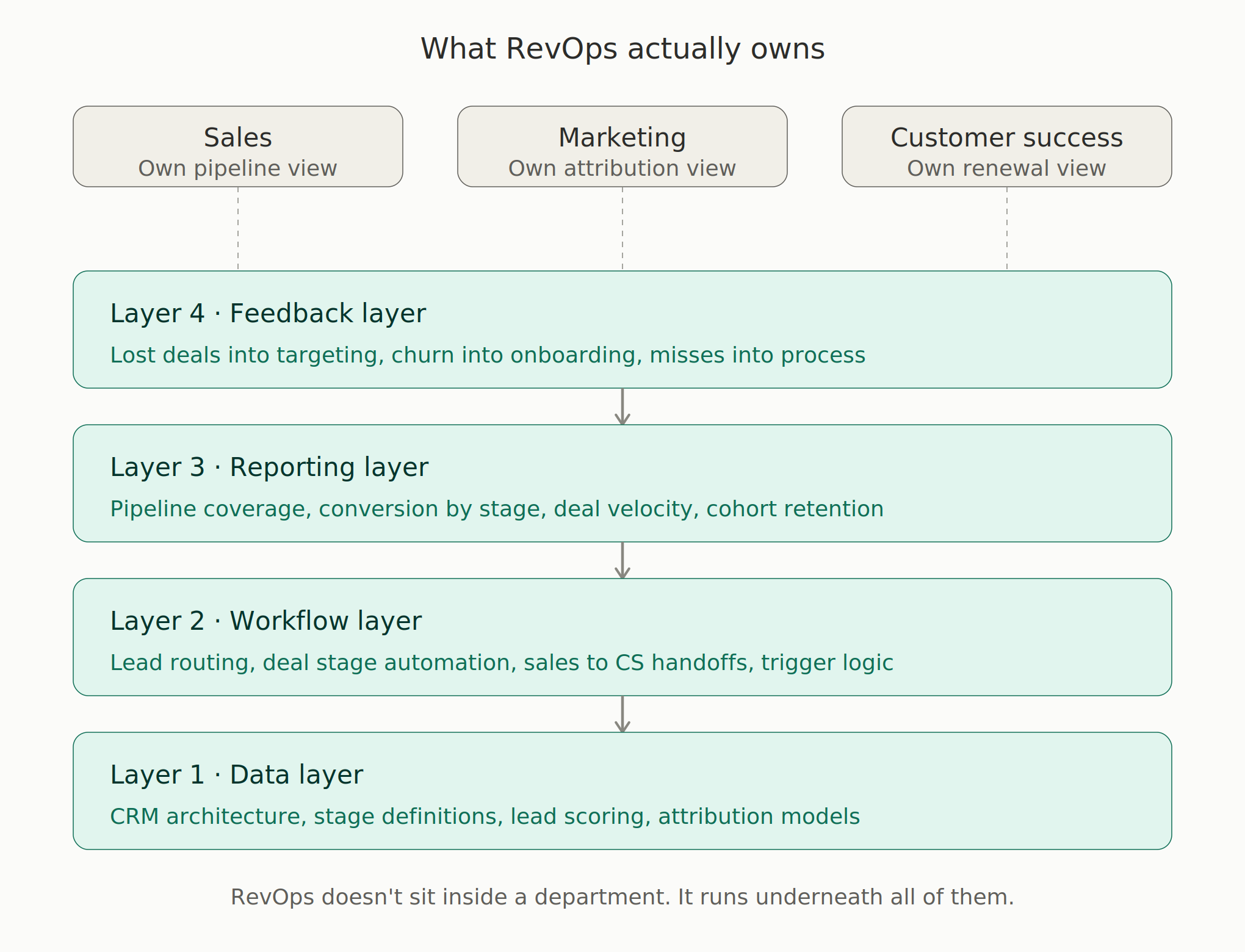
    RevOps owns the data layer: CRM architecture, pipeline stage definitions, lead scoring logic, attribution models, data hygiene. The single source of truth that every other team operates from.

    RevOps owns the workflow layer: how leads route, how deals progress through stages, what triggers automation, what requires human judgment, how the handoff from sales to CS actually works in practice instead of in a Notion doc nobody reads.

    RevOps owns the reporting layer. Not just dashboards. The architecture of how the company sees itself. Pipeline coverage. Conversion rates by stage. Deal velocity. Cohort retention. The numbers that drive decisions, built on definitions everyone agrees on.

    RevOps owns the feedback layer: the loops that turn lost deals into changes in targeting, churned customers into changes in onboarding, missed targets into changes in process. This is the layer that makes revenue compound instead of plateau.

    Each layer depends on the one underneath it. Reporting is meaningless without clean data. Workflows break without reliable reporting. Feedback loops never close without all three operating together. This is why RevOps cannot be a side project for a Salesforce admin. It's an operating layer.

    original 1
    original 1

    When you need it (and what bad RevOps looks like)

    Founders ask when they should hire RevOps. The honest answer is that you needed it the moment you had more than one channel feeding pipeline and more than one person closing deals.

    Most companies ignore it until $3M to $5M ARR. By that point, their CRM data has been corrupted for two quarters and it takes another six months to clean. The cost of waiting compounds quietly.

    But hiring the wrong RevOps person is worse than not hiring one. Bad RevOps looks like a Salesforce admin who builds reports nobody uses, takes tickets from sales reps, and slowly becomes the person you ask to "pull a list." Good RevOps looks like an operator who can tell you why your sales cycle just got 14 days longer and which two stages of your sequence to rebuild to fix it.

    Bad RevOps reacts to requests. Good RevOps owns the system and proactively rebuilds the pieces that are degrading.

    The hiring trap

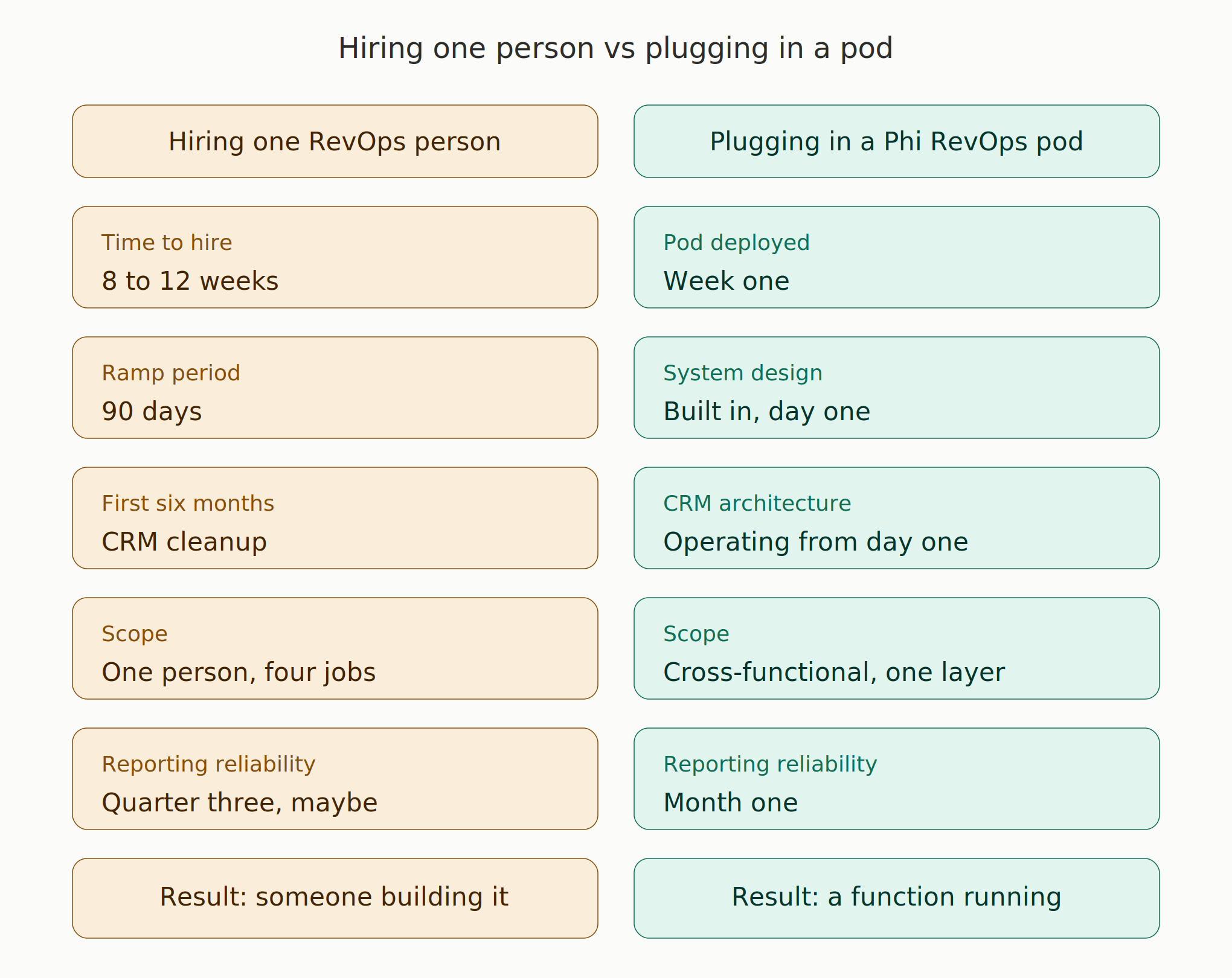
    Most companies try to solve this with one person. A "RevOps Manager" who is supposed to be a Salesforce admin, an analyst, an automation engineer, and a strategist at once.

    The hire takes 8 to 12 weeks to find. They take 90 days to ramp. They spend the next six months untangling the existing CRM mess before they can do anything strategic. By month nine, the CRO is asking why pipeline reporting still isn't fixed and the RevOps lead is buried in cleanup work that should have been done by an architect, not a single hire.

    This is what happens when you treat a system problem like a hiring problem.

    Phi deploys RevOps pods that arrive with the architecture built in. The pod includes operators who own CRM design, attribution tracking, automation workflows, and pipeline reporting as one connected layer. They plug into your existing stack (HubSpot, Salesforce, whatever you're running) and produce clean data and reliable reporting in weeks, not quarters.

    No ramp period. No "let me audit your CRM for three months first." The system starts working immediately because the pod arrives as a system, not as a single hire trying to build one alone.

    Hiring one RevOps person is hiring someone to build infrastructure from scratch. Plugging in a Phi pod is plugging into infrastructure that already knows how to operate.

    original 2
    original 2

    The truth founders eventually face

    RevOps stops being optional the moment a company stops being founder-led on revenue.

    While the founder is the bottleneck, they hold the system together with memory and Slack threads. The minute they hand off, the absence of architecture becomes visible. Numbers stop reconciling. Handoffs stop happening. The CRO inherits a pipeline they can't trust and a team that can't agree on what's real.

    Most founders treat this as a hiring problem. It's not. It's a system problem dressed up as a hiring problem. And no single hire fixes a system that was never built.

    If your CRM is starting to feel like a liability instead of an asset, that's the signal. The function exists to be built before you need it, not after the data is already corrupted.

  • What B2B Lead Generation Services Actually Deliver

    What B2B Lead Generation Services Actually Deliver

    Most founders buying lead generation services for the first time get surprised twice. First by how different providers are from each other. Then by how long it takes to see results they can act on.

    This post breaks down what b2b lead gen services actually include, how to compare lead gen companies, and what realistic delivery looks like before you sign anything.

    What "Lead Generation" Actually Means

    The term lead generation services covers a wide range of models. What one provider calls lead gen, another calls demand gen or pipeline development. Before comparing vendors, map exactly what is in scope.

    Most lead generation company offerings fall into one of these buckets:

    Model

    What It Delivers

    What It Doesn't

    List building

    Verified contact data

    Outreach or pipeline

    Appointment setting

    Calendar slots

    Qualified intent

    SDR outsourcing

    Booked meetings

    Closed revenue

    Full outbound pod

    Contextualized pipeline

    Marketing or content

    Inbound + outbound hybrid

    Multi-channel coverage

    RevOps infrastructure

    If a provider is only building lists or handing off raw contact data, that is not b2b lead gen services in any meaningful sense. You still need someone to design and run the outreach. The distinction between appointment setting and full outbound execution matters more than most buyers realize. The B2B appointment setting services breakdown covers where that line sits.

    What a Strong Provider Actually Includes

    At minimum, a credible lead generation company should deliver:

    • ICP definition and list building tied to firmographic and technographic signals, not just job titles

    • Multi-channel outreach across email and LinkedIn with sequenced follow-up

    • Messaging strategy built around the specific pain your ICP is actively dealing with

    • CRM hygiene so that booked meetings arrive with context, not just a name

    • Reporting at both the activity level (sends, opens, replies) and the outcome level (meetings booked, pipeline generated)

    What most b2b lead gen services skip is the connection to your broader revenue system. Meetings that land in your CRM with no context, no qualifying notes, and no handoff protocol are noise. Not pipeline. The high-performing SDR system guide covers what that operational layer looks like when it is built correctly.

    How to Evaluate Lead Gen Companies

    When comparing lead gen companies, four things matter more than everything else.

    ICP specificity. Can they segment beyond job title and company size? The best b2b lead gen services work off intent signals, recent funding rounds, hiring patterns, and technographic data. Generic lists produce generic reply rates.

    Messaging ownership. Do they write the sequences, or do you? If you are writing the copy, you are doing the hard part. A credible lead generation company should bring a messaging framework and test variations from week one. The 9-step cold outreach framework shows the sequencing logic behind outbound that actually converts.

    Reporting transparency. You need weekly visibility into sends, open rates, reply rates, and meetings booked. If a provider is reluctant to share granular data, that is the signal.

    Pipeline vs. activity SLAs. Some lead generation services promise activity (X sends per month). Better ones commit to outcomes (X qualified meetings per month). Know which kind you are buying before you sign.

    Realistic Timelines and Results

    The single biggest source of disappointment with b2b lead gen services is timeline mismatch.

    Week

    What's Happening

    1-2

    ICP definition, list build, domain warm-up

    3-4

    First sequences live, early reply data coming in

    5-6

    Messaging iteration based on what is and isn't working

    7-8

    First qualified pipeline from outbound

    If a lead generation company promises booked meetings in week one, they are either skipping domain warm-up (which kills deliverability) or working off pre-built lists with no targeting logic. Neither produces durable pipeline.

    The SDR metrics sales leaders track post goes into the numbers you should hold any lead generation services provider accountable to across the full ramp period.

    What Does It Cost?

    Lead generation services pricing varies significantly by model and scope:

    • Managed outbound pods: $8,000 to $20,000/month depending on headcount and tooling

    • Appointment setting only: $3,000 to $8,000/month

    • List building only: $1,000 to $3,000/month

    The lowest-cost option is almost never right for a company trying to build repeatable pipeline. The embedded SDR team vs. in-house hiring comparison covers where the real cost difference sits when you account for ramp time, tooling, and management overhead. For additional context on what a bad hire in the same function actually costs, the bad sales hire cost breakdown runs the math in detail.

    The Difference Between Lead Gen and Pipeline

    Most lead gen companies stop at the meeting. They count it as a win whether or not the prospect was qualified. A better model connects outbound prospecting directly to sales execution, so the person booking the meeting and the person running it are working from the same context.

    The gap between those two things is often where pipeline stalls. If your funnel is generating meetings but not closing them, the stalled pipeline GTM audit is the right diagnostic to run.

    Outbound in isolation also doesn't produce compounding results. The outbound GTM in 2026 post covers how the model is shifting toward systems that combine workflow automation, data enrichment, and tighter sales handoffs. The workflow automation for SDR scaling post goes deeper on the operational side.

    How Phi Approaches This

    Phi's outbound GTM pod plugs directly into your existing stack and operates as an embedded team. That covers SDRs, sequencing infrastructure, data enrichment, and automation running on Clay, HeyReach, Instantly, and n8n.

    The accountability model is different from most lead generation services. Phi's pods are measured on qualified pipeline, not activity metrics. That model produced 93 meetings and 44 closed deals in four months running Payoneer's outbound operation.

    For a broader comparison of how this differs from traditional outsourcing, how B2B sales outsourcing works covers the structural differences.

  • SDR Hiring Mistakes That Kill Ramp Time

    SDR Hiring Mistakes That Kill Ramp Time

    Most companies treat SDR ramp as a waiting game. You hire, you onboard, and you wait 60 to 90 days to find out if the rep produces.

    That wait is not inevitable. In most cases, it is a direct result of decisions made before the first call was ever dialed.

    This post covers where SDR hiring goes wrong, what effective SDR onboarding actually looks like, and how to build SDR training infrastructure that gets reps productive in weeks, not months.

    The Real Cost of Getting SDR Hiring Wrong

    A bad SDR hire costs more than the salary. It costs the ramp window (typically 60 to 90 days), the manager's bandwidth, the accounts burned with poor messaging, and the pipeline that never materialized.

    The average SDR takes 3.2 months to hit full productivity. At most startups, that number stretches further because the infrastructure to support ramp simply does not exist at the point of hire. Before you think about headcount, read what a bad sales hire really costs your startup.

    Mistake 1: Hiring for Personality Instead of Coachability

    The most common SDR hiring mistake is confusing energy with execution.

    Confident communicators get the offer. Coachable processors get results.

    Knowing how to hire SDRs who ramp fast means designing an interview process that tests for coachability, not charisma. Ask candidates to role-play a cold call, give real feedback, and re-run it immediately. Watch how they process the correction.

    What predicts ramp time:

    • Do they take feedback without defensiveness?

    • Do they apply it within the same session?

    • Can they hold a structure under pushback?

    Those three signals beat enthusiasm every time.

    Mistake 2: No Defined Interview Structure

    Most startups run unstructured interviews for SDR roles. A recruiter screens, a manager chats, someone extends an offer. That is not a process. It is a coin flip.

    A structured SDR interview process should include:

    Stage

    What You Are Testing

    Screen call

    Baseline communication and genuine interest

    Skills assessment

    Prospecting research and cold email writing

    Mock cold call

    Objection handling and coachability under pressure

    Final panel

    Values alignment and ramp readiness

    Skipping the mock cold call is where most hiring decisions break down. You are hiring someone to make cold calls. Test it before the offer letter goes out.

    For a fuller view of how this fits into a repeatable SDR system, see how to build a high-performing SDR system for startups.

    Mistake 3: No Training Infrastructure Before Day One

    SDR training does not begin on the first day. It starts before you post the role.

    If you cannot answer these questions before hiring, you will slow ramp significantly:

    • What is the ICP in plain language?

    • What objections does the SDR need to handle?

    • What sequences are already built and tested?

    • What does a qualified meeting look like?

    Companies that prepare training materials before onboarding new SDRs cut ramp time by 30 to 40%. The rep spends less time figuring out the system and more time working inside it.

    Outbound targeting and prospecting techniques also need to be documented before a new rep touches them. See outbound prospecting techniques for B2B meetings for what that baseline should include.

    Mistake 4: Treating SDR Onboarding as Administrative

    Most SDR onboarding programs are HR-flavored orientation sessions. Tools access, org chart, and company history. Useful background, but not what moves the needle.

    Effective onboarding has one goal: get the rep to their first qualified meeting as fast as possible.

    A productive first-30-days structure:

    Week 1

    • ICP deep dive with recorded call examples

    • Message framework and objection handling walkthroughs

    • Shadow calls with a senior rep or AE

    Week 2

    • Supervised prospecting with live daily feedback

    • First cold calls with immediate debrief sessions

    Week 3

    • Independent outreach with daily pipeline review

    • Sequence testing with performance tracking

    Week 4

    • First qualified meetings booked independently

    • Ramp assessment against pre-set milestones

    The faster you get a rep to their first real meeting, the more their confidence compounds. That first win is not just a pipeline event. It is the belief that drives the next 90 days. Track the right signals throughout with SDR metrics sales leaders should track, and automate the operational overhead early using workflow automation for scaling SDR teams.

    Mistake 5: No Feedback Loop Between SDR and AE

    SDRs operate best when they know what happens after the handoff.

    Most startups run SDR and AE functions as separate silos. The SDR books the meeting, the AE runs it, and the SDR never hears how it went. That breaks the feedback loop essential to improving messaging, tightening qualification, and reducing no-shows.

    Fix this by building a shared qualification rubric that both SDR and AE agree on before a meeting counts. When the AE runs discovery, the SDR should receive a one-line note on qualification quality. That note is SDR training happening in real time, without anyone scheduling a training session.

    For a deeper look at how appointment-setting quality ties back into this system, see B2B appointment setting services and how B2B sales outsourcing works.

    Reducing SDR Turnover in the First 90 Days

    SDR turnover in the first 90 days is almost always a hiring or onboarding failure, not a performance failure.

    When a rep leaves or underperforms in the first quarter, the root causes are predictable:

    • Unclear expectations set at the hire stage

    • No ramp targets with weekly milestones

    • No feedback mechanism until the damage is done

    • Isolation from the broader revenue team

    The best protection against early turnover is structured onboarding with weekly check-ins and explicit targets for each week of ramp. Reps who know what success looks like in week two do not wait until week eight to realize they are behind.

    The decision between building this infrastructure in-house versus embedding an SDR team that comes with it already built is worth understanding before you scale. See embedded SDR team vs in-house hiring for a direct comparison. Also relevant: how to scale a sales team at your startup.

    What to Prepare Before You Post the Role

    The infrastructure that predicts ramp time better than candidate quality:

    • Written ICP with firmographic and behavioral criteria

    • Tested sequences live in your outbound platform

    • Call recording library with annotated examples

    • Qualification criteria shared and agreed upon with AEs

    • Ramp milestones defined for weeks 1 through 8

    • Manager bandwidth confirmed for daily debriefs in the first 30 days

    If this list does not exist before interviews start, the hiring process is premature. See outbound sales automation tools for the platform layer and RevOps best practices that move the pipeline for the operational foundation underneath.

    How Phi Builds SDR Operations That Ramp Fast

    Phi's Outbound SDR pods do not start with SDR hiring. They start with infrastructure.

    Before any SDR touches a prospect, the pod has ICP definitions, tested sequences, qualified call recordings, and a feedback loop between outreach and discovery already in place. The system is built before the rep joins it.

    That is how Payoneer booked 93 meetings and closed 44 deals in four months. It is how TruckX scaled from $2M to $16M ARR in 18 months. The SDRs were effective because the system they plugged into was built to make them effective. Read both: TruckX case study and Datatruck case study.

    If your SDR ramp is longer than 60 days, the problem is rarely the rep.

    Talk to Phi about your outbound infrastructure

  • Embedded SDR Teams vs In-House Hiring for B2B Growth

    Embedded SDR Teams vs In-House Hiring for B2B Growth

    You hired an outsourced SDR vendor six months ago. The meetings were supposed to start flowing in week four.

    They didn't.

    The rep didn't know your ICP. The sequences were recycled from three other clients. The meetings that did get booked didn't convert because they weren't the right buyers. You paid full price for the experiment.

    That's not an outsourcing problem. That's a model problem.

    The decision between an outsourced SDR team and building in-house isn't really about cost or speed, though both matter. It's about whether your outbound motion lives inside your revenue system or outside it.

    Most founders make this call based on budget. The ones who get it right make it based on infrastructure readiness.

    This breakdown covers what each model actually costs, how fast each generates a qualified pipeline, where embedded sales teams outperform, and the specific conditions that make in-house hiring the right call.

    What Is an Embedded SDR Team vs a Traditional Outsourced Arrangement

    A traditional outsourced SDR arrangement is transactional. You pay a vendor for a set number of meetings per month. The SDR sits in their office, runs generic sequences across multiple client accounts, and moves on when results disappoint. Brand voice, ICP nuance, and tool integration are rarely a priority.

    An embedded sales team operates differently. The SDRs are integrated directly into your revenue architecture. They work in your CRM, run your sequences, follow your messaging, and report against your funnel metrics, not a vendor's SLA.

    The practical differences:

    • Ownership: Traditional outsourcing means the vendor owns the output. Embedded means the client owns the system.

    • Integration: Embedded sales teams run inside your existing stack — CRM, sequencing tools, enrichment data.

    • Accountability: Reporting maps to your pipeline, not generic meetings booked.

    • Brand alignment: SDRs learn your ICP, your objection patterns, your positioning, and your competitors.

    For a broader view of how B2B sales outsourcing is typically structured, see how B2B sales outsourcing works.

    The Cost Comparison: Outsourced SDR vs Hiring In-House

    This is where the decision usually gets made, and where it gets made wrong most often.

    In-house SDR costs (annualized, U.S. market):

    Cost Item

    Estimated Annual Cost

    Base salary

    $55,000–$70,000

    OTE / commissions

    $15,000–$25,000

    Benefits + payroll taxes

    $15,000–$20,000

    Tools (CRM, sequencer, data)

    $10,000–$18,000

    Recruiting + onboarding

    $8,000–$15,000

    Total

    $103,000–$148,000/year

    And that's before accounting for 60–90 days of ramp time or the risk of a mis-hire. For a full breakdown of that risk, see what a bad sales hire really costs your startup.

    Embedded SDR team costs:

    Phi's embedded pod model runs approximately $2,400/month per SDR, with team lead and tooling costs built in. Annualized, that's $28,000–$35,000 per embedded SDR, inclusive of infrastructure and management overhead.

    The math on in-house vs outsourced sales is less ambiguous than founders expect: an embedded pod typically costs 25–35% of what in-house staffing runs, with no recruiting risk and a meaningfully shorter ramp.

    Speed to Pipeline: How Fast Does an Outsourced SDR Team Generate Meetings?

    In-house SDRs typically need 60–90 days before they're producing a consistent pipeline. You're carrying full salary costs through that entire window.

    An outsourced SDR team operating on pre-built infrastructure — enrichment workflows, multi-sender sequencing, ICP targeting — moves faster. Phi's outbound pods typically reach active sequencing within 2–3 weeks of onboarding.

    For context: the Payoneer outbound program Phi ran produced 93 meetings and 44 closed deals in four months. The infrastructure was live before a single sequence launched.

    How fast you get to meetings depends heavily on how clearly your ICP is defined before the engagement starts. Loose targeting inflates the ramp regardless of who's doing the work. Outbound prospecting techniques for B2B meetings cover the ICP precision inputs that actually affect meeting quality.

    Performance Benchmarks: Embedded vs In-House SDRs

    No benchmark applies universally. Industry, ACV, outreach channel, and sequence quality all factor in. These figures represent reasonable reference points for B2B SaaS and tech at $1,000–$15,000 ACV:

    Metric

    In-House SDR

    Embedded SDR Team

    Ramp time

    60–90 days

    15–30 days

    Meetings booked per month (mature)

    8–15

    12–20

    Email response rate

    2–5%

    4–8%

    Cost per meeting

    $400–$800

    $150–$350

    Embedded teams tend to outperform on cost per meeting because of shared tooling infrastructure, multi-sender sequencing, and enrichment systems that take months to build in-house. For the specific metrics worth tracking as this matures, see SDR metrics sales leaders track.

    Common Pitfalls of Outsourced SDR Teams

    Not all outsourced arrangements fail the same way. The failure modes are consistent enough to map:

    • Generic sequencing: Templates recycled across clients. Recipients can tell.

    • No CRM integration: Meetings get booked but don't land in your pipeline correctly.

    • Misaligned ICP targeting: Vendors optimize for meetings booked, not qualified meetings booked.

    • No feedback loop: Sales objection patterns never reach the SDR. Messaging calcifies.

    • Rep turnover: The SDR you onboarded and trained is swapped out by month three.

    The fix is not finding a "better" outsourced vendor. It's shifting to a model where the SDR operates inside your system, not alongside it. Workflow automation for scaling SDR teams covers how infrastructure design removes most of these failure points before they surface.

    When Does It Make Sense to Bring SDRs In-House?

    The transition to in-house SDRs makes sense when specific conditions are met, not before:

    • You have a documented, repeatable outbound playbook with proven messaging and objection responses

    • ARR is above $3M–$5M, and in-house unit economics become favorable

    • You have a full-time sales leader who can manage, coach, and retain SDR talent

    • Your GTM motion is stable enough that a 90-day ramp does not disrupt the active pipeline

    Bringing SDRs in-house before those conditions hold usually means paying full employment costs to run an experiment that an embedded sales team should have already de-risked. How to build a high-performing SDR system for startups outlines the infrastructure requirements before headcount scaling becomes the right move.

    How Phi Deploys Embedded SDR Teams

    Phi's outbound pods are built for this motion. SDRs embed directly into your revenue stack, running Clay for enrichment, HeyReach for LinkedIn sequencing, Instantly for email outbound, and n8n for workflow automation.

    The pod integrates with your CRM, follows your ICP definition, and reports against your pipeline metrics. It is not an outsourced SDR arrangement sitting outside your system. It is your outbound infrastructure, operated by a team with the tooling and process to run it at full capacity from week three.

    For founders at Seed to Series B evaluating this decision, B2B appointment setting services and outbound sales automation tools cover the channel architecture context worth understanding before committing to a model. If you're building toward a full operating system across the revenue function, revenue operating system: Seed to Series B maps how outbound fits into the broader infrastructure.

    The in-house vs outsourced sales decision is not permanent. The goal is to generate a repeatable pipeline as fast as possible with the least structural risk. For most early-stage B2B companies, embedded beats in-house until the playbook is proven.

    Talk to Phi about embedding an SDR pod

  • SDR Metrics Every Sales Leader Needs to Track

    SDR Metrics Every Sales Leader Needs to Track

    Most SDR dashboards are full of numbers. Very few of them are useful.

    Activity counts, email open rates, call attempts per day. Leaders report on all of it, and almost none of it predicts whether the pipeline is going to hold.

    The SDR metrics that actually matter are the ones connected to revenue. This post covers the specific sales development rep metrics to track at each stage of the funnel, the SDR benchmarks worth comparing against, and how to structure your measurement system so it tells you what is actually happening inside your outbound motion.

    Why most SDR tracking breaks down

    The most common mistake is tracking activity as a proxy for performance. Calls made, emails sent, LinkedIn touches. These numbers are easy to pull and easy to report.

    They are also meaningless in isolation.

    An SDR who sends 80 emails a day and books zero meetings is performing worse than one who sends 30 and books four. Activity tracking without conversion tracking is noise.

    The right measurement system connects input metrics to output metrics and tells you where the funnel is leaking. Getting this architecture right is part of building a high-performing SDR system from day one.

    The core SDR KPIs framework

    There are three layers to SDR KPIs: activity, conversion, and pipeline contribution. Every metric you track should fit into one of these layers.

    Layer

    What It Measures

    Example Metrics

    Activity

    Input volume and effort

    Calls per day, emails sent, LinkedIn touches

    Conversion

    Efficiency of that activity

    Response rate, connect rate, meeting-booked rate

    Pipeline

    Revenue impact

    SQL rate, pipeline generated, revenue influenced

    Tracking only one layer is where most teams go wrong. Activity without conversion is busy work. Conversion without pipeline context is vanity. All three together tell a complete story.

    Activity benchmarks: what good looks like

    There is no universal number that works across every segment, price point, and channel mix. But these ranges reflect what outbound prospecting at scale tends to produce in B2B.

    Outbound SDR daily activity benchmarks:

    • Cold calls per day: 40 to 80, depending on territory size and research depth

    • Personalized emails per day: 30 to 60

    • LinkedIn touches per day: 10 to 20

    • Total touchpoints per prospect in a sequence: 8 to 12

    The right number depends heavily on your outbound sales automation tools and how much admin work is handled by the stack versus the rep. Teams using Clay, Instantly, or HeyReach for enrichment and sequencing can run higher volume without sacrificing personalization quality.

    One flag worth noting: if your SDRs are hitting activity targets but booking nothing, the problem is usually targeting, messaging, or both. Not volume.

    Meeting-booked rate: the number that matters most

    If there is one sales development rep metric that tells you whether your outbound motion is working, it is the meeting-booked rate.

    Benchmarks by channel:

    Channel

    Low

    Average

    Strong

    Cold email

    0.5%

    1.5 to 2%

    3%+

    Cold calling

    1%

    2 to 4%

    6%+

    LinkedIn outbound

    2%

    4 to 6%

    8%+

    Multi-touch sequences

    2%

    3 to 5%

    7%+

    These ranges vary by ICP, deal size, and sequence quality. Enterprise outbound to C-suite will naturally run lower than mid-market outbound to VP-level buyers.

    A strong meeting-booked rate is not the only signal. You also need meetings that show up and meetings that convert to a qualified pipeline. B2B appointment setting at high volume means nothing if your show rate is below 70%.

    Response rate and connect rate

    These sit between activity and conversion. They tell you whether your targeting and messaging are working before you even get to the meeting.

    Response rate (email or LinkedIn): 5 to 10% on a cold sequence is a healthy baseline. Below 3% is a messaging or ICP problem. Above 15% usually means you are targeting a segment with very high intent.

    Connect rate (cold calling): Expect 5 to 10% of dials to reach a live person in most B2B segments. Lower in heavily filtered enterprise environments. Higher in SMB or owner-operated businesses.

    These numbers feed directly into workflow automation decisions for your SDR team. If connect rates are low, a higher-touch, lower-volume approach on LinkedIn might be worth testing before scaling call volume further.

    How SDR metrics differ across inbound and outbound

    One of the more common mistakes is measuring outbound SDRs and inbound SDRs against the same SDR benchmarks. The inputs and expectations are fundamentally different.

    Metric

    Outbound SDR

    Inbound SDR

    Meeting-booked rate

    2 to 5%

    15 to 30%

    Response rate

    5 to 10%

    30 to 60%

    Avg. time to book

    3 to 7 days

    Same day to 48 hours

    Primary skill

    Prospecting, sequencing

    Speed to lead, qualification

    Outbound SDRs are generating demand from scratch. Inbound SDRs are converting demand that already exists. Holding both to the same quota or conversion rate will misrepresent performance in both directions.

    This distinction also matters when you are deciding whether to outsource your outbound function versus building an inbound qualification team in-house.

    Pipeline contribution: the SDR metric most teams undertrack

    Most SDR scorecards stop at meetings booked. The better question is how much qualified pipeline those meetings are generating.

    Pipeline contribution benchmarks:

    • Percentage of total pipeline sourced by SDRs: 30 to 50% for outbound-heavy teams

    • SQL rate from SDR-sourced meetings: 40 to 60%

    • Average pipeline per SDR per month: $100K to $300K is a reasonable range for mid-market B2B

    Tracking this connects the SDR function directly to RevOps best practices and gives leadership a cleaner view of CAC and payback period per channel.

    If your SDRs are booking meetings but pipeline contribution is low, the problem is usually qualification. The ICP definition needs tightening, or the handoff to AE is not working.

    Building a measurement system that holds

    The mechanics of tracking these numbers require a clean data layer. CRM hygiene, attribution logic, and funnel stage definitions all have to be consistent for the SDR metrics to mean anything.

    This is where most scaling teams hit a wall. The revenue operating system has to be built alongside the SDR motion, not bolted on afterward. When those two things are out of sync, you end up with numbers nobody trusts and decisions made on gut feel instead of data.

    A GTM audit is often the fastest way to identify where the measurement system is breaking down and what to fix first.

    How Phi approaches SDR performance

    Phi's outbound GTM pods plug directly into a client's revenue stack. The pod builds the measurement layer so that activity, conversion, and pipeline contribution are all visible in real time.

    On the Payoneer engagement, 93 meetings were booked and 44 deals closed in four months. That kind of output requires knowing which SDR KPIs matter, which sequences are converting, and where to optimize without slowing the machine down.

    If your SDR team is producing activity but not pipeline, or if the metrics are not telling a clear story, talk to our team about what the right measurement framework looks like for your stage.

  • RevOps Best Practices That Actually Move Pipeline Forward

    RevOps Best Practices That Actually Move Pipeline Forward

    Your RevOps function exists. You hired for it. You have the dashboards. And your pipeline still isn't moving.

    The dashboard problem

    We see this pattern constantly. A company builds out RevOps. They hire a RevOps manager, maybe a small team. They set up dashboards in HubSpot or Salesforce. They build reports that show pipeline by stage, conversion rates, average deal cycle. The leadership team reviews these dashboards every Monday.

    And nothing changes.

    The pipeline doesn't grow. The conversion rates don't improve. The sales cycle doesn't shorten. The dashboards just confirm, week after week, that things are roughly the same.

    The problem isn't the data. The problem is that most RevOps functions are built to observe the pipeline, not move it. They report on what happened. They don't change what happens next.

    That's the difference between RevOps as a reporting function and RevOps as an operating system. One gives you visibility. The other gives you velocity.

    Why most RevOps teams get stuck in "reporting mode"

    It usually starts well. The first RevOps hire cleans up the CRM. Builds the dashboards. Standardizes the pipeline stages. Everyone feels good because there's finally visibility into what's happening.

    Then it stalls. The RevOps team becomes the "dashboard team." Sales asks for a new report. Marketing asks for a new attribution view. The CEO wants a board deck with pipeline metrics. RevOps spends 80% of its time pulling data and building slides. Maybe 20% on actually fixing the systems that produce that data.

    This is the trap. RevOps gets hired to build infrastructure but ends up maintaining dashboards. And nobody notices because the dashboards look professional and the Monday meetings feel productive.

    Meanwhile, the actual problems sit untouched. Leads are leaking between marketing and sales because the handoff isn't automated. Reps are spending two hours a day on data entry that should take zero. Outbound campaigns run in Instantly but the results don't flow back into the CRM, so attribution is a guess. Customer success has no idea which accounts are at risk because the signals live in three different tools that don't talk to each other.

    Those are pipeline problems. And dashboards don't fix pipeline problems. Systems do.

    What RevOps looks like when it actually moves pipeline

    The RevOps teams that move pipeline share a few things in common. None of them are about which tool you use or how your dashboards look.

    The system connects, not just reports

    The first thing that separates real RevOps from reporting-mode RevOps: every tool in the stack talks to every other tool. Not through manual exports. Not through someone copy-pasting data between tabs. Through actual infrastructure.

    Lead enrichment in Clay feeds directly into outbound sequences in Instantly and HeyReach. When a prospect replies, that signal routes back into the CRM automatically. When a deal moves stages, the relevant teams get notified without someone sending a Slack message. When a customer churns, the data flows back to inform which ICP segments are actually working.

    This sounds basic. Almost nobody does it. Most companies have five or six tools that each work fine in isolation and don't connect to anything else. RevOps should be the connective tissue. Not the reporting layer on top.

    At Phi, we build these connections through n8n workflows. When a lead hits a certain activity threshold across channels, the system routes them to the right rep with full context. When a campaign underperforms, the system flags it before someone notices in a weekly review. That's RevOps as infrastructure.

    Attribution is closed-loop, not last-touch

    Most attribution models are broken. They give credit to the last thing that happened before a deal closed. The rep gets credit. Or the demo gets credit. Or the Google ad gets credit.

    Nobody knows what actually generated the pipeline.

    Closed-loop attribution tracks the full path. Which enrichment source identified the lead. Which outbound sequence made first contact. Which content the prospect engaged with before booking a call. Which rep handled the conversation. Which CS touchpoint led to expansion.

    This isn't about building a perfect model. Perfect attribution doesn't exist. It's about building enough signal that you can make real decisions. Like: should you double down on that LinkedIn sequence targeting TMS companies, or is it the email sequence targeting factoring firms that's actually producing deals?

    Without this, you're investing in channels based on vibes. With it, you're investing based on data. That's RevOps moving pipeline.

    Lead routing happens in seconds, not days

    Here's a number that will bother you: the average response time to inbound leads at most B2B companies is over 24 hours. Some studies put it closer to 42 hours.

    Your prospect filled out a form. They were interested. They were thinking about their problem right then. And your team got back to them two days later, after they'd already talked to a competitor.

    RevOps that moves pipeline treats lead routing as critical infrastructure. When a lead comes in, the system scores it (is this actually ICP?), enriches it (what do we know about this company?), routes it (which rep handles this segment?), and notifies the rep, all within minutes. Not because someone manually checks the inbox. Because the system is built to do it automatically.

    Same thing on the outbound side. When a prospect engages with a sequence (opens three emails, clicks a link, views the LinkedIn profile), the system should surface that signal to the rep immediately. Not in next Monday's pipeline review. Now.

    Feedback loops exist between every function

    The biggest pipeline killer in most B2B companies is the gap between teams. Marketing generates leads that sales says are garbage. Sales closes deals that CS struggles to retain. CS identifies expansion opportunities that nobody follows up on.

    RevOps closes these gaps by building feedback loops into the system.

    Sales marks a lead as "bad fit"? That data flows back to marketing so the targeting improves. CS flags an account as "at risk"? That triggers a retention workflow and informs the outbound team which segments have churn problems. A deal closes faster than average? The system captures what was different about that deal so the pattern can repeat.

    These aren't meetings. They're automated feedback loops built into the infrastructure. The data moves without anyone scheduling a sync.

    The CRM is a system, not a spreadsheet

    This one sounds obvious. It isn't.

    Most CRMs are glorified spreadsheets with a nicer interface. The data is stale because reps don't update it. The stages are meaningless because they were set up once and never validated against actual deal progression. The forecasting is fiction because it's based on rep self-reporting rather than system signals.

    RevOps that works treats the CRM as the operating system for revenue. That means: automated data capture so reps don't manually log activities. Validated pipeline stages that reflect how deals actually move, not how someone imagined they would. Contact and account enrichment that runs continuously, not once at lead creation. Hygiene workflows that catch duplicates, stale deals, and missing fields before they corrupt the data.

    When the CRM is clean and connected, everything else works better. Forecasting gets accurate. Attribution gets reliable. Reps trust the system instead of building their own shadow spreadsheets.

    What this looks like when it all connects

    We ran this system for Payoneer. Their outbound operation needed infrastructure, not just people. We embedded the full RevOps and outbound layer. Lead enrichment feeding sequencing. Routing automation. Attribution tracking across every touchpoint. CRM workflows that kept the data clean without manual input.

    93 meetings booked. 44 closed deals. Four months.

    The meetings didn't come from working harder. They came from a system where every component connected to every other component. The enrichment informed the targeting. The targeting informed the sequences. The sequences fed data back into the CRM. The CRM surfaced signals for the reps. The reps closed.

    That's RevOps moving pipeline. Not reporting on it.

    The real question

    Pull up your RevOps dashboards right now. Look at the metrics. Pipeline by stage. Conversion rates. Average deal cycle.

    Now ask: which of those dashboards actually changed how your team operates this quarter? Which one triggered a decision that moved pipeline?

    If the answer is "none of them," your RevOps function is reporting. It's not operating.

    And reporting never moved pipeline forward.

    If you want to see what RevOps looks like when it's built to operate, not just observe, talk to someone who's built it before.

  • Outbound Prospecting Techniques That Book More B2B Meetings

    Outbound Prospecting Techniques That Book More B2B Meetings

    Most outbound prospecting fails before the first message is sent. Not because the product is wrong. Because the rep skipped research, picked the wrong channel, or ran a cadence that looked identical to every other vendor in the prospect's inbox.

    Here is what actually works.

    What Is Outbound Prospecting?

    Outbound prospecting is the process of identifying potential buyers and initiating contact before they have raised their hand. Unlike inbound, where leads come to you, B2B prospecting requires building the pipeline from scratch, one targeted account at a time.

    The goal is simple: get the right person to agree to a conversation.

    How it differs from lead generation:

    • Lead generation creates conditions for inbound interest

    • Outbound prospecting goes directly to the buyer, regardless of prior intent

    • It requires ICP precision, research discipline, and sequenced follow-through

    Research Before You Reach Out

    The most common mistake in sales prospecting is skipping research. Sending volume without context is spam.

    Before writing a single message, know:

    • What the company is actively doing (funding rounds, new hires, product launches, expansions)

    • What pain the contact is likely sitting with based on their role and company stage

    • What they have said publicly on LinkedIn, in interviews, or in press coverage

    • Who else is involved in the buying decision, not just the title you are targeting

    Good research takes 5 to 10 minutes per account. It is the difference between a reply and a delete.

    For a structured way to research accounts at scale without adding headcount, the AI deep research playbook for GTM executives walks through how to build that process systematically.

    Prospecting Techniques With the Highest Response Rates

    Not all prospecting techniques work equally across verticals, deal sizes, or buyer personas.

    Technique

    Best For

    Typical Response Rate

    Personalized cold email

    Mid-market, technical buyers

    3 to 8%

    Cold calling

    SMB, freight, logistics, field sales

    5 to 15% connection rate

    LinkedIn DMs

    Senior IC to VP level

    8 to 15% reply rate

    Multi-channel sequence

    All segments

    2 to 3x single-channel rates

    Video prospecting

    Enterprise, high-ACV deals

    Higher reply, lower volume

    The biggest lift comes from combining channels in a single cadence rather than running them independently.

    How to Build a Multi-Channel Prospecting Sequence

    A multi-channel prospecting sequence coordinates email, phone, and LinkedIn touches into a single timed cadence. The goal is consistent visibility without being aggressive.

    A standard 10-day sequence:

    • Day 1: Personalized email, reference a specific trigger (funding, new hire, recent post)

    • Day 2: LinkedIn connection request, no pitch in the note

    • Day 4: Follow-up email, shift the angle slightly

    • Day 6: Cold call, reference the earlier email

    • Day 8: LinkedIn message, short and direct

    • Day 10: Final email, clean close or clear exit

    Each touchpoint should feel like a continuation, not a repeat. If you are saying the same thing five times, the prospect has already decided.

    For teams scaling this without adding reps, outbound sales automation tools cover which platforms handle sequencing, personalization, and tracking at volume. And for the infrastructure side of running this inside a growing team, workflow automation for scaling SDR teams is worth reading alongside it.

    How Many Touchpoints Should a Cadence Include?

    The data consistently points to 8 to 12 touchpoints before walking away from a qualified account. Most reps stop at 2.

    A few rules that matter more than the number:

    • Space touchpoints across 2 to 3 weeks minimum for cold accounts

    • Mix channels so you are not resending the same email on a different day

    • Change the angle with each wave, not just the subject line

    • Exit cleanly after the full cadence, then recycle the account 90 days later

    One well-researched, specific message outperforms ten generic ones. Touchpoint count only matters if the quality holds.

    The Biggest Mistakes in B2B Outbound Prospecting

    Most B2B prospecting failures come down to the same patterns.

    Targeting the wrong level. Going straight to the C-suite without a champion below is slow and expensive. Map the buying committee first. How to architect GTM around the B2B buying committee covers exactly how to structure outreach when multiple stakeholders are involved.

    Messaging that leads with the product. Nobody cares about your features. They care about the problem you solve and whether you understand their version of it. Start with pain, not pitch.

    No follow-up discipline. A single email is not a cadence. Most replies come after the fourth or fifth touchpoint. Stopping early is the most expensive mistake in sales prospecting.

    Inconsistent research quality. Personalization that references someone's industry but not their actual situation reads as automated. Prospects know.

    Ignoring channel fit. A logistics VP who answers the phone is a different buyer than a SaaS CTO who lives in LinkedIn DMs. Match the channel to the person, not the playbook.

    Prospecting Inside a Larger GTM Motion

    Outbound prospecting works best when it is aligned with how the rest of your GTM is structured, not running as a standalone activity.

    If you are running a focused market expansion, the bowling pin GTM strategy explains how to sequence outbound efforts, so you are not spreading across too many segments at once.

    If you are combining prospecting with a self-serve or inbound motion, the hybrid GTM playbook covers how to layer both without creating channel conflict.

    And if you are deciding between building the prospecting function internally or bringing in an external team, how B2B sales outsourcing works lays out the tradeoffs clearly.

    For teams earlier in the process who are still codifying their sales motion before scaling, how smart founders codify their GTM before scaling is a useful starting point.

    How Phi Consulting Helps With Outbound Prospecting

    Phi runs Outbound GTM Pods embedded directly into a startup's revenue architecture. That means SDRs, GTM Engineers, and RevOps operators working as a coordinated unit rather than a batch of freelancers running disconnected sequences.

    The work covers ICP definition, account research, sequence design, and performance tracking, all tied to pipeline outcomes rather than activity metrics.

    The SDR system post covers what that infrastructure looks like internally. And if you need meetings booked without building it yourself, B2B appointment-setting services explain what the managed model looks like in practice.